




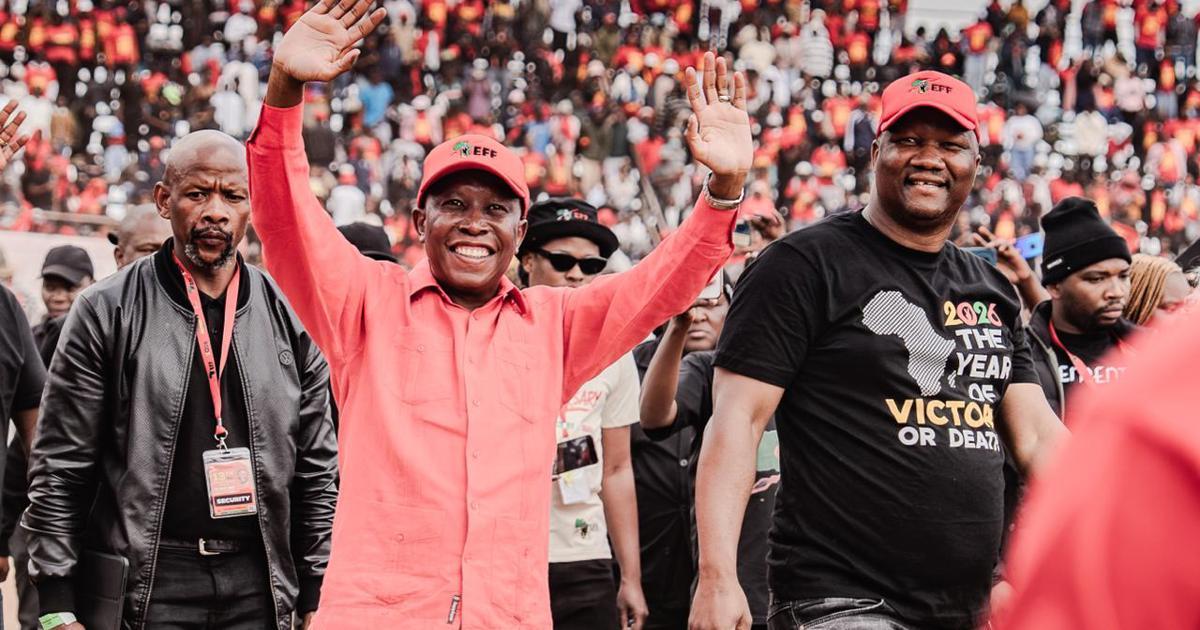
“The Economic Freedom Fighters has defended its controversial “victory or death” slogan ahead of South Africa’s 4 November 2026 local government elections, with deputy president Godrich Gardee insisting that it refers to political victory and the possible loss of public hope rather than a call for violence. The debate places the party’s campaign messaging, promises to improve conditions in disadvantaged communities and ability to translate rally support into votes under scrutiny during the final stretch of campaigning.”
EFF’s controversial campaign message draws renewed attention
South Africa’s political campaign has entered a decisive period as political parties intensify their efforts to persuade voters ahead of the local government elections scheduled for 4 November 2026. Among the developments attracting attention is the Economic Freedom Fighters’ defence of its “victory or death” slogan, which has prompted questions about the meaning of forceful political language and its potential influence on supporters.
On 28 October, EFF deputy president Godrich Gardee defended the slogan during an interview reported by Eyewitness News. He argued that the expression should be interpreted as a political battle cry rather than a threat against human life. According to Gardee, the intended message concerns the consequences of continued political disappointment for communities that have not experienced the improvements they expect.
The controversy comes as parties compete to demonstrate that they can address unemployment, inadequate housing, poverty, crime and unreliable municipal services. These issues are particularly important in communities where residents judge political leadership through their everyday experiences of local government.
For the EFF, the challenge is to ensure that its forceful campaign language communicates urgency without distracting from its policy proposals or raising unnecessary concerns about political intimidation.
Gardee explains the intended meaning of the slogan
Gardee’s explanation centres on the distinction between literal and political interpretations of the phrase. He said the slogan does not mean that people should die. Instead, he described it as a warning that the hopes of disadvantaged South Africans could continue to deteriorate if voters do not support the change the party advocates.
The deputy president argued that politics is a competitive environment in which parties use strong language to mobilise supporters and communicate the importance of an election. In his view, the EFF’s slogan must be understood within that political context.
Nevertheless, the debate illustrates the difficulties parties face when using emotionally charged expressions. Supporters may interpret a slogan as a declaration of determination, while opponents or members of the wider public may understand it differently.
Political communication therefore requires more than the intention behind a message. The way a slogan is received, repeated and interpreted can also influence public confidence in a party.
The EFF’s defence seeks to establish that its message is about electoral success and social change, not physical harm. Whether voters accept that explanation will depend partly on the party’s broader campaign conduct, the statements of its leaders and the way supporters engage with political opponents.
Poverty and service delivery remain central to the campaign
Gardee connected the slogan to the difficulties experienced by residents of informal settlements and historically disadvantaged communities. He specifically referred to Khayelitsha, Langa, Nyanga and Philippi, arguing that the hopes of residents in such areas have been undermined by persistent hardship.
These concerns reflect broader challenges confronting municipalities across South Africa. Residents depend on local authorities for essential services, including water provision, sanitation, refuse collection, electricity infrastructure, road maintenance and the management of public spaces.
When these services deteriorate, the effects extend beyond inconvenience. Businesses may struggle to operate, children can face difficult living and learning conditions, and households may spend additional money securing necessities that functioning municipal systems should provide.
Consequently, local elections provide an opportunity for residents to assess whether governing parties have fulfilled their responsibilities and whether opposition parties offer credible alternatives.
The EFF has positioned itself as a party seeking stronger economic inclusion and improved living conditions for poor and historically marginalised communities. However, campaigning on these concerns is only the beginning. Voters must also consider whether the party’s proposals are financially realistic, administratively achievable and supported by a clear implementation plan.
Political promises become meaningful when they translate into measurable improvements in people’s lives.
The EFF seeks to turn campaign enthusiasm into votes
Gardee also urged voters to support the EFF, arguing that South Africans have endured prolonged problems with service delivery under the African National Congress and other parties that have governed municipalities.
He encouraged voters to give the EFF an opportunity to demonstrate what it could achieve in office. The message reflects the party’s attempt to position itself as an alternative for residents dissatisfied with existing political leadership.
However, strong campaign attendance and enthusiastic supporters do not automatically guarantee electoral success. Parties must convert public interest into voter registration, turnout and votes cast at the ballot box.
That process requires effective organisation, communication with communities, credible candidates and a clear explanation of what voters can expect after election day.
The EFF has also rejected the suggestion that its appeal is limited to young people. Gardee said its rallies attract supporters across age groups, including senior citizens. This is significant because municipal elections involve communities with different priorities, economic circumstances and expectations of government.
Young voters may prioritise employment, education and opportunities to establish businesses. Older residents may focus on pensions, healthcare access, safety and dependable services. Families across these groups may share concerns about housing, the cost of living and local infrastructure.
For the EFF, demonstrating that its policies respond to these varied needs will be important in building support beyond its established base.
Security and crime feature in the party’s message
During the interview, Gardee also discussed substance abuse, illegal drugs and public safety. He called for stronger law enforcement, additional personnel, improved training and measures to prevent criminal organisations from infiltrating security institutions.
These comments broadened the discussion beyond the disputed slogan to include concerns that directly affect residents’ quality of life.
Crime and drug-related harm can place significant pressure on families and communities. Municipalities also have responsibilities that intersect with public safety, including maintaining street lighting, managing public spaces and supporting local prevention initiatives within their legal powers.
Nevertheless, municipalities do not control every aspect of policing or criminal investigations. Effective responses require cooperation between local authorities, the South African Police Service, national government departments and community organisations.
Gardee argued that government should act decisively against the sources of illegal drugs and strengthen security capacity. Such proposals will require careful consideration of staffing, budgets, accountability and the legal responsibilities of the relevant institutions.
Voters can reasonably ask political parties to explain how their proposals would be funded, which authorities would implement them and how residents would measure progress.
Political competition extends beyond the major parties
Gardee also addressed the emergence of other parties on the left of South Africa’s political spectrum, including the South African Communist Party’s participation in electoral politics. He dismissed suggestions that new competitors would necessarily undermine the EFF’s support.
The broader political environment is increasingly competitive, with established parties and smaller organisations seeking to attract voters frustrated by governance failures or dissatisfied with the policies of existing administrations.
This competition can give voters more choices. However, a fragmented political landscape may also make it harder for any single party to secure a majority in a municipality.
Where no party wins an outright majority, coalition negotiations can determine who governs and which policies are implemented. Such arrangements can broaden representation, but disagreements over leadership positions and policy priorities can also threaten stability.
The debate is particularly relevant to major urban centres, where competing parties may need to negotiate after the election.
A report published by IOL on 28 October highlighted the coalition choices facing parties contesting Johannesburg. The article described differing approaches to possible partnerships, including the MK Party’s decision to rule out a coalition with the Democratic Alliance in the city.
These developments underline the importance of looking beyond campaign slogans. Voters must consider not only which party they support but also how political parties might cooperate to form functioning municipal administrations.
The test of political leadership is effective governance
Gardee said voters should judge the EFF on its manifesto and its ability to improve people’s lives. He referred to activities the party says it has undertaken, including assistance to poor households and community infrastructure projects.
Such claims are part of the party’s argument for electoral support, but voters should examine them alongside verifiable evidence, implementation records and the responsibilities of the relevant authorities.
A party’s performance in government can be assessed through several practical indicators: whether municipal finances are managed responsibly, whether essential services are maintained, whether infrastructure projects are completed and whether residents can obtain answers when problems arise.
Transparency is equally important. Public procurement, municipal appointments and spending decisions should be subject to appropriate oversight. Residents should be able to understand how public money is used and whether promised projects are delivered.
For opposition parties seeking to enter government, credible plans should identify priorities, costs, deadlines and the officials responsible for implementation.
For parties already governing municipalities, election campaigns provide an opportunity to explain their records, acknowledge shortcomings and outline corrective action.
These standards apply to the EFF and every other party competing for public office.
The final rally offers an opportunity to reinforce the message
The EFF’s Tshela Thupa Rally, scheduled for 31 October, is expected to serve as an important part of the party’s final campaign push before election day. Gardee urged supporters to convert their enthusiasm into votes.
The rally will provide an opportunity for party leaders to communicate their priorities, energise supporters and encourage participation in the elections.
It will also place renewed attention on the relationship between political messaging and public responsibility. A campaign can be passionate and confrontational while still making clear that political disagreement must be resolved through lawful democratic processes.
Political parties have a responsibility to communicate their positions without encouraging intimidation or violence. Equally, voters and commentators should assess statements in context while remaining attentive to their potential consequences.
As the election approaches, the EFF’s message will compete with the proposals and records of the ANC, DA, MK Party and other political organisations. The outcome will depend on voters’ assessments of leadership, policy, credibility and their expectations for municipal government.
What the controversy means for South African voters
The dispute over “victory or death” illustrates the wider challenges of election campaigning in a country facing significant social and economic pressures. Parties must demonstrate that they understand residents’ frustrations while offering practical and responsible routes towards improvement.
For the EFF, Gardee’s explanation clarifies how the party says its slogan should be understood. However, the ultimate measure of its campaign will be whether voters believe its policies can improve their circumstances and whether the party can translate its promises into effective governance.
For voters, the coming election offers an opportunity to compare programmes rather than relying exclusively on campaign rhetoric. Questions about employment, infrastructure, public safety, financial management and service delivery deserve close attention.
The elections will also test whether parties can respect democratic competition and, where necessary, cooperate after voting to establish stable municipal governments.
Ultimately, political slogans can attract attention, express frustration and mobilise supporters. They cannot replace effective administration, accountable leadership or reliable public services.
As South Africa approaches 4 November, the central question is not simply which party can deliver the most forceful campaign message. It is which leaders can earn public confidence, manage municipal responsibilities competently and produce measurable improvements for the communities they seek to represent.



