




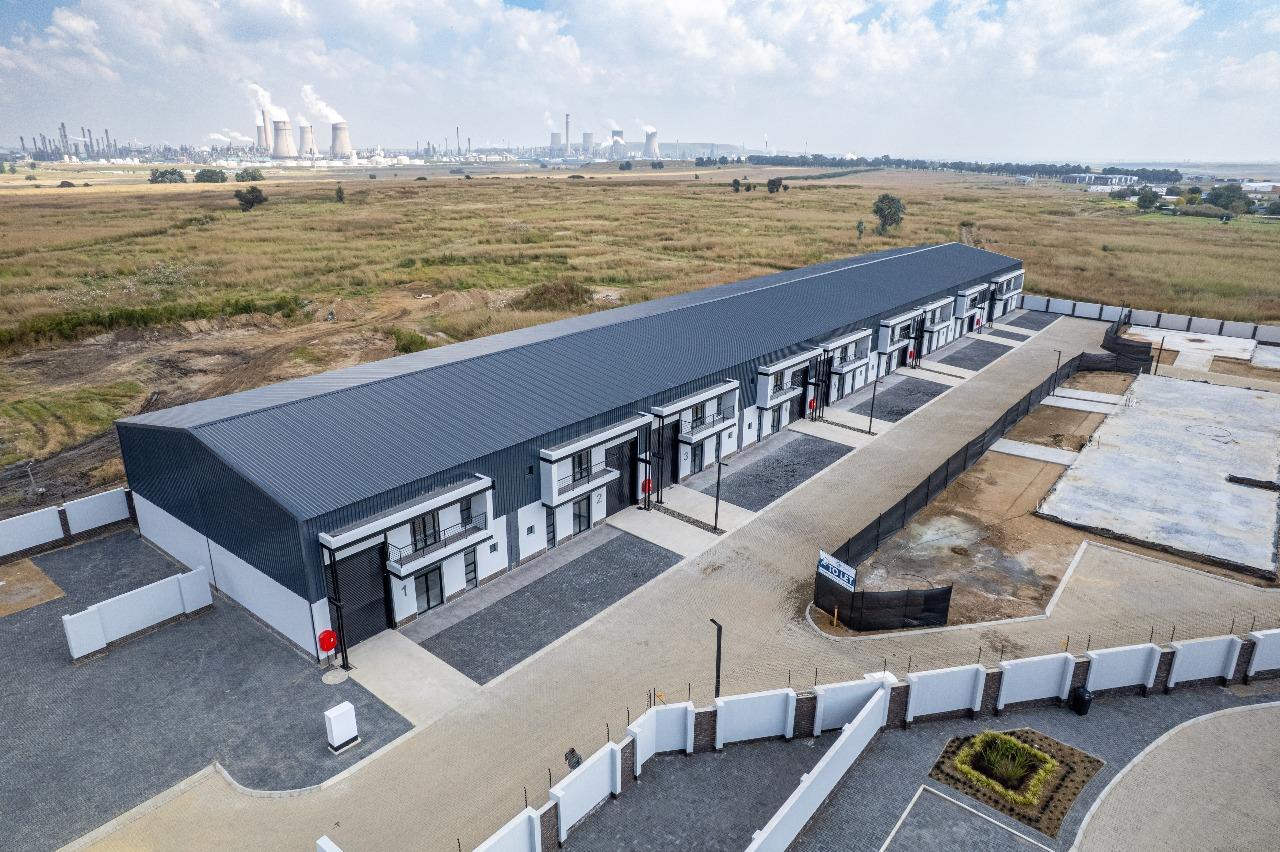
“Broll Auctions and Sales’ October 2026 property auction is highlighting a broad selection of South African industrial real estate, including a Wellington engineering headquarters, 29 industrial units in Secunda, light-industrial space in Sandton and mini-industrial units in Durban. The properties demonstrate continued investor interest in income-producing industrial assets, owner-occupier facilities, warehousing and logistics locations despite wider economic and operating-cost pressures.”
South Africa’s industrial property market is receiving a fresh vote of confidence as a diverse collection of factories, warehouses, workshops, light-industrial properties and income-producing industrial assets comes to market through Broll Auctions and Sales’ October auction. The sale, scheduled for 22 October 2026, brings together opportunities across several important economic centres, giving investors and owner-occupiers access to properties ranging from established industrial facilities to multi-unit warehousing and development opportunities.
The auction is particularly significant because the properties illustrate the breadth of South Africa’s industrial real estate sector. Instead of being concentrated in one type of asset, the offering includes a former engineering headquarters in Wellington, a portfolio of 29 industrial units in Secunda, a mixed retail and light-industrial investment in Wynberg, Sandton, and a Durban building containing 123 mini-industrial units. Together, these properties highlight demand for manufacturing, logistics, storage, workshops and smaller industrial operations.
One of the most notable opportunities is the former engineering headquarters in Wellington Industrial Park in the Western Cape. The property is being offered with vacant possession, making it particularly relevant to an owner-occupier seeking an established industrial facility. The site covers approximately 3,000 square metres and contains three buildings with a combined gross lettable area of about 3,150 square metres. Approximately 60% of the space is dedicated to factory accommodation, while the remaining area consists largely of offices.
The Wellington property has several characteristics that are important for industrial users. Its main factory has an internal height exceeding eight metres, providing useful vertical capacity for manufacturing, equipment and storage. It also has a mezzanine and dedicated spray booth, while the office accommodation includes reception areas, boardrooms and executive suites. A second three-storey building provides additional flexibility and could potentially accommodate expansion or tenants.
Location is another important advantage. The property has access to the R44 and N1, placing industrial users within relatively convenient reach of Cape Town and surrounding economic centres. Broll describes Wellington’s established industrial node as an area where many premises are owner-occupied and industrial properties do not frequently change hands. This scarcity can make the availability of a sizeable existing industrial facility particularly interesting to businesses looking to secure premises rather than construct new buildings.
Another major industrial opportunity is located in Secunda, where a portfolio of 29 freehold industrial units is being offered by tender. The properties are situated at the corner of Manie Maritz and Schalk Burger Streets and cover approximately 34,000 square metres of land. Their combined gross lettable area is about 23,509 square metres, comprising warehousing, workshops and office accommodation. Approximately 80% of the space is already let, providing an established rental base for a new owner.
The Secunda portfolio also includes about 8,727 square metres of yard and parking space. That is particularly relevant for logistics companies, contractors, manufacturers and businesses that require external storage, vehicle parking or operational yards in addition to enclosed buildings. The variety of unit sizes and uses could also help diversify the tenant base and reduce dependence on a single industrial occupier.
Secunda’s wider economic environment adds another layer of significance to the opportunity. Demand for industrial accommodation in the town is supported by the Sasol Synfuels complex and surrounding mining and industrial operations. Industrial properties in such locations can benefit from the presence of established economic infrastructure and businesses that require workshops, warehouses, contractor facilities and supporting services.
The Secunda offering also illustrates an important feature of industrial real estate: investors are increasingly able to combine rental income with opportunities for operational improvement. With approximately 20% of the industrial portfolio not occupied, a purchaser may have the potential to increase income through leasing vacant space, although actual returns would depend on tenant demand, rental levels, property condition and the costs associated with refurbishment or repositioning.
In Wynberg, Sandton, another property provides a different industrial investment model. The property at 3 5th Street contains approximately 2,637 square metres of retail, light-industrial and storage space on a 3,887-square-metre freehold erf zoned Industrial 3. Its location at the corner of 5th Street and Arkwright Avenue provides exposure to traffic moving towards the M1 and Sandton.
The Sandton property is already income-producing. An anchor tenant has occupied the premises for more than 14 years, while additional tenants, antenna income and a 35 kWp solar installation contribute to the investment profile. The investment information indicates gross annual rental of approximately R2.14 million, recoveries of around R1 million and net annual income of approximately R2 million.
This combination of light-industrial, storage and retail space demonstrates how industrial properties in established urban areas can serve multiple commercial functions. Such properties may appeal to investors seeking existing cash flow rather than purely speculative development opportunities. The presence of long-standing tenants can also provide a degree of income visibility, although investors would still need to assess lease terms, tenant concentration, maintenance requirements and future redevelopment potential before purchasing.
In Durban, Broll is marketing a particularly distinctive industrial property: a multi-storey mixed-use building containing 123 mini-industrial units and four ground-floor shops. The building has approximately 5,552 square metres of floor area on a relatively small 668-square-metre erf and generates gross annual income of about R4.85 million at an occupancy rate of 60%.
The Durban asset is significant because smaller industrial accommodation plays an important role in supporting entrepreneurs, artisans, traders, manufacturers and service businesses. Instead of relying on one large industrial tenant, a multi-unit property can accommodate numerous smaller occupiers. However, the 60% occupancy rate also indicates substantial scope—and associated risk—for a purchaser seeking to improve performance by filling vacant units.
The building also includes a vacant warehouse and penthouse, providing additional potential for a future owner. These spaces could create opportunities for further income generation, subject to market demand, building condition, municipal requirements and the capital investment needed to make the accommodation suitable for tenants.
The wider auction also includes industrially relevant properties outside the conventional factory and warehouse category. Along the N2 between Piet Retief and Ermelo, a former BP filling station sits on a 4,772-square-metre erf zoned Industrial 1 with approved filling-station rights. The property has 787 square metres of gross lettable area, including a 466-square-metre convenience store, while an existing liquor-store tenant occupies 148 square metres.
In East London, two adjoining properties on Amalinda Main Road are also being offered separately. The properties include an Engen fuel station and the Plumblink Centre, together providing roughly 1,900 square metres of buildings on more than 3,300 square metres of land. Their solar installations are another notable feature, demonstrating how energy resilience is becoming increasingly important for South African commercial and industrial property owners.
Energy considerations are increasingly relevant to industrial real estate because warehouses, workshops, factories and commercial facilities depend on reliable electricity for production, refrigeration, lighting, security and equipment. Recent developments in South Africa’s electricity sector have reduced the immediate pressure associated with load shedding, but industrial users continue to face questions around grid capacity, electricity costs, renewable integration and energy resilience.
The auction therefore arrives at an interesting moment for South Africa’s industrial property sector. Industrial real estate is closely connected to manufacturing, logistics, mining, construction, retail supply chains and small business activity. When these sectors expand, demand for warehouses, workshops, distribution facilities and production space can increase. Conversely, weak economic growth and rising operating costs can put pressure on tenants and landlords.
Recent economic indicators provide a mixed backdrop. South Africa’s private sector contracted at its fastest pace since December in September, according to the S&P Global Purchasing Managers’ Index, with new orders declining and supply bottlenecks and fuel-related cost pressures increasing.
Nevertheless, the auction’s geographic spread suggests that industrial property opportunities are not limited to the country’s largest metropolitan markets. Wellington, Secunda, Durban, East London, Sandton and Mpumalanga all feature, reflecting the importance of regional industrial nodes and transport corridors.
Transport infrastructure is particularly important. KwaZulu-Natal’s ports, road networks and logistics infrastructure remain central to South Africa’s role as a trade gateway, while government and industry are continuing efforts to strengthen freight and logistics performance.
For investors, this means location remains one of the most important considerations when evaluating industrial property. Access to highways, ports, rail infrastructure, major customers, labour markets and suppliers can influence tenant demand and long-term property values. For owner-occupiers, the same factors can affect distribution costs, employee access and operational efficiency.
The October Broll auction consequently provides a useful snapshot of South Africa’s industrial property landscape. It brings together income-producing assets, vacant owner-occupier facilities, multi-unit industrial properties and strategically located commercial sites. While each property carries its own risks and investment requirements, the diversity of the offering demonstrates the continuing importance of industrial real estate to the country’s broader economy.
The properties will go under the hammer on 22 October 2026 at noon at The Wanderers Golf Club in Illovo, Johannesburg, while the Secunda industrial portfolio is being offered by tender with the tender closing on 23 October 2026. Investors and prospective owner-occupiers will need to undertake their own due diligence covering zoning, leases, building condition, tenant quality, municipal services, financing and potential capital expenditure before committing to a purchase.
Ultimately, the significance of the auction extends beyond the individual properties. It highlights how factories, warehouses, workshops and flexible industrial spaces remain fundamental components of South Africa’s real estate market. As logistics networks evolve, manufacturing investment changes and businesses seek strategically located premises, well-positioned industrial assets are likely to remain an important part of the country’s commercial property story.



