




“Broll Auctions and Sales’ penultimate auction of 2026 is bringing a diverse selection of South African commercial properties to market, including an N2 filling station, Sandton commercial investment, Durban mini-industrial building, Secunda industrial portfolio and Fourways development land. The auction highlights continued opportunities for investors seeking income-producing assets, industrial property and development opportunities despite wider economic and operating-cost pressures.”
South Africa’s Commercial Property Market Shows Its Depth as Broll Auction Brings Forecourts, Factories and Fourways Land to Market
South Africa’s commercial property market is entering the final quarter of 2026 with investors showing continued interest in income-producing, industrial and development assets. A major signal comes from Broll Auctions and Sales’ penultimate auction of the year, which brings a varied collection of commercial opportunities to the market, including an N2 filling station in Mpumalanga, industrial properties in Sandton and Secunda, a mixed-use building in Durban, and a development site in Fourways.
For commercial investors, such diversity can spread exposure across different income models and operating environments. Broll’s October sale is scheduled for 22 October 2026 at noon at The Wanderers Golf Club in Illovo, Johannesburg. The catalogue includes properties across several regions and sectors, giving buyers exposure to retail, light industrial, storage, logistics and development opportunities, while highlighting different risk and return profiles. The sale follows what Broll described as a successful September auction, which recorded strong attendance and a good number of concluded deals.
Forecourt Opportunity on the N2
One of the most distinctive properties is a former BP filling station positioned along the N2 between Piet Retief and Ermelo in Mpumalanga. The site is currently closed, but its BP supply agreement remains in place, creating the possibility for a buyer to rebrand or operate it as a white site.
The property sits on a 4,772-square-metre erf zoned Industrial 1, with approved filling-station rights. The site and retail licences are also available for transfer. Its location is noteworthy because there is a stretch of roughly 50 kilometres between filling stations on this section of the N2, according to the auction information.
The property includes about 787 square metres of gross lettable area, including a 466-square-metre convenience store with built-in refrigeration equipment and infrastructure that could support reopening. For a strategic buyer, the opportunity is therefore not simply about acquiring land. It involves the possibility of restoring a trading operation where road traffic, local agricultural activity and limited competing fuel infrastructure could support demand.
A buyer would still need to assess the condition of the site, licensing requirements, environmental obligations, capital expenditure and the economics of reopening before committing funds.
Income-Producing Sandton Property
Another notable asset is a commercial investment at 3 5th Street in Wynberg, Sandton. The property occupies a 3,887-square-metre freehold erf zoned Industrial 3 and provides 2,637 square metres of retail, light-industrial and storage space.
Its income profile makes it relevant to investors seeking established cash flow. The property has an anchor tenant that has occupied the site for more than 14 years, alongside other tenants, antenna income and a 35kWp solar installation.
The investment information indicates gross annual rental of about R2.14 million, recoveries of approximately R1 million and net annual income of around R2 million. These figures allow buyers to examine current income rather than relying entirely on future development assumptions.
The long-standing anchor tenant is also important. Tenant stability can reduce leasing risk, although investors must still investigate lease expiry dates, escalation clauses, tenant financial strength, maintenance obligations and potential vacancies.
Durban’s Mixed-Use Mini-Industrial Property
The auction also includes a multi-storey mixed-use building on Beatrice Street in Durban’s CBD. The property contains 123 mini-industrial units and four ground-floor shops, creating a tenant mix aimed at small manufacturers, traders and artisans.
The building measures 5,552 square metres and stands on a 668-square-metre erf. It generates gross annual income of approximately R4.85 million at 60% occupancy.
The 60% occupancy level is both an income opportunity and a risk indicator. A buyer could potentially increase revenue by filling vacant units, but that strategy depends on demand, tenant quality, rental levels and the condition of the building.
Secunda Industrial Portfolio
A further highlight is a portfolio of 29 freehold industrial units in Secunda at the corner of Manie Maritz and Schalk Burger Streets. The portfolio covers 34,000 square metres of land and has total gross lettable area of 23,509 square metres.
The properties include warehouses, workshops and offices and are about 80% let. There is also 8,727 square metres of yard and parking space. This combination makes the portfolio relevant to logistics, warehousing and contractor businesses.
The vacancy component gives an investor room to pursue additional rental income, but it also requires a careful assessment of why certain areas are vacant and what investment may be required to attract new tenants.
Secunda’s industrial economy provides another layer of support. Demand for commercial and industrial space is linked to the Sasol Synfuels complex and surrounding mining and industrial activity. That economic base can help underpin demand, although investors remain exposed to broader industrial cycles and individual tenant performance.
Fourways Development Land
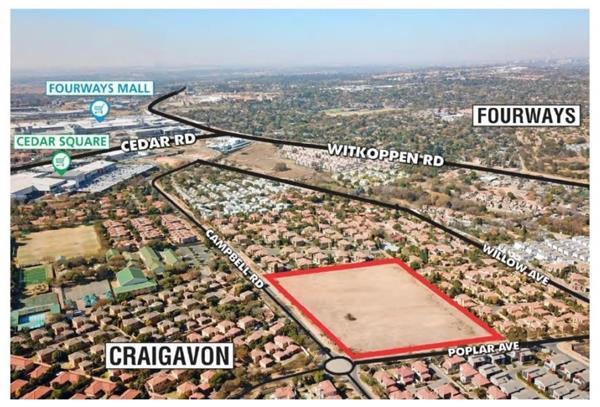
The catalogue also includes a development site in Fourways, Johannesburg. Development land differs from established income-producing property because its value proposition depends on planning, zoning, infrastructure, construction economics and future demand.
Fourways remains a prominent growth area, supported by established residential communities, retail centres, business nodes and transport connections. A well-positioned development site can attract developers looking for longer-term opportunities.
However, vacant land carries a different risk profile. Buyers must investigate permitted development rights, bulk availability, municipal services, access, environmental conditions and the time and cost required to reach completion.
What the Auction Says About South African Commercial Property
Taken together, the properties demonstrate the breadth of South Africa’s commercial property market. Investors are not looking only for premium office buildings or major shopping centres. Opportunities also exist in filling stations, mini-industrial facilities, warehouses, mixed-use properties and development land.
This is relevant as businesses navigate higher operating costs, infrastructure constraints and uneven economic growth. Recent private-sector data showed South Africa’s private sector contracted sharply in September, with weaker new orders and rising cost pressures, including fuel-related costs. Those conditions can influence tenant affordability and operating margins, making careful due diligence essential.
The market also shows signs of resilience. South Africa’s office vacancy rate fell to 11.8% in the third quarter of 2026, according to a Property Wheel report citing SAPOA research. The decline, five percentage points below the mid-2022 peak, indicates improving absorption in at least one major commercial property segment.
For buyers, the lesson is that commercial property cannot be assessed solely through headline prices. The quality of the tenant base, rental income, location, infrastructure, vacancy, zoning and future demand all matter.
Conclusion
Broll’s penultimate auction of 2026 provides a useful snapshot of where commercial property opportunities are emerging across South Africa. From the N2 forecourt and Sandton investment to Durban’s mini-industrial building, Secunda’s industrial portfolio and Fourways development land, the assets demonstrate different ways investors can participate in the commercial market.
The strongest opportunities are likely to be those where the underlying fundamentals are clear: sustainable income, strategic locations, functional infrastructure and realistic potential for value creation. Nevertheless, auction buyers must examine leases, zoning, municipal accounts, building conditions, licences, financing requirements and future capital expenditure before bidding.
As the year moves toward its final quarter, the Broll auction shows that South Africa’s commercial property market remains active, diverse and capable of presenting opportunities for investors prepared to undertake detailed due diligence.



