




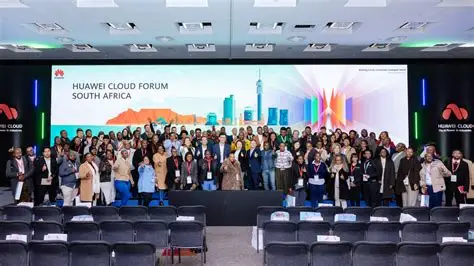
“The Huawei South Africa Connect 2026 Summit brought together policymakers, academics, and industry leaders to accelerate AI adoption beyond pilot projects. With government support and Huawei’s ACT framework, South Africa is positioning itself as a continental leader in AI-driven economic growth and social inclusion.”
South Africa’s digital transformation journey reached a pivotal milestone with the Huawei South Africa Connect 2026 Summit, held under the theme “Where Innovation Shapes the Future.” The summit underscored the country’s ambition to harness Artificial Intelligence (AI) as a driver of economic growth, social inclusion, and global competitiveness. With more than 2,900 leaders from government, academia, and industry in attendance, the event highlighted South Africa’s readiness to leapfrog into the next phase of AI adoption.
Government’s Vision for Inclusive AI
Solly Malatsi, Minister of Communications and Digital Technologies, emphasized that South Africa’s digital future must prioritize participation and equitable access. He argued that connectivity and affordable devices are immediate priorities to ensure inclusivity in the digital economy. Malatsi framed AI as a tool for social justice, capable of addressing pressing challenges such as healthcare delivery, education access, and energy management. This vision positions AI not merely as a technological advancement but as a transformative force for national development.
Huawei’s Strategic Framework
Will Meng, CEO of Huawei South Africa, outlined a three-stage path to AI readiness:
- Informatisation: Building robust connectivity infrastructure.
- Digitalisation: Leveraging data for actionable insights.
- Intelligence: Creating new economic value through AI applications.
Meng cited Huawei’s projects in China as proof that this phased approach can deliver tangible results. He also highlighted South Africa’s role as a founding member of the World AI Cooperation Organisation, signaling the country’s commitment to global collaboration.
The ACT Pathway
Nicholas Ma, Huawei’s Corporate Vice President, introduced the ACT framework—Assess, Calibrate, Transform—as a roadmap for enterprises moving from pilot projects to scaled AI adoption.
- Assess: Identify high-value scenarios.
- Calibrate: Refine AI models using quality industry data.
- Transform: Fully integrate AI into operations.
Globally, Huawei has identified over 1,000 production scenarios and built a developer community of more than four million. For South Africa, this framework provides a tested methodology for scaling AI across sectors such as finance, energy, telecommunications, and education.
Economic Potential
South Africa’s AI market is currently valued at over R50 billion and is projected to triple by 2030. This growth potential underscores the importance of moving beyond pilot projects into full-scale adoption. By leveraging AI, South Africa can enhance productivity, foster innovation, and strengthen its position as a continental leader in digital transformation.
Challenges and Risks
Despite the optimism, challenges remain. Infrastructure gaps, data governance issues, and skills shortages could hinder progress. Ensuring equitable access to AI technologies is critical to avoid exacerbating existing inequalities. Moreover, the collapse of South Africa’s draft AI policy earlier this year highlights the need for robust governance frameworks to maintain credibility and trust in AI policymaking.
Conclusion
The Huawei South Africa Connect 2026 Summit marks a turning point in the country’s AI journey. By aligning government priorities with industry innovation and global collaboration, South Africa is poised to transition from experimentation to scaled AI adoption. If successful, this transformation could redefine the nation’s economic trajectory, making AI not just a technological tool but a cornerstone of inclusive growth and social progress.



