




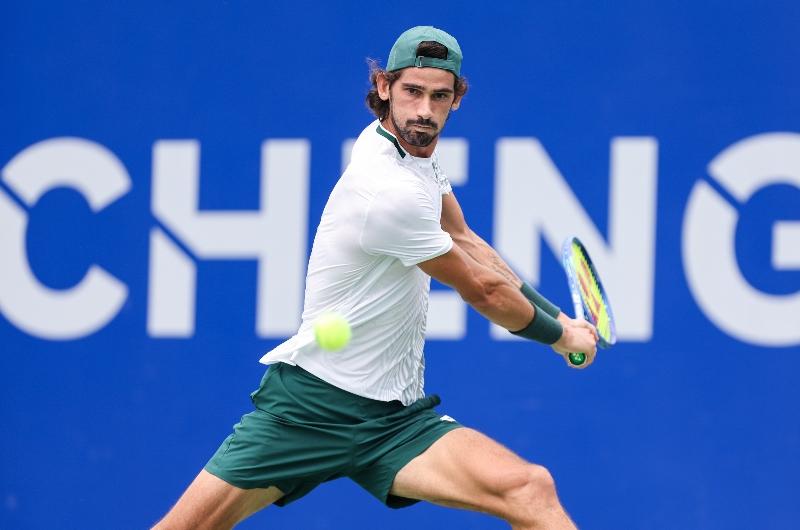
“South African tennis star Lloyd Harris has produced one of the most encouraging stretches of his 2026 season, winning the Jingshan Open in China after a dramatic comeback against Italy’s Mattia Bellucci before immediately turning his attention to the Shanghai Masters. Although Harris subsequently lost in the Shanghai qualifying final to Hong Kong’s Coleman Wong, his results in China — including a Chengdu quarter-final and five-match Jingshan title run — underline a significant return to form for South Africa’s leading men’s player.”
South Africa’s Lloyd Harris finds momentum at crucial stage of season
For South African tennis, the emergence of sustained international form from Lloyd Harris is an important development. The 29-year-old Cape Town-born player has endured an uneven period in his career, including significant injury setbacks, but his recent performances in China suggest that he is once again building the competitive rhythm that previously carried him into the upper reaches of the ATP rankings.
Harris’ victory at the Jingshan Open was particularly significant because of the manner in which it was achieved. The South African entered the ATP Challenger 100 event as the sixth seed and progressed through five matches before facing Italy’s Mattia Bellucci in the championship match. Rather than producing a straightforward final, Harris had to recover from a difficult opening set before eventually winning 1-6, 6-3, 7-6(7-4).
The victory demonstrated several qualities that have been central to Harris’ best tennis: an ability to compete aggressively, resilience when matches turn against him and confidence in deciding moments. Most importantly, he did not allow the loss of the opening set to dictate the remainder of the final.
Bellucci took the first set 6-1, putting Harris under immediate pressure. However, the South African responded by raising his level in the second set and eventually forcing the contest into a deciding-set tie-break. According to the tournament reports, Harris also saved two championship points before completing the comeback.
That resilience made the victory more than another entry on Harris’ season record. It provided evidence that he can still navigate high-pressure matches and produce his best tennis when the result is on the line.
A five-match run to the title
Harris’ road to the Jingshan championship was equally important. He opened his campaign with a straight-sets victory over Canada’s Alexis Galarneau, winning 6-2, 6-3. He then defeated France’s Luka Pavlovic 6-2, 6-3 before overcoming American Andre Ilagan 7-5, 6-1 in the quarter-finals.
The semi-final against Australia’s Alex Bolt was his most complicated challenge before the championship match. Bolt took the opening set 7-5, but Harris fought back to take the second-set tie-break 7-6(2). Bolt subsequently retired because of a right-leg injury, sending Harris through to the final.
Winning five consecutive matches to lift a Challenger title is valuable for any player trying to rebuild momentum. For Harris, however, the timing was especially important.
The South African had already shown encouraging form at the Chengdu Open immediately before the Jingshan tournament. He came through qualifying in Chengdu and progressed to the quarter-finals, where he eventually lost to Poland’s Hubert Hurkacz. Along the way, Harris defeated Monaco’s Valentin Vacherot and other opponents to establish himself as a dangerous player during the Chinese swing.
That combination of results meant that Harris arrived at Shanghai carrying genuine momentum rather than relying on a single isolated tournament performance.
The Shanghai Masters provided another test
The schedule, however, left little time for Harris to celebrate his Jingshan success.
Immediately after winning the Challenger title, the South African moved into qualifying at the Rolex Shanghai Masters. He defeated Australia’s Alex Bolt 7-5, 6-4 in his opening qualifying match, continuing his impressive run in China.
That victory was another encouraging display. Harris used his serve effectively and remained composed in important moments, advancing to the qualifying final.
His next opponent was Coleman Wong of Hong Kong, a rapidly improving young player who was also enjoying a strong run of form. Wong defeated Harris 6-4, 3-6, 6-2 in the final qualifying round and therefore advanced to the Shanghai Masters main draw.
Although the defeat prevented Harris from reaching the Shanghai main draw, it does not erase the progress made during the preceding tournaments.
Indeed, Harris’ recent results demonstrate why rankings alone do not always tell the full story of a player’s current trajectory. His ranking had improved significantly during the recent period, with Tennis Majors listing him at No. 125 on 5 October after being ranked No. 175 in August.
The improvement is a useful indication that his results are beginning to translate into ranking momentum.
A reminder of Harris’ potential
There is also a larger story behind Harris’ current revival.
The South African previously reached a career-high singles ranking of No. 31. His career was disrupted by serious injuries, meaning his return to competitive tennis has required patience and consistency.
For South African supporters, his return is important because the country has been looking for greater depth at the highest levels of men’s tennis. Harris has frequently carried the country’s hopes on the international circuit, particularly at Grand Slam tournaments.
His 2026 US Open campaign provided another example. Harris reached the second round in New York before losing to Greece’s Stefanos Tsitsipas in four sets.
That result, followed by his performances in Chengdu and Jingshan, suggests that his season has gradually developed into something more encouraging.
The key now is consistency.
A single Challenger title can provide confidence, ranking points and prize money, but maintaining that level against stronger opposition is the real challenge. The Shanghai qualifying defeat against Wong illustrates the gap Harris is still trying to close between Challenger-level success and consistent Masters-level progression.
Nevertheless, the sequence of results is promising.
What the China swing means for South African tennis
Harris’ performances also matter beyond his personal career.
South African tennis has been working to develop a new generation of players, while established figures continue to provide a bridge between the country’s history and its future. The recent rise of junior and emerging players such as Connor Doig and Jahnie van Zyl has provided encouragement, while Harris remains one of the country’s most visible representatives in men’s professional tennis.
His success therefore offers an important example for younger South African players.
Harris’ career demonstrates that progress in professional tennis is rarely linear. Players can experience breakthrough performances, injuries, ranking drops and difficult periods before rebuilding their careers.
His Jingshan victory was particularly valuable because it came through adversity. Losing the first set heavily in the final could have led to a quick defeat, but Harris instead found a way back into the match. That ability to remain mentally engaged is often what separates tournament winners from players who simply produce occasional flashes of quality.
The South African will now have to turn that resilience into sustained performance.
The road ahead
The immediate Shanghai opportunity may have ended with the qualifying defeat to Wong, but Harris leaves the Chinese swing with plenty of positives.
He has won a significant Challenger title, reached a quarter-final at an ATP-level event in Chengdu and accumulated several victories against players capable of challenging him. His ranking has also moved in the right direction.
For a player attempting to re-establish himself after injury and difficult seasons, those developments are significant.
The next challenge will be converting that momentum into deeper runs at ATP Tour events and, ultimately, returning to the main draws of the sport’s biggest tournaments on a regular basis.
South African fans will also be watching closely to see whether Harris can continue climbing the rankings during the final stages of the 2026 season.
For now, however, the message from China is encouraging. Harris showed that he can win long matches, recover from difficult positions and handle pressure when titles are at stake.
His Jingshan triumph was not simply another Challenger trophy. It was a reminder of the level Harris can reach when his game, fitness and confidence align.
And while his Shanghai Masters campaign ended in qualifying, the broader Chinese swing has strengthened the case that South Africa’s leading men’s player is moving in the right direction.
For South African tennis, that is perhaps the most important takeaway. Harris still has work ahead of him, but after a difficult period, his recent results provide genuine evidence that another chapter of his career may be taking shape.



