




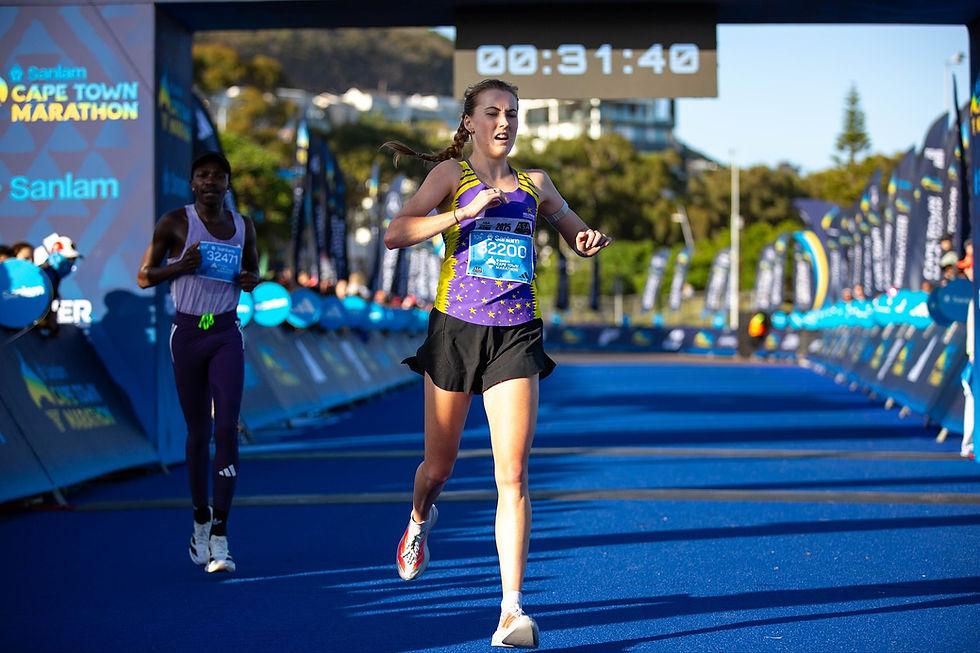
“South African distance runner Tayla Kavanagh has broken the national women’s 10km road record with a remarkable 30:50 at the tRUNsylvania International 10K in Brașov, Romania, becoming the first South African woman to run the distance under 31 minutes. The performance was her second national record in just over two weeks, following her 14:51 South African 5km record at the World Athletics Road Running Championships in Copenhagen.”
Tayla Kavanagh Smashes South African 10km Record in Romania
South African athletics is ending an extraordinary 2026 road-running season with another major national record, this time from Tayla Kavanagh, whose rapid rise has reached another level after she broke the women’s 10km road record in Romania.
The 25-year-old Durban athlete produced a stunning 30 minutes and 50 seconds at the tRUNsylvania International 10K, part of the Brașov Running Festival, on 4 October. She finished fifth in a world-class international field, but her position mattered less than the time she recorded. Kavanagh became the first South African woman to break the 31-minute barrier over 10km.
The performance also represented a dramatic improvement over the previous South African record. The former mark of 31:12 had been established by fellow South African distance star Glenrose Xaba in Durban in July 2024. Kavanagh therefore removed an extraordinary 22 seconds from the national record. She also improved her own previous personal best of 31:26 by 36 seconds.
The magnitude of the improvement makes the achievement particularly significant. Breaking a national record by a few seconds is difficult enough at elite level, but reducing a 10km national standard by 22 seconds demonstrates just how dramatically Kavanagh’s performances have progressed during 2026.
A Second National Record in Weeks
Kavanagh’s latest achievement did not arrive unexpectedly. It forms part of an exceptional period in which she has repeatedly demonstrated that she belongs among South Africa’s leading distance runners.
Just weeks before the Romanian race, she established another national record at the World Athletics Road Running Championships in Copenhagen. Kavanagh finished fourth in the women’s 5km race in 14:51, missing the podium by only one second. World Athletics officially lists the 14:51 performance as a personal best and South African national record.
That Copenhagen performance was already a major breakthrough. Kavanagh had been competing against some of the strongest road runners in the world and managed to remain close enough to the leading group to challenge for a medal.
Her subsequent performance in Brașov has taken that momentum even further.
World Athletics’ athlete profile now lists Kavanagh’s personal bests as 14:51 for 5km, 30:50 for 10km road, 14:58.49 for 5000m, 8:46.86 for 3000m, and 32:05.59 for 10,000m.
Those figures illustrate an athlete developing across several distances rather than specialising in only one event.
A Difficult Final Kilometre
The Romanian race was not an easy victory for Kavanagh. In fact, she finished fifth behind four athletes who all ran faster than 30:40.
Ethiopia’s Asefu Abreha won the race in 30:16, followed by Aynadis Mebratu in 30:19 and 19-year-old Yenenesh Shimket in 30:21. Djibouti’s Samia Hassan Nour finished fourth in 30:37, while Kavanagh followed in fifth in 30:50.
The quality of the field makes Kavanagh’s performance even more impressive.
The race was contested in cool conditions, with the temperature reported at around 8 degrees Celsius. The leading athletes went through the first half of the race at a relatively controlled pace before the competition intensified during the second half.
Kavanagh later explained that the final kilometre was particularly difficult. She had to push herself hard while reminding herself that every second mattered.
That mentality proved decisive.
Her ability to continue producing speed when fatigue was building allowed her to finish in 30:50 and secure one of the most important records of her career.
From Personal Best to National Record
The scale of Kavanagh’s improvement is perhaps best understood by comparing her old and new personal bests.
Before the Brașov race, her best 10km time stood at 31:26. She therefore improved by 36 seconds in a single race. At elite level, such a substantial improvement over 10km is highly unusual.
The previous national record of 31:12 was already a significant benchmark. Xaba had established that mark in Durban in 2024, and it represented one of the strongest performances in South African women’s road running.
Kavanagh’s 30:50 therefore does more than replace an existing record. It changes the national benchmark by moving South African women’s 10km running into the sub-31-minute territory.
That milestone has symbolic importance because the 31-minute barrier represents a significant performance level internationally.
The Rise of a New South African Distance Star
Kavanagh’s 2026 season has transformed her status in South African athletics.
World Athletics lists her as a five-time national champion and notes that she has also achieved a top-eight finish at the Commonwealth Games. Her performances this year have now extended from track championships to international road racing.
Earlier in the year, she showed strong form over 3000m and 5000m. She subsequently competed successfully at the national level before producing her breakthrough international road performances.
Her success is also significant for the broader development of South African women’s distance running.
For years, South Africa has produced outstanding female distance runners, including athletes such as Elana Meyer, Irvette van Zyl and Glenrose Xaba. Kavanagh’s emergence adds another major name to that tradition.
Her record has also created an intriguing rivalry between generations of South African distance running. Xaba, whose record Kavanagh broke, has already congratulated her and suggested that the two could potentially push each other towards even faster performances.
Xaba’s Legacy and Kavanagh’s Opportunity
Glenrose Xaba’s previous record was not the only important achievement by a South African woman during the same weekend.
On the same Sunday that Kavanagh was competing in Romania, Xaba won the SPAR Women’s 10km Challenge in Johannesburg and became the first woman to win the SPAR Grand Prix series four times. She finished in 32:26.
The timing creates an interesting moment for South African athletics.
Xaba has established herself as one of the country’s leading road runners, while Kavanagh is now demonstrating that she can challenge and surpass national standards.
Rather than signalling the end of Xaba’s influence, however, the development could strengthen the country’s distance-running depth.
South Africa now has multiple athletes capable of competing at international level, creating stronger competition and potentially helping the national team at future championships.
Looking Towards the Future
Kavanagh has indicated that she intends to take an off-season break after what she described as a dream year for her running career. That decision could be important because her 2026 campaign has involved repeated high-level competitions and record-breaking performances.
The athlete has also spoken about the possibility of targeting future World Championships qualification standards.
Her progression suggests that longer-distance events could become increasingly important.
While the 10km record has immediately placed her in the spotlight, her performances over 5km, 5000m and 10,000m show that she has the range required to move between road and track competition.
The next stage of her career could therefore involve deciding how aggressively to pursue the 10km, half-marathon and marathon distances while maintaining her track speed.
A Landmark Moment for South African Athletics
Kavanagh’s 30:50 is more than another number on the South African record books.
It represents the culmination of years of training, recovery, racing experience and confidence. It also demonstrates how quickly an athlete can progress when several elements come together at the right time.
Her 2026 season has already included a national 5km record and now a national 10km record. World Athletics’ official results confirm that the 30:50 in Brașov is her current 10km personal best, while the race organisers also recorded it as a South African national record.
Most importantly, Kavanagh’s performance sends a powerful message about the future of South African women’s distance running.
The country has a new benchmark to chase, a new athlete capable of competing with the world’s best, and a new generation of runners watching what is possible.
For Kavanagh, however, the record is unlikely to be the final destination. At 25, she still has considerable time to develop, and her rapid improvement during 2026 suggests that the 30:50 mark may eventually become another stepping stone.
For now, the achievement stands as one of the biggest South African athletics performances of the year: Tayla Kavanagh has broken the 31-minute barrier, rewritten the national 10km record and firmly established herself among the country’s elite distance runners.



