




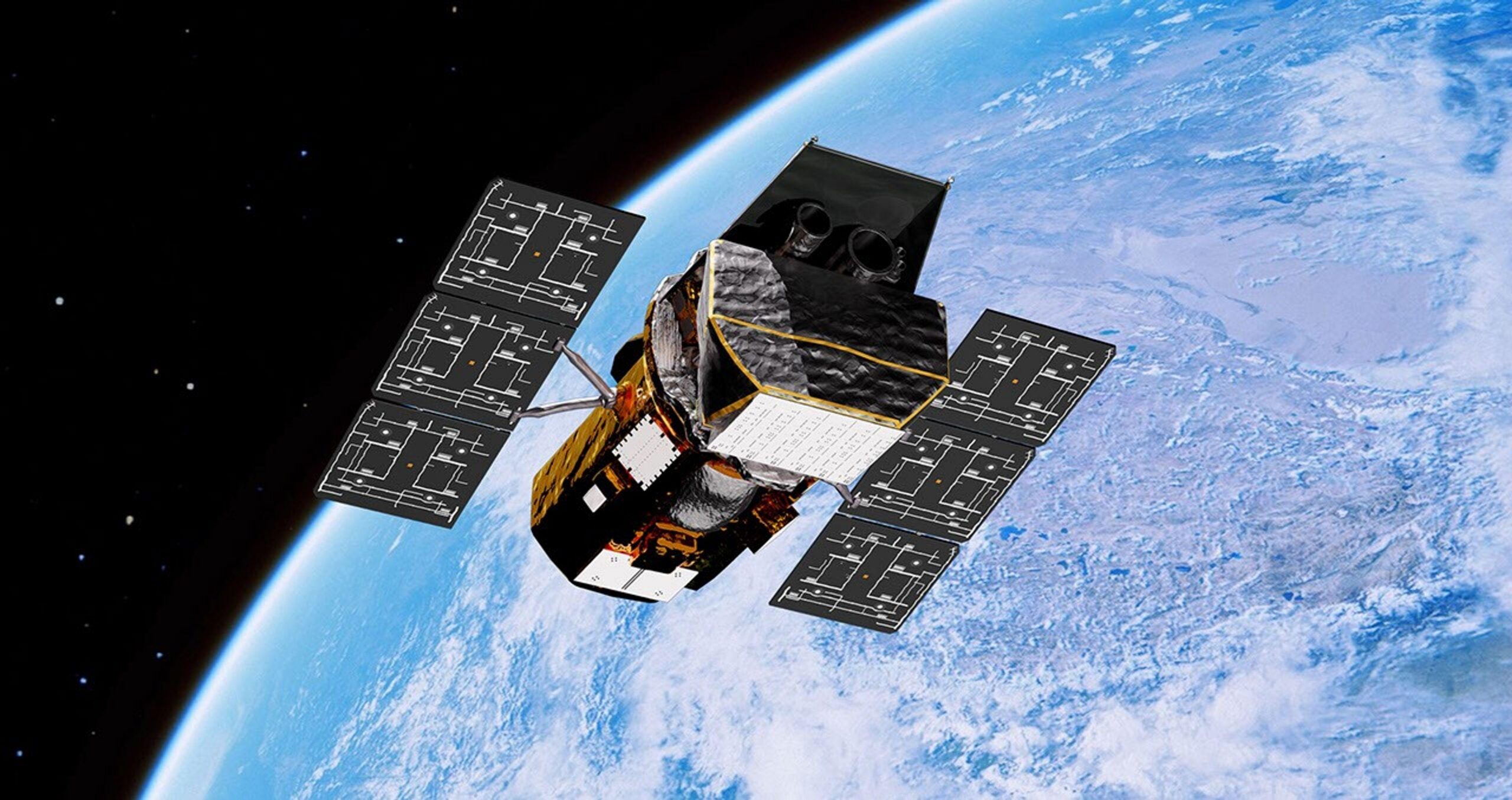
“NASA’s Neil Gehrels Swift Observatory, a space telescope launched in 2004, is expected to re-enter Earth’s atmosphere on 4 November 2026 after nearly 22 years of observing gamma-ray bursts and other cosmic phenomena. The spacecraft’s failed rescue mission, uncertain re-entry timing and the small risk associated with surviving debris have renewed international attention on satellite disposal, orbital servicing and space sustainability.”
NASA’s Swift Space Telescope Heads for Fiery Re-Entry After Nearly 22 Years in Orbit
NASA’s Neil Gehrels Swift Observatory is approaching the end of an extraordinary space mission, with the ageing spacecraft expected to return to Earth’s atmosphere on Wednesday, 4 November 2026, nearly 22 years after its launch. The event marks the conclusion of a scientific programme that transformed astronomers’ understanding of gamma-ray bursts, distant galaxies and some of the universe’s most energetic phenomena.
The spacecraft, weighing approximately 1,452 kilograms, has spent almost two decades studying cosmic explosions and other astronomical events. Its anticipated atmospheric re-entry has attracted international attention because of the possibility that some components could survive the journey through Earth’s atmosphere.
According to information reported by Reuters, NASA expects most of the observatory to burn up during atmospheric re-entry. However, certain heavier components could potentially survive, although the probability of causing harm to people on the ground remains extremely low. The United States Space Force has estimated the probability of someone being harmed at approximately one in 2,100.
An Extraordinary Mission Comes to an End
Swift was launched in November 2004 with an original primary mission lasting approximately two years. Its scientific objectives centred on detecting and investigating gamma-ray bursts, extraordinarily energetic explosions associated with distant galaxies and the collapse of massive stars.
These bursts are among the most powerful explosions observed in the universe. Some last only fractions of a second, while others continue for several minutes. Despite their short duration, they can release enormous quantities of energy, making them valuable targets for astronomers studying the evolution of stars and galaxies.
Swift was specifically designed to identify these events quickly and direct its instruments towards their locations.
Its scientific capabilities extended beyond gamma-ray observations. The observatory carried three complementary instruments, allowing researchers to investigate astronomical phenomena across different wavelengths.
Over the years, Swift became an important international astronomical resource, supporting observations of black holes, supermassive galaxies, stellar explosions, comets and other celestial objects.
Its long operational history substantially exceeded its original mission expectations.
Why Swift Is Returning to Earth
The spacecraft’s declining orbit has been influenced by atmospheric drag and changing solar activity.
Although satellites in low Earth orbit operate above most of Earth’s atmosphere, extremely thin atmospheric layers remain present at their operating altitudes. These particles gradually interact with spacecraft, producing drag that reduces orbital energy and altitude.
Solar activity can intensify this process. When the Sun releases energy into Earth’s upper atmosphere, atmospheric gases expand, increasing the density of the environment encountered by orbiting spacecraft.
The resulting drag can accelerate orbital decay.
Swift has gradually lost altitude, making its eventual atmospheric return increasingly difficult to avoid.
Unlike spacecraft equipped with propulsion systems designed for orbital manoeuvres, Swift cannot independently perform the necessary reboost manoeuvres to maintain a higher orbit.
Consequently, NASA has been monitoring its orbital trajectory and estimating the timing and location of its eventual re-entry.
The Failed Rescue Mission
Before accepting the spacecraft’s inevitable return, NASA supported an ambitious attempt to extend Swift’s operational life.
The rescue initiative involved a specialised spacecraft called LINK, developed by Arizona-based Katalyst Space Technologies.
The mission was designed to demonstrate whether a robotic spacecraft could rendezvous with an ageing satellite, establish contact and provide the propulsion needed to raise it into a more sustainable orbit.
Such capabilities are increasingly important as the space industry considers ways of maintaining satellites, extending mission lifetimes and reducing orbital debris.
However, the rescue attempt did not succeed.
LINK experienced uncontrolled spinning after reaching space, preventing the spacecraft from completing its intended rendezvous and rescue operations.
Mission managers subsequently abandoned the attempt in August 2026.
The failure represented a significant setback for Swift’s continued operation, but it also demonstrated the technical challenges associated with spacecraft servicing.
Many satellites were originally designed without the docking interfaces, accessibility features or operational systems necessary for robotic servicing.
Successfully approaching and manipulating such spacecraft requires sophisticated navigation, control systems and precision engineering.
The Swift rescue initiative therefore represented more than an attempt to preserve an astronomical observatory. It also served as a demonstration of technologies that could influence the future of commercial satellite maintenance and space infrastructure.
What Happens During Atmospheric Re-Entry?
During atmospheric re-entry, spacecraft encounter increasingly dense atmospheric layers, producing substantial heating and aerodynamic forces.
These conditions can cause spacecraft structures to break apart and burn.
NASA expects most of Swift to disintegrate during its return to Earth. Nevertheless, components constructed from materials capable of resisting extreme temperatures may survive long enough to reach the surface.
The precise location of surviving debris cannot be established with certainty until the spacecraft’s final trajectory and atmospheric behaviour become clearer.
The expected re-entry timing has also involved uncertainty.
NASA’s reported prediction placed the event around 3:30 a.m. Eastern Standard Time on Wednesday, corresponding to 08:30 GMT, with an uncertainty window of approximately 11 hours.
Other tracking estimates differed, demonstrating how difficult it can be to determine the precise moment when an uncontrolled spacecraft will encounter sufficient atmospheric resistance to begin breaking apart.
The uncertainty reflects the complexity of atmospheric conditions, spacecraft orientation and orbital dynamics.
Africa and South Africa’s Space Interests
The predicted debris corridor has attracted particular attention because it extends across tropical regions, including parts of Africa, Asia and Latin America.
However, the corridor should not be interpreted as a prediction that debris will fall in South Africa.
NASA’s estimated surviving-debris latitude range is approximately 20.6 degrees north to 20.6 degrees south. This broad geographical band includes extensive ocean areas and several populated regions.
The probability of harm remains low, according to the reported NASA assessment.
For South Africa, the event nevertheless provides an opportunity to consider the importance of satellite tracking, space weather monitoring and responsible space operations.
The South African National Space Agency (SANSA) contributes to national space capabilities through satellite Earth observation, space science and space weather research.
These activities support applications ranging from environmental monitoring and disaster management to scientific research and technological development.
South Africa’s participation in international astronomy initiatives also highlights the importance of developing sustainable space infrastructure and strengthening scientific cooperation.
Lessons for the Future of Space Sustainability
Swift’s anticipated re-entry illustrates a growing challenge facing the international space industry.
As more satellites are launched, spacecraft operators must increasingly consider how their missions will end.
Responsible satellite disposal involves planning for controlled atmospheric re-entry, orbital removal or other approaches designed to minimise the creation of long-lasting debris.
Space debris presents risks to operational spacecraft, scientific missions and future human activities in orbit.
The Swift mission demonstrates why disposal considerations should be integrated into spacecraft design rather than treated as an afterthought.
Future spacecraft could benefit from propulsion systems, docking interfaces and other technologies that make orbital maintenance and disposal more manageable.
The unsuccessful LINK rescue also highlights the importance of developing reliable robotic servicing systems.
Although the attempt failed, the underlying technology remains relevant to commercial operators, scientific institutions and governments seeking to extend satellite lifetimes.
A Lasting Scientific Legacy
Swift’s scientific contribution extends far beyond its eventual atmospheric return.
Its observations have helped astronomers investigate gamma-ray bursts, identify their sources and examine the environments surrounding some of the universe’s most energetic events.
The observatory also supported investigations into black holes, stellar explosions and other astronomical phenomena.
Its extended operational lifetime allowed researchers to accumulate an enormous body of observations, contributing to international scientific research and supporting discoveries that would otherwise have been difficult to achieve.
The mission’s longevity demonstrates how spacecraft can deliver substantial scientific value beyond their original design expectations.
Swift’s legacy will therefore continue through the observations, research publications and scientific discoveries made possible by its instruments.
Conclusion
NASA’s Neil Gehrels Swift Observatory is expected to complete its remarkable journey through space with its atmospheric re-entry on 4 November 2026.
Although the spacecraft’s return presents a small possibility of surviving debris reaching Earth’s surface, NASA’s reported risk assessment indicates that the probability of harm is extremely low.
The failed rescue mission, meanwhile, has highlighted the challenges and opportunities associated with robotic spacecraft servicing.
For South Africa and the wider African space community, Swift’s final journey reinforces the importance of scientific cooperation, responsible satellite operations and investment in space technology.
As the observatory disappears from orbit, its scientific legacy will remain an important contribution to humanity’s understanding of the universe.
The mission’s conclusion also serves as a reminder that the future of space exploration depends not only on launching space



