




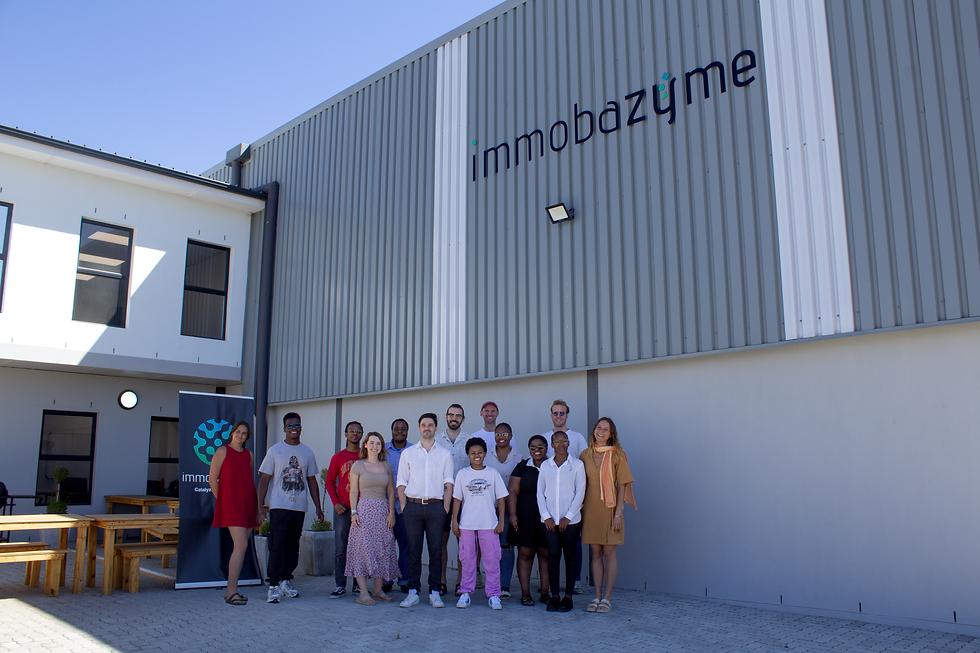
South African biotechnology company Immobazyme is advancing its commercial manufacturing ambitions after its co-founder and CEO, Dominic Nicholas, shared the company’s journey from early-stage research to developing products for industrial, cosmetic, food and pharmaceutical applications. The company has achieved ISO 22000 certification, expanded the international reach of its Solulase product to four continents and is developing a 1,800-square-metre manufacturing facility to strengthen its production capabilities and support the growth of locally developed biotechnology.
South African Biotechnology Startup Immobazyme Advances Local Manufacturing as It Scales Towards Commercial Production
South Africa strengthens its position in biotechnology innovation
South Africa’s biotechnology industry is gaining momentum as local entrepreneurs increasingly focus on turning scientific discoveries into commercially viable products. One company contributing to this development is Immobazyme, a South African biotechnology business working to manufacture specialised biological products for industries ranging from food processing and cosmetics to pharmaceuticals and industrial applications.
The company’s progress was highlighted on 4 November 2026 in a publication by the Centre for Epidemic Response and Innovation (CERI) at Stellenbosch University. The article, titled Scaling Biotechnology, examines the experiences of Immobazyme’s co-founder and chief executive officer, Dominic Nicholas, who discussed the company’s development during an African STARS seminar.
His presentation highlighted the opportunities and challenges associated with transforming biotechnology research into commercial manufacturing. It also demonstrated why innovation requires more than scientific knowledge: businesses need investment, skilled professionals, suitable infrastructure, regulatory compliance and a clear understanding of customer requirements.
For South Africa, these developments are particularly important because biotechnology offers opportunities to establish new manufacturing capabilities, develop specialised skills and create products that can compete in international markets.
From scientific research to commercial biotechnology
Founded in 2019 by Dominic Nicholas, Nick Enslin and Ethan Hunter, Immobazyme was established to develop biological products with applications across several industries.
The company focuses on recombinant proteins and other biotechnology-based products that can serve industrial, cosmetic, food and pharmaceutical markets.
Recombinant proteins are produced using genetically engineered biological systems, allowing microorganisms or other biological production systems to manufacture specific proteins for commercial and scientific applications.
These technologies have significant potential because proteins and enzymes are important ingredients in numerous industrial processes. They can support food production, manufacturing, research, product development and pharmaceutical applications.
However, developing a product in a laboratory is only one part of the commercialisation process. Businesses must also demonstrate that their products can be manufactured consistently, meet customer specifications and comply with applicable industry standards.
Immobazyme’s experience demonstrates the importance of navigating these different stages while developing a sustainable business.
Reducing dependence on imported biotechnology products
One of the major opportunities identified during the African STARS seminar concerns Africa’s dependence on imported enzymes and recombinant proteins.
These products are used by businesses across multiple sectors, yet much of the required supply originates outside the continent.
This creates opportunities for local biotechnology manufacturers to establish alternative supply chains and develop products closer to the industries that need them.
Developing domestic manufacturing capacity could provide several advantages. Businesses may benefit from improved access to specialised ingredients, more responsive suppliers and opportunities to develop products suited to regional market requirements.
Furthermore, local production could support the growth of technical expertise and create opportunities for researchers, scientists, engineers and manufacturing professionals.
However, reducing import dependence requires more than establishing laboratories. Biotechnology companies must invest in production equipment, quality management, regulatory compliance and the expertise required to manufacture products at commercial volumes.
Immobazyme’s expansion illustrates how South African entrepreneurs are attempting to address these challenges through locally developed technology and manufacturing investment.
Building products that can compete internationally
The company has already achieved several important commercial milestones.
According to CERI’s 4 November report, Immobazyme has achieved ISO 22000 certification, supplied its Solulase product across four continents, completed a customer-funded field trial and designed a production cleanroom.
These developments demonstrate progress beyond the research stage.
ISO 22000 is an internationally recognised food safety management standard. Certification is relevant to businesses operating in food-related supply chains because customers and commercial partners need confidence that products are manufactured under appropriate food safety management systems.
The company’s international product distribution also illustrates the potential for South African biotechnology businesses to reach customers beyond their domestic market.
However, international expansion requires businesses to understand the technical and regulatory expectations of different markets.
Customers may require additional laboratory testing documentation, food safety certification and other compliance requirements before approving a supplier.
Nicholas highlighted the importance of understanding these requirements early in product development.
This is an important lesson for South African innovators. A product can perform successfully from a scientific perspective but still struggle to enter the market if the manufacturer has not considered certification, documentation and customer approval processes.
Consequently, regulatory planning should form part of commercial strategy from the beginning rather than becoming an obstacle after a product has been developed.
Investing in advanced manufacturing infrastructure
A major part of Immobazyme’s expansion involves the development of a 1,800-square-metre manufacturing facility.
The facility is intended to support the company’s growing manufacturing ambitions and provide additional capacity for its biotechnology operations.
Manufacturing infrastructure is particularly important in biotechnology because production processes often require specialised equipment, controlled environments, trained personnel and carefully managed quality systems.
The transition from small laboratory experiments to larger production volumes can introduce technical and financial challenges.
Production conditions must remain consistent as manufacturing capacity increases. Companies must also ensure that equipment, processes and quality controls can support customer demand.
For an emerging biotechnology business, these requirements can represent a significant investment.
Nevertheless, establishing suitable manufacturing infrastructure can create opportunities to expand production, develop additional products and serve larger commercial markets.
The planned facility therefore represents an important component of Immobazyme’s longer-term development strategy.
The importance of skilled professionals
Another significant lesson from Nicholas’s presentation concerned the importance of building the right team.
During its early development, the company attempted to conserve limited financial resources by having its founders undertake many responsibilities themselves.
However, the experience demonstrated the value of bringing experienced professionals into the business and providing them with the resources and independence required to perform effectively.
This lesson is relevant to South Africa’s wider innovation ecosystem.
Technology businesses often begin with a small group of researchers or entrepreneurs who possess strong technical knowledge. However, commercial expansion requires additional expertise in finance, manufacturing, quality management, sales, operations and regulatory affairs.
Without these capabilities, promising innovations can struggle to progress beyond early development.
Investing in skilled employees can therefore improve operational performance and strengthen a company’s ability to respond to commercial opportunities.
For South Africa, developing a larger pool of biotechnology professionals will also be important for supporting the growth of the wider industry.
Universities, research institutions, technical colleges and private businesses all have potential roles in developing the skills required by advanced manufacturing companies.
Collaboration between universities, researchers and businesses
Immobazyme’s story also highlights the value of South Africa’s university-linked innovation ecosystem.
The company was founded by Stellenbosch University graduates, while the African STARS seminar provided an opportunity to share its experiences with researchers and emerging scientific leaders.
Such platforms can help connect academic research with business experience.
Researchers may develop valuable discoveries, but commercialising those discoveries often requires market research, investment, industry partnerships and access to production infrastructure.
Entrepreneurs, meanwhile, can benefit from scientific expertise, research networks and opportunities to collaborate with universities.
The Centre for Epidemic Response and Innovation’s African STARS Seminar Series provides a platform for fellows to engage with leaders working across science, healthcare and biotechnology.
These exchanges can help emerging researchers understand the practical realities of innovation, including the importance of customer discovery, commercial planning and professional management.
Strengthening these relationships could help South Africa translate more scientific knowledge into commercially useful products.
Opportunities for the South African economy
The expansion of local biotechnology manufacturing has implications beyond the success of an individual company.
A stronger biotechnology sector could contribute to industrial diversification by supporting manufacturing activities that require specialised scientific knowledge and technical expertise.
It could also create opportunities for local suppliers, research institutions, equipment providers and other businesses participating in biotechnology value chains.
Furthermore, South African companies that successfully develop internationally competitive products could generate export opportunities and attract additional investment.
These developments are particularly relevant as countries increasingly focus on supply-chain resilience and access to strategically important technologies.
Biotechnology has applications in food production, agriculture, healthcare, cosmetics and industrial manufacturing. Consequently, investment in the sector could support several areas of economic activity.
Nevertheless, commercial success will depend on whether businesses can consistently manufacture products that meet customer expectations at competitive prices.
Access to finance, infrastructure, skilled professionals and reliable supply chains will remain important considerations.
The challenges of scaling innovation
Despite its progress, Immobazyme’s experience illustrates that scaling biotechnology is not straightforward.
Manufacturing expansion requires substantial investment, while businesses must manage production costs and maintain consistent quality.
They must also understand the regulatory requirements of their target markets.
For smaller companies, these responsibilities can place pressure on management teams and financial resources.
Access to suitable manufacturing facilities is another important consideration. Establishing specialised infrastructure independently can be expensive, particularly during the early stages of commercial development.
This makes collaboration with research institutions, universities and industrial partners particularly valuable.
South Africa’s innovation policy environment can also play an important role by supporting technology development, encouraging private-sector investment and improving access to research infrastructure.
Public-private partnerships could help promising businesses overcome some of the barriers that prevent scientific discoveries from reaching commercial markets.
A promising future for South African biotechnology
Immobazyme’s development demonstrates how South African entrepreneurs are working to build businesses around locally developed scientific capabilities.
Its progress in international product supply, certification and manufacturing development highlights the opportunities available when research, entrepreneurship and commercial planning work together.
The company’s next challenge will be to translate its expanding infrastructure and product development activities into sustainable commercial growth.
For South Africa, the wider opportunity is to establish a biotechnology ecosystem capable of producing more specialised products locally, supporting industrial development and competing in international markets.
The country’s universities, research institutions, entrepreneurs and government agencies will have important roles in achieving this objective.
Ultimately, innovation should not be measured only by the number of scientific discoveries or research projects completed. Its economic and social value also depends on whether new ideas become useful products, sustainable businesses and technologies that address real-world needs.
Immobazyme’s journey offers an encouraging example of this transition, demonstrating how South African biotechnology can move from laboratory research towards commercial production and international participation.



