




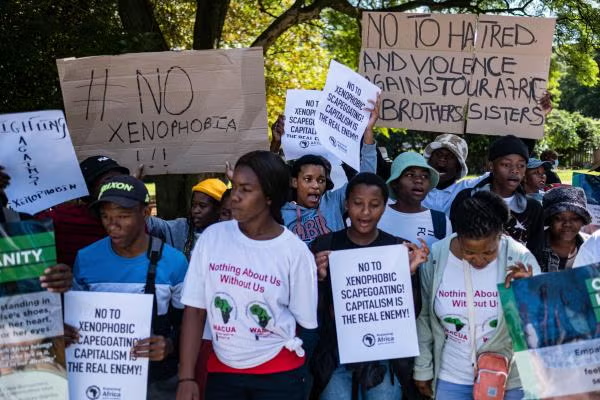
“Thousands of South Africans joined Operation Ubuntu marches today, uniting civil society, student groups, unions, and faith-based organizations to demand an end to xenophobia, land dispossession, and gender-based violence. The coalition’s message of solidarity underscores growing frustration with corruption, poor service delivery, and insecurity, pressing the government for immediate accountability.”
South Africa witnessed a powerful surge of activism today as Operation Ubuntu, a coalition of more than 60 organizations, mobilized mass protests across Johannesburg, Cape Town, and Durban. Timed to coincide with Women’s Month, the marches carried a unified message: justice, safety, and dignity for all South Africans, regardless of nationality, gender, or socioeconomic status. The demonstrations mark one of the largest coordinated civil society actions in recent years, signaling a growing demand for accountability from the government.
Background of the Movement
Operation Ubuntu emerged in response to escalating xenophobic violence, mass evictions, and rising community insecurity. Since early 2026, vigilante groups have targeted migrant communities, spreading misinformation that foreign nationals are responsible for unemployment and crime. Activists argue these narratives mask deeper governance failures such as corruption, poor service delivery, and economic stagnation. The coalition’s name, “Ubuntu,” reflects the African philosophy of interconnectedness: “I am because we are.” Organizers emphasize that South Africa’s democracy cannot thrive while vulnerable groups are scapegoated and marginalized.
Key Demands of Protesters
The coalition outlined a comprehensive set of demands:
- End Xenophobia: Immediate action against hate speech and violence targeting migrants.
- Land and Housing Justice: Rejection of the PIE Amendment Bill, which activists say enables corporate land grabs and mass evictions.
- Community Safety: Stronger policing against vigilante groups and drug lords, alongside measures to curb mass shootings.
- Gender-Based Violence: Protection of women and children, with activists declaring that “women’s safety is not negotiable.”
- Economic Justice: Ending exploitation of Africa’s mineral wealth by multinational corporations.
Voices from the Streets
In Cape Town, organizer Tauriq Jenkins declared: “None of us are free until all of us are safe.” Protesters carried placards reading “Migrants Are Human Too” and “Housing Is a Human Right.” In Johannesburg, activist Thuli Nkadimeng demanded prosecution of vigilante groups, while in Durban, women’s organizations highlighted the intersection of xenophobia and gender-based violence. These voices reflect the urgency of the movement and the breadth of its support.
Government Response
The South African Police Service (SAPS) received a formal memorandum from Operation Ubuntu, urging immediate arrests of individuals inciting violence against migrants. While officials acknowledged receipt, activists remain skeptical of government promises, citing past failures to act decisively against xenophobic attacks. The coalition insists that without concrete measures, South Africa risks further instability and erosion of democratic values.
Historical Context
South Africa has faced waves of xenophobic violence before, notably in 2008 and 2015, which left dozens dead and displaced thousands. However, the current protests differ in scale and organization. Unlike previous outbreaks confined largely to impoverished communities, Operation Ubuntu represents a broad, cross-sector coalition with national reach. This evolution suggests that activism in South Africa is entering a new phase—one that is more coordinated, intersectional, and politically assertive.
Implications for Politics
With local elections scheduled for November 2026, the protests could reshape political discourse. Analysts warn that failure to address activists’ demands may fuel populist movements exploiting anti-immigrant sentiment. Conversely, effective government engagement could strengthen democratic institutions and restore public trust. Either way, Operation Ubuntu has placed activism squarely at the center of South Africa’s political landscape.
Conclusion
Operation Ubuntu’s marches today underscore the resilience of South Africa’s civil society and its determination to confront injustice. By demanding accountability on issues ranging from xenophobia to gender-based violence, activists are not only challenging government failures but also reasserting the values of solidarity and democracy. Whether the state responds with meaningful reforms or continues to falter, the protests mark a turning point in the country’s political activism.



