




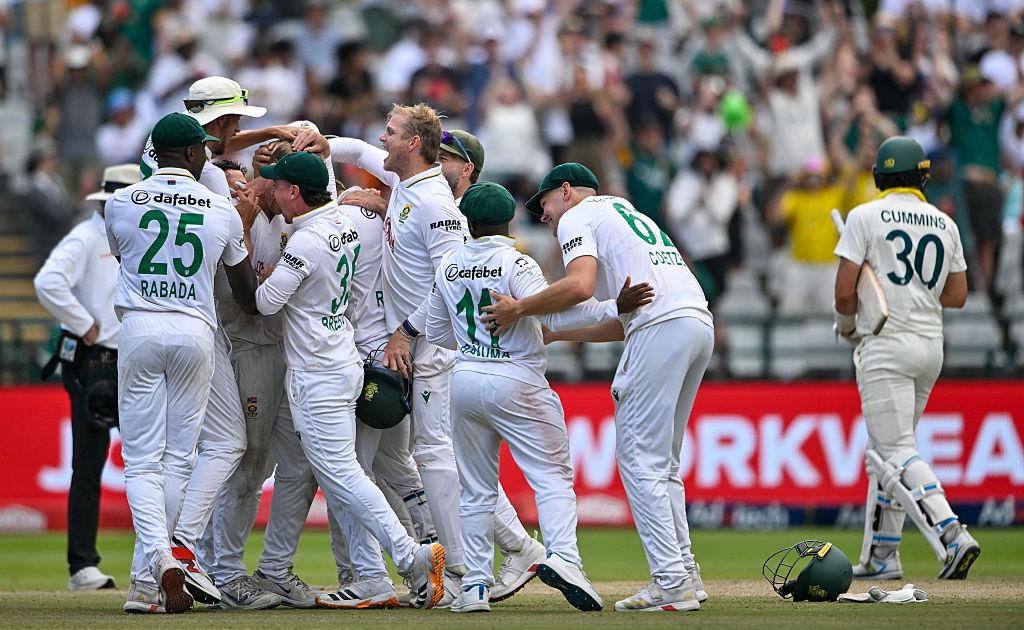
“South Africa’s Proteas Men have completed a remarkable comeback against Australia, winning the three-match Test series 2–1 after recovering from a heavy defeat in Durban to dominate the remaining two Tests. The triumph in Cape Town elevated South Africa to the No. 1 position in the ICC Men’s Test Team Rankings and strengthened their World Test Championship campaign.”
Proteas Rise to World No. 1 After Historic 2–1 Test Series Victory Over Australia
South Africa have delivered one of the most memorable performances in recent Test cricket, defeating Australia 2–1 in a dramatic three-match series and reclaiming the number one position in the International Cricket Council’s Men’s Test Team Rankings. The Proteas sealed the series with a commanding 176-run victory at Newlands Cricket Ground in Cape Town on 31 October 2026, completing an extraordinary turnaround after suffering a heavy defeat in the opening Test in Durban.
The achievement represents a significant moment for South African cricket. Under captain Temba Bavuma, the team demonstrated resilience, tactical intelligence and collective determination to overcome one of the world’s strongest cricketing nations. The victory also strengthened South Africa’s position in the 2025–2027 ICC World Test Championship cycle, as the reigning champions continue their campaign to defend their international title.
A Difficult Beginning in Durban
The Australian tour began with a difficult challenge for the home side at Hollywoodbets Kingsmead Stadium in Durban. Australia secured a convincing 214-run victory in the opening Test, placing South Africa under immediate pressure in the series.
The defeat exposed several weaknesses in South Africa’s batting performance while demonstrating Australia’s ability to capitalise on favourable situations. The visitors established an important advantage through their first-innings performance and maintained sufficient control to prevent the Proteas from recovering.
For South Africa, the opening result demanded an immediate response. The players faced the challenge of rebuilding confidence, strengthening their batting partnerships and improving their execution with the ball.
Rather than allowing the defeat to define their campaign, the Proteas responded with determination in the second Test.
Proteas Deliver Dominant Response in Gqeberha
The second Test at Dafabet St George’s Park in Gqeberha provided the turning point of the series.
South Africa produced a substantially improved performance, winning by an innings and 31 runs to level the series at 1–1. The victory demonstrated the team’s ability to respond under pressure while restoring confidence ahead of the decisive encounter in Cape Town.
The Proteas displayed greater discipline in their batting, improved partnerships and effective bowling execution. Their ability to control the match across multiple sessions prevented Australia from establishing the dominance they had enjoyed in Durban.
The victory also reinforced the importance of adaptability in Test cricket. Conditions, momentum and individual performances can change dramatically between matches, particularly in a long series against highly competitive opposition.
South Africa entered the final Test with renewed confidence, knowing that a victory would secure the series and deliver a significant ranking achievement.
Newlands Becomes the Stage for a Historic Finish
The third Test at Newlands Cricket Ground began on 27 October and concluded on 31 October 2026.
Australia entered the match with the opportunity to win the series, while South Africa were determined to complete their comeback. The encounter developed into a compelling contest featuring substantial batting contributions, challenging bowling conditions and changing momentum.
South Africa scored 329 in their first innings. Marques Ackerman narrowly missed a century with 95, while Aiden Markram contributed 78. Australia’s Mitchell Starc produced an outstanding bowling performance, claiming six wickets for 72 runs.
Australia responded with 429, establishing a first-innings lead of 100 runs. Josh Inglis scored 102, while Alex Carey contributed 80. Their partnership and individual performances placed the visitors in a favourable position.
However, South Africa’s second innings transformed the contest.
Rickelton and Mulder Produce Match-Changing Centuries
The Proteas began their second innings needing to overcome Australia’s advantage while establishing a competitive target.
Ryan Rickelton and Wiaan Mulder delivered crucial centuries, providing the foundation for South Africa’s recovery. Rickelton scored 101, while Mulder produced an impressive 115.
Their contributions were particularly significant because they arrived during a period when the match remained finely balanced.
The partnership helped South Africa rebuild after losing important wickets and created the opportunity to establish a challenging target for Australia’s final innings.
Marques Ackerman also contributed 62 runs, adding valuable support to the recovery.
South Africa eventually reached 387, setting Australia a target of 288 runs for victory.
The target created a compelling final-day contest. Australia possessed experienced batters capable of pursuing challenging totals, while South Africa had an opportunity to exploit the pressure of a series-deciding fourth innings.
Kagiso Rabada Changes the Match in the Opening Over
The decisive fifth day began with Kagiso Rabada delivering an extraordinary opening spell.
Australia’s pursuit quickly deteriorated as Rabada removed Matt Renshaw and Marnus Labuschagne in the opening over. Renshaw was dismissed for a duck, while Labuschagne fell for four.
The opening breakthrough placed Australia under immediate pressure and transformed the atmosphere at Newlands.
Rabada continued attacking the Australian batting lineup, combining pace, movement and relentless accuracy. Travis Head became another important casualty, falling to a catch by Marco Jansen at gully.
The dismissal also marked Rabada’s 350th Test wicket, an important milestone in his international career.
He became the fastest bowler to reach the landmark in terms of deliveries bowled, completing the achievement in 13,808 balls.
Rabada’s contribution was not simply statistical. His opening spell established the conditions for South Africa’s victory by removing key Australian batters before they could settle into the chase.
Simon Harmer Completes Australia’s Collapse
After Rabada’s devastating opening, Simon Harmer assumed responsibility for dismantling the remaining Australian batting lineup.
The experienced off-spinner produced a remarkable performance, claiming six wickets for just 16 runs in 21.1 overs during the second innings.
His bowling combined accuracy, flight and the ability to exploit the conditions at Newlands.
Australia struggled to establish meaningful partnerships as Harmer repeatedly challenged the batters. Alex Carey, Cooper Connolly and Mitchell Starc were among the players dismissed during the collapse.
Cameron Green attempted to resist the South African attack, contributing 27 runs from 110 deliveries. However, Harmer eventually defeated him with a delivery that turned sharply and struck the stumps.
Australian captain Pat Cummins also attempted to defend his wicket, scoring 11 from 90 balls. Harmer eventually trapped him leg before wicket.
Josh Hazlewood was bowled shortly afterwards, completing the innings and securing South Africa’s victory.
Australia were dismissed for 111, losing the Test by 176 runs.
Harmer finished with match figures of 10 wickets for 120 runs, recording his first ten-wicket haul in Test cricket.
South Africa Reclaim the Number One Ranking
The victory elevated South Africa to the number one position in the ICC Men’s Test Team Rankings, replacing Australia at the summit.
The achievement reflects the team’s consistency, resilience and ability to perform under pressure.
South Africa had previously reached the top position in 2016. Their return to the summit in 2026 provides further evidence of the team’s competitiveness across the longest format of international cricket.
The series also strengthened South Africa’s World Test Championship campaign. As defending champions, the Proteas remain focused on maintaining their performance across the remaining fixtures.
The Australian series demonstrated that South Africa can recover from setbacks and compete effectively against elite opposition.
Marco Jansen’s All-Round Excellence
Marco Jansen played an important role throughout the series, contributing with both bat and ball.
His performances included valuable wickets, important runs and influential fielding contributions.
Jansen was named Player of the Series after accumulating 198 runs and 13 wickets across the three Tests.
His versatility strengthened South Africa’s balance and provided captain Bavuma with additional tactical options.
The performances of Jansen, Rabada, Harmer, Rickelton and Mulder highlighted the depth of talent available to the Proteas.
Rather than relying exclusively on one player, South Africa benefited from contributions across several departments.
Australia Face Questions Following Defeat
Australia’s series loss represents a significant setback for the visitors.
The team began strongly in Durban but struggled to maintain consistency across the remaining matches.
Their batting performances in Gqeberha and Cape Town proved particularly damaging. Australia were dismissed for 99 in the second innings of the second Test and 111 in the final innings of the third Test.
These collapses prevented the visitors from converting favourable situations into victories.
Captain Pat Cummins acknowledged that Australia had failed to give themselves a sufficient opportunity to win the final match.
The defeat also ended Australia’s long-standing dominance at the top of the Test rankings.
However, the series provided valuable lessons for the visitors regarding batting discipline, adaptability and the importance of maintaining partnerships under pressure.
Significance for South African Cricket
The series victory carries considerable importance beyond the immediate sporting result.
South Africa’s success demonstrates the value of developing a balanced team capable of performing in different conditions.
The Proteas displayed strong batting depth, an effective pace attack and the ability to exploit spin-friendly conditions.
Their performances also reinforced the significance of leadership and collective responsibility.
Captain Temba Bavuma’s role in guiding the team through a difficult opening defeat was particularly important. The squad responded positively to the challenge and maintained its focus throughout the series.
The victory also generated renewed enthusiasm among supporters, particularly following the dramatic conclusion at Newlands.
For South African cricket, maintaining this momentum will be essential as the team prepares for upcoming international assignments.
Looking Ahead to Bangladesh
South Africa’s next major Test assignment is against Bangladesh, with the first match scheduled for 15 November 2026 at the DP World Wanderers Stadium in Johannesburg.
The second Test will take place at SuperSport Park in Centurion from 23 to 27 November.
Cricket South Africa announced a 15-player squad on 2 November, with Bavuma retaining the captaincy.
Tony de Zorzi returns following recovery from a hamstring injury, while Zubayr Hamza has also been included. Anrich Nortje returns after recovering from a groin injury.
Lungi Ngidi remains unavailable while continuing his rehabilitation.
The Bangladesh series presents South Africa with another opportunity to strengthen their position in the World Test Championship and demonstrate that their Australian victory was part of a sustained period of excellence.
Conclusion
South Africa’s 2–1 Test series victory over Australia represents a remarkable achievement in international cricket.
After losing the opening match in Durban, the Proteas responded with victories in Gqeberha and Cape Town, demonstrating resilience and determination.
The final Test showcased outstanding performances from Kagiso Rabada and Simon Harmer, whose bowling contributions proved decisive. Meanwhile, Ryan Rickelton and Wiaan Mulder delivered crucial centuries that established the winning target.
The victory restored South Africa to the number one position in the ICC Men’s Test Team Rankings and strengthened their World Test Championship campaign.
With Bangladesh arriving in November, the Proteas now have an opportunity to build on their success and maintain their position among the world’s leading Test teams.
The Newlands triumph will remain an important moment in South African cricket, reflecting the team’s ability to overcome adversity, deliver exceptional performances and achieve success on the international stage.



