




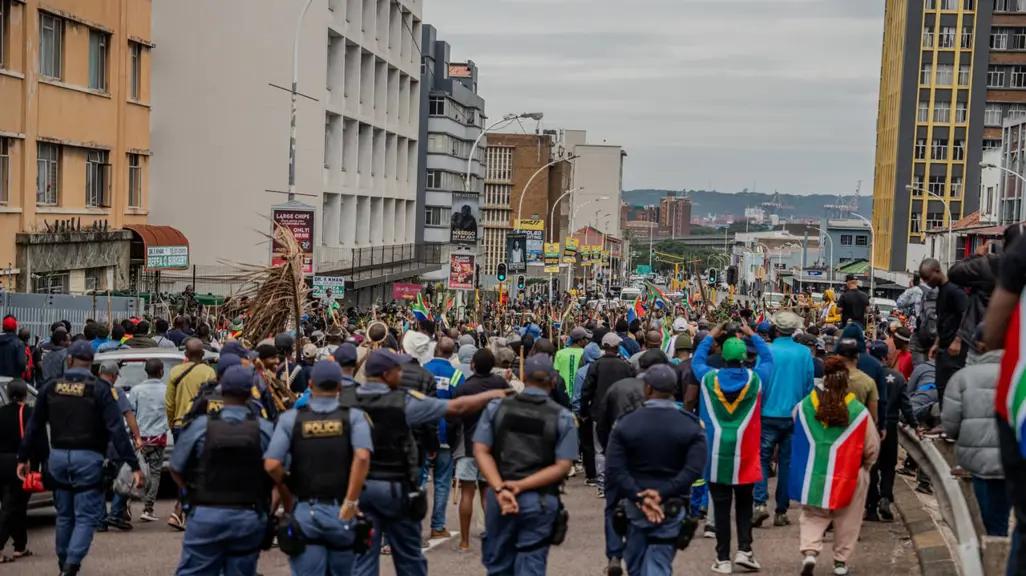
“President Cyril Ramaphosa has authorised the deployment of 510 South African National Defence Force members to KwaZulu-Natal to support police operations amid anti-immigration protests and concerns about further violence in Durban. The deployment, which is expected to cost R34 million and continue until 30 November 2026, highlights growing concerns about public safety, misinformation, the protection of foreign nationals and the responsibility of government to address community grievances through lawful means.”
South Africa deploys 510 soldiers to KwaZulu-Natal as anti-immigration activism intensifies
Government turns to military support as tensions rise
South Africa has entered another critical moment in its ongoing debate over immigration enforcement, constitutional rights and the limits of political activism. President Cyril Ramaphosa’s authorisation of 510 South African National Defence Force (SANDF) members to support police operations in KwaZulu-Natal signals the seriousness with which the government is treating the risk of further unrest linked to anti-immigration protests.
According to Eyewitness News, the deployment is expected to cost approximately R34 million and is scheduled to continue until 30 November 2026. It forms part of Operation Prosper, an ongoing joint security operation, and is intended to assist law enforcement in maintaining public order and responding to potential flare-ups in Durban.
The decision follows weeks of demonstrations, confrontations and public debate about undocumented migration and access to South Africa’s asylum system. Although activists have raised concerns about border management, public services and the government’s ability to enforce immigration legislation, some demonstrations have been accompanied by serious violence, including attacks on property and foreign nationals.
The military deployment therefore raises an important political question: how can a democratic government respond to genuine public dissatisfaction while protecting constitutional rights, preventing vigilantism and ensuring that vulnerable communities remain safe?
How the protests escalated
The latest wave of unrest intensified in early October, when groups opposed to undocumented immigration demonstrated in Durban and Johannesburg’s Soweto township. Protesters objected to the processing of asylum applications following a Constitutional Court judgment delivered in July 2026.
Reporting by Al Jazeera on 8 October documented vehicles being set alight and foreign-run businesses being forced to close during demonstrations in the two urban centres. Police reported that 14 vehicles were torched in Durban and 10 in Soweto. The unrest was accompanied by concerns about looting, intimidation and the safety of people conducting ordinary business.
These incidents illustrate how political activism can change character when demonstrations move from expressing grievances to threatening people or destroying property. Peaceful protest is an important democratic mechanism, allowing communities to challenge government decisions and demand accountability. However, the use of violence against individuals because of their nationality or perceived immigration status raises a different set of legal and ethical issues.
The developments also demonstrate the influence of organised movements in shaping the national immigration debate. Groups such as March and March and Operation Dudula have mobilised supporters around demands for stricter immigration enforcement. Their activities have brought questions about undocumented migration into public discussion, while also attracting criticism from human-rights organisations over intimidation and actions targeting migrants.
The challenge for the authorities is to distinguish between peaceful political participation and criminal conduct without treating all protesters as responsible for the same actions.
The court judgment at the centre of the dispute
The Constitutional Court ruling has become a central issue in the political confrontation.
In an official briefing on 8 October, the government’s Inter-Ministerial Committee on Migration explained that the judgment concerned provisions of the Refugees Act that prevented some people from accessing the asylum process because of procedural requirements. These included circumstances involving irregular entry, the absence of an asylum transit visa or failure to report to a refugee reception office within a prescribed period.
The court found that such procedural barriers could prevent asylum claims from being properly assessed on their merits. The ruling did not automatically grant refugee status, permanent residence or citizenship to everyone who entered the country. Instead, it required eligible claims to be considered through the established legal process.
An asylum application is a request for protection, not an automatic approval of that request. Authorities retain responsibility for examining applications, determining whether applicants meet the relevant legal requirements and enforcing immigration law in accordance with constitutional and statutory obligations.
Nevertheless, the government’s implementation of the ruling created administrative pressure. The Department of Home Affairs reported that refugee reception offices were overwhelmed by the number of people seeking access to the application process. This operational strain contributed to public concern and intensified political pressure on officials to explain how the asylum system would function.
The situation demonstrates the importance of clear public communication when court judgments have major practical consequences. In an environment of high unemployment, limited resources and distrust of public institutions, inaccurate claims can spread rapidly and increase tensions.
Misinformation and the politics of immigration
Ramaphosa has attributed part of the unrest to misinformation surrounding the court judgment. The government’s clarification sought to counter claims that the ruling granted undocumented foreign nationals blanket amnesty or automatically entitled them to remain permanently in South Africa.
The episode shows how information can influence political mobilisation. When a complex legal decision is reduced to an inaccurate claim, public discussion may shift away from the actual ruling and towards fear, anger and demands based on misunderstandings.
This does not mean that every concern expressed by protesters is insincere or that immigration management should be excluded from political debate. Border control, administrative efficiency, employment opportunities, housing and the capacity of public services are legitimate matters for democratic scrutiny.
However, political leaders and campaign organisers have a responsibility to distinguish verifiable evidence from speculation. Similarly, government departments must communicate policy changes in language that ordinary residents can understand, especially when changes affect communities already concerned about economic insecurity.
The government faces a difficult balancing act. It must demonstrate that immigration legislation is enforced, that asylum applications are handled fairly and that public resources are administered effectively. At the same time, it must explain why access to a lawful application process is not equivalent to automatic permission to remain in the country.
Without that clarity, public frustration can become easier to exploit, increasing the risk of confrontation between communities.
Human rights and the safety of foreign nationals
The violence associated with the protests has raised serious concerns about the safety of foreign nationals living and working in South Africa. Human Rights Watch warned in May 2026 that anti-immigration activism had been accompanied by intimidation, attacks and discrimination against African and Asian migrants. The organisation called on authorities to protect those at risk and hold perpetrators accountable.
These concerns are especially significant because a person’s nationality or immigration status does not remove the obligation of the state to protect them from violence. Even where an individual has violated immigration rules, enforcement must follow the law rather than be delegated to vigilante groups.
The recent unrest has also affected business owners, employees, families and residents who depend on functioning local economies. When shops close because of threats, workers may lose income, customers lose access to goods, and neighbourhoods experience further economic disruption. Fear can also discourage migrants from seeking help from public institutions, potentially making it harder for police and other authorities to address crime.
For South Africa, the stakes extend beyond the immediate security situation. The country has a history of xenophobic violence, including major outbreaks in 2008 and subsequent episodes in later years. The latest developments reinforce concerns that unresolved economic grievances can become entangled with hostility towards foreign communities.
Civil society organisations advocating for migrant rights have condemned violence while emphasising that public concerns must be addressed through lawful democratic processes. Their position highlights a central principle: protecting migrants and improving immigration enforcement are not necessarily competing objectives. Both require effective institutions, reliable information and consistent application of the law.
What the military deployment means
The deployment of 510 soldiers is intended to strengthen support for police in KwaZulu-Natal. Under the announced arrangements, the military personnel are expected to assist with maintaining order and remain available if further unrest occurs. The operation is scheduled to run until the end of November, with an estimated cost of R34 million.
Nevertheless, deploying soldiers cannot resolve the underlying political and social issues on its own. Security operations may help authorities respond to immediate threats, but lasting stability depends on effective policing, credible immigration administration, cooperation with community leaders and prosecution of crimes.
The government must also ensure that security interventions remain lawful, proportionate and subject to appropriate oversight. Public confidence depends not only on whether the authorities restore order, but also on whether they protect residents consistently and respect the rights of peaceful demonstrators.
Parliamentary oversight of the deployment is therefore important. Representatives should be able to scrutinise the operation’s objectives, expenditure, duration and results. Transparent reporting would help the public understand whether the intervention is improving safety and whether the resources committed are achieving their intended purpose.
The political challenge facing South Africa
The protests expose a broader problem for South African political leadership: the gap between public expectations and the perceived performance of government institutions.
High unemployment, inequality, concerns about crime and dissatisfaction with public services create fertile ground for political mobilisation. When residents believe that authorities are unable to manage borders or enforce legislation effectively, movements promising decisive action can attract support.
However, blaming entire national or ethnic communities does not provide a sustainable solution to these problems. Government must investigate specific allegations, publish reliable information, strengthen administrative capacity and enforce the law consistently.
Political parties and civil society also have a role in ensuring that immigration debates remain evidence-based. They can organise peaceful demonstrations, challenge government decisions, propose legislative reforms and hold officials accountable without encouraging attacks on individuals.
The coming weeks will test whether national and provincial authorities can prevent renewed violence while restoring confidence in the asylum system and immigration enforcement. The response will need to combine immediate public safety measures with longer-term institutional reforms.
Conclusion: Activism must remain within democratic boundaries
The authorisation of 510 soldiers to KwaZulu-Natal marks a significant response to South Africa’s escalating immigration-related tensions. It reflects the government’s concern about further unrest, but it also underscores the limits of relying on security deployments to address deeper political grievances.
Peaceful activism remains an essential part of South Africa’s democracy. Citizens must be able to demand better border management, question government decisions and campaign for policy changes. Equally, foreign nationals must be protected against intimidation, discrimination and violence, while asylum applications and immigration cases are handled through lawful procedures.
The most sustainable response requires accurate public communication, effective administration, accountable policing and meaningful engagement with affected communities. Government must demonstrate that it can enforce immigration laws without undermining constitutional protections.
Ultimately, the success of the deployment should not be measured solely by whether further demonstrations are prevented. It should also be measured by whether people can live and work safely, whether public institutions regain credibility and whether political disagreement can be expressed without violence.
South Africa’s challenge is to uphold both public order and democratic freedoms. Meeting that challenge will require more than soldiers on the streets: it will require institutions that work, leaders who communicate honestly and communities that pursue their concerns through peaceful and lawful means.



