




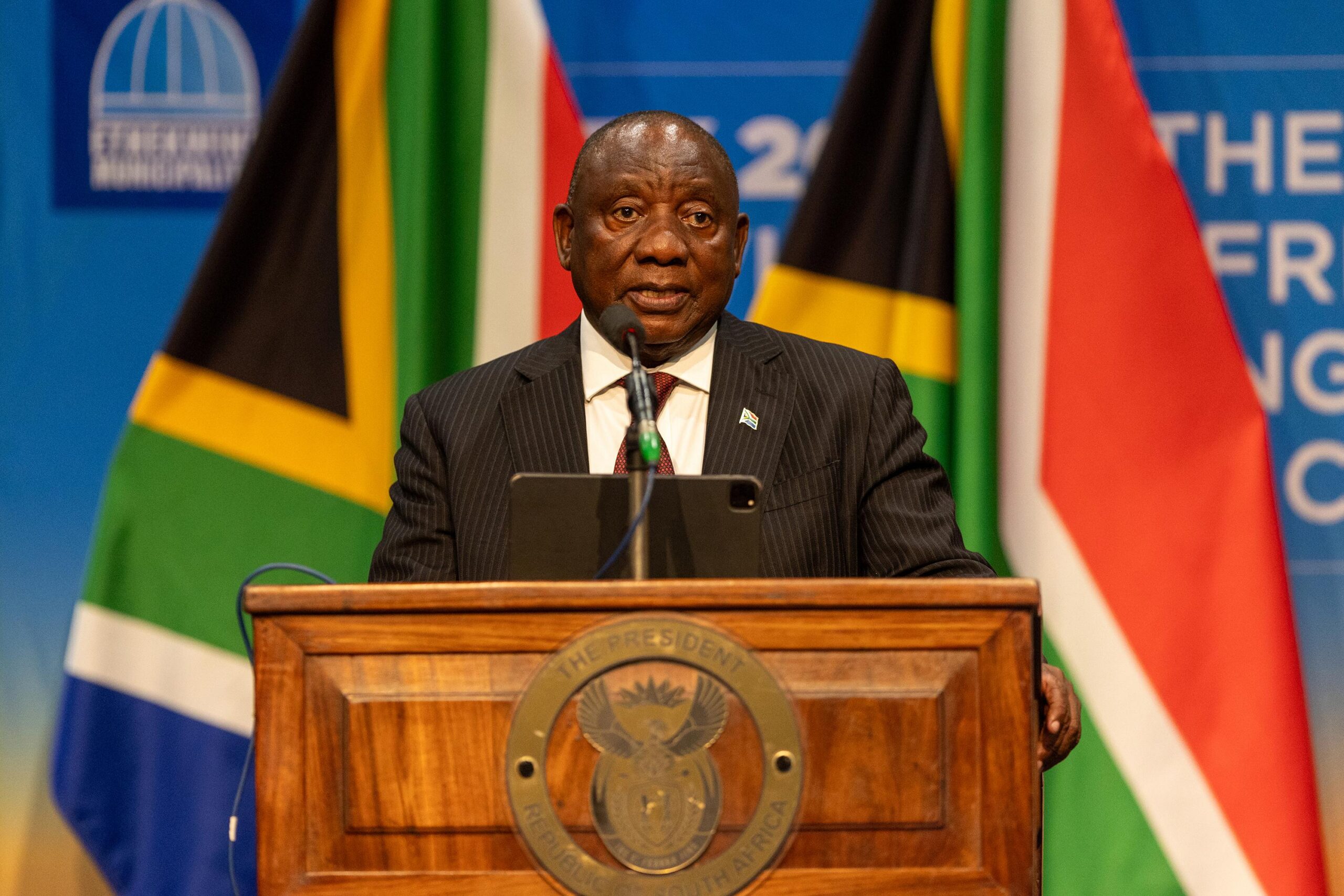
“South African President Cyril Ramaphosa has pledged that the government will protect lives, property and the right to conduct lawful business amid protests and violence associated with illegal immigration. His remarks, delivered at a Durban business gathering, place the rule of law, public safety, government accountability and the protection of economic activity at the centre of the country’s current governance debate.”
Ramaphosa Pledges Government Action to Protect Businesses and Uphold the Rule of Law in South Africa
South African President Cyril Ramaphosa has reiterated the government’s responsibility to protect lives, property and lawful commercial activity amid renewed tensions surrounding undocumented immigration and protests in parts of the country. Speaking at the Durban Chamber of Commerce and Industry’s 170th anniversary gala dinner on Wednesday evening, 28 October, the president condemned violence and attacks on businesses, emphasising that economic prosperity depends on social stability and respect for the rule of law.
The remarks bring governance, law enforcement, public safety and economic stability into sharp focus as South Africa approaches its local government elections scheduled for 4 November 2026. They also raise questions about how national and provincial authorities will respond to community grievances while ensuring that constitutional rights and legal protections apply to everyone.
Government responsibility and the protection of lawful business
According to reporting by SABC News, Ramaphosa stated that the government would take the necessary steps to protect people and their property and safeguard the right to conduct lawful business. His comments followed reports of violence, intimidation and attacks on commercial premises amid protests linked to immigration concerns.
The government’s responsibility in this situation extends beyond issuing public statements. It includes ensuring that police respond appropriately to reported crimes, that investigations are conducted professionally and that victims can access the justice system without discrimination.
For businesses, the immediate concern is whether owners, workers, customers and suppliers can operate without fear of intimidation or property damage. Shops and other commercial premises depend on predictable operating conditions. When violence disrupts trading, the consequences can include lost income, interrupted employment, damaged stock and reduced access to essential goods in affected neighbourhoods.
The impact can extend to local communities, particularly where small businesses provide employment and essential services. Restoring public confidence therefore requires authorities to demonstrate that unlawful conduct will be investigated and addressed through established legal processes.
Ramaphosa’s remarks underline the government’s stated position that grievances about immigration cannot justify criminal acts. The distinction is important in a constitutional democracy: people can raise concerns about public services, border management, employment and immigration administration, but the resolution of those concerns must remain within the law.
Constitutional rights and the limits of protest
South Africa’s governance framework recognises the importance of public participation and peaceful protest. Demonstrations allow citizens to communicate dissatisfaction, draw attention to community problems and demand responses from public institutions.
However, peaceful protest does not provide immunity for violence, threats, intimidation, looting or damage to property. Public authorities must protect the rights of demonstrators while also safeguarding the rights and physical security of other people.
The current tensions illustrate the practical difficulty of balancing those responsibilities. Authorities must distinguish between peaceful participants expressing legitimate concerns and individuals suspected of committing criminal offences. A blanket response that treats every protester as a criminal would undermine legitimate civic participation, while a failure to address violence could leave communities and businesses exposed.
The government’s response will consequently be assessed through its actions as well as its statements. Relevant measures include transparent communication, proportionate policing, lawful arrests where evidence supports them, fair investigations and access to judicial oversight.
The constitutional principle of equality before the law is especially significant where disputes involve people of different nationalities or immigration statuses. Immigration status may have legal consequences, but it does not remove the state’s responsibility to protect individuals against violence or to investigate alleged crimes fairly.
Legal action and the role of the courts
SABC News reported that Police Minister Feroz Cachalia had approached the courts seeking an urgent interdict against March and March and its leaders, including Jacinta Ngobese-Zuma. According to the report, the application seeks to prevent marching activities, intimidation and disruption at state institutions, including hospitals and Home Affairs offices. The matter was expected to be heard in the Durban High Court on Friday, 30 October.
The application represents an important test of how the state uses legal mechanisms to manage public demonstrations. An interdict is a court order intended to prevent or restrain specified conduct when the legal requirements are satisfied. It is not the same as a general prohibition on expressing political opinions or raising concerns about government policy.
The court will need to consider the application and the relevant legal arguments before any conclusions can be drawn about the relief sought. Until a ruling is issued, the requested restrictions should not be described as an established court order.
This distinction matters for accurate public information. Government officials, protest organisers, journalists and members of the public should differentiate between allegations, applications, judicial findings and enforceable orders.
The proceedings also demonstrate the role of the judiciary in a constitutional system. Courts provide a mechanism for resolving disputes about rights, public safety and lawful conduct. Their independence enables legal questions to be considered according to evidence and applicable law rather than solely through political pressure.
Immigration concerns and community relations
Immigration remains a contentious public issue in South Africa, where concerns about employment, public services, documentation and law enforcement frequently feature in political debate. These concerns require evidence-based policy responses and effective public administration.
The government must address unlawful immigration through established legal procedures, including appropriate border management, documentation systems and immigration enforcement. At the same time, claims about crime, employment or pressure on public services need to be assessed carefully rather than used to justify collective blame against foreign nationals.
Violence against people because of their nationality or perceived immigration status threatens social cohesion and can damage relations between communities. It can also create uncertainty for businesses that employ foreign nationals or depend on regional trade and supply networks.
The responsibility for managing immigration does not rest exclusively with police. It also involves Home Affairs, border authorities, local administrations and other institutions responsible for documentation, service delivery and enforcement. Coordination between these bodies is essential if public concerns are to be addressed consistently.
Public communication is equally important. Unverified information can heighten tensions, especially when claims about court decisions or immigration rules circulate rapidly through social media. Government departments should provide clear explanations of relevant laws and administrative decisions, while media organisations should distinguish verified facts from speculation.
Community leaders and civil society organisations can also contribute by encouraging peaceful engagement, reporting threats and supporting dialogue between residents, authorities and affected businesses.
Security measures and public accountability
The security situation has required additional attention from national authorities. The Associated Press reported on 28 October that Ramaphosa had authorised the deployment of 510 soldiers to KwaZulu-Natal following violence associated with anti-immigration tensions. The soldiers were to support police operations rather than replace ordinary policing.
uch deployments raise governance questions about operational coordination, public expenditure, the limits of military support and accountability for conduct during security operations. Any deployment must operate within its legal mandate, with responsibilities clearly allocated between the military and civilian law-enforcement agencies.
Police remain central to crime prevention, investigation and the maintenance of public order. Military support cannot substitute for effective criminal investigations, functioning courts or reliable public administration.
Authorities should communicate the objectives and duration of security measures clearly, subject to legitimate operational requirements. They should also provide appropriate mechanisms for reporting misconduct and investigating allegations of excessive force or other unlawful behaviour.
These safeguards help ensure that emergency responses remain compatible with democratic principles. Security measures can address immediate risks, but sustainable stability depends on institutions that operate lawfully, professionally and transparently.
Governance, economic confidence and the business environment
Ramaphosa’s address to the Durban business community also connects public safety with broader economic governance. Businesses need confidence that contracts, property rights and lawful commercial activities will be protected. Persistent insecurity can increase operating costs, discourage investment and interrupt employment.
The concern extends beyond the businesses directly affected by protests. Suppliers, transport operators, employees and customers may all experience the consequences of disruption. In areas where small enterprises are important sources of household income, repeated incidents can weaken local economic activity.
However, protecting business interests must not mean disregarding peaceful protest or legitimate public grievances. Effective governance requires authorities to protect commercial activity while maintaining access to democratic participation and ensuring that public institutions respond to community needs.
A credible response should therefore combine appropriate policing with administrative improvements. If communities raise concerns about immigration enforcement, officials should explain the applicable rules and demonstrate how complaints are investigated. If residents raise concerns about public services or employment, responsible departments should provide evidence, identify their responsibilities and communicate realistic measures for improvement.
This approach can help prevent public frustration from becoming a recurring source of confrontation.
The wider challenge of institutional accountability
The current debate takes place against broader concerns about the strength of South Africa’s governance institutions. In a report published on 28 October, Reuters cited a Business Leadership South Africa assessment warning that the country faces a risk of returning to the Financial Action Task Force’s grey list. The assessment placed the country’s anti-corruption reform score at 51.2, while the overall reform index rose to 72.5.
The grey-listing concern is a separate issue from the Durban protests, but it illustrates the wider importance of credible law enforcement, successful prosecutions and institutional accountability. Weaknesses in investigations and the recovery of criminal assets can affect confidence in the state’s capacity to enforce the law.
These issues should not be conflated: the reform assessment does not establish that the protests caused weaknesses in anti-corruption performance. Rather, both developments highlight different aspects of the relationship between effective institutions, public confidence and economic stability.
Governance requires more than announcing new measures. It requires implementation, monitoring, transparent reporting and consequences where misconduct is established. Independent oversight and functioning courts help establish whether official decisions comply with the law.
Local elections place service delivery in focus
The approaching local government elections add another dimension to the debate. Municipalities are responsible for important local functions, including aspects of infrastructure, planning, waste management and service delivery. Their performance influences how residents experience government in their daily lives.
Parliament has recently highlighted the revised White Paper on Local Government as a framework intended to address structural weaknesses, strengthen financial sustainability and clarify the relationship between political leadership and professional administration. The parliamentary committee also stressed the importance of measurable improvements in basic services.
Although municipal service delivery and immigration-related violence are distinct policy areas, both demonstrate why residents need institutions that respond predictably to public concerns. Effective local governance depends on accountable leadership, capable administration and cooperation between national, provincial and municipal authorities.
Voters approaching the 4 November elections can examine how candidates propose to address public safety, municipal performance, infrastructure and community relations. Assessing specific commitments alongside documented records can help residents understand the practical choices before them.
Conclusion: Turning commitments into measurable action
Ramaphosa’s pledge to protect lawful business and uphold the rule of law places the government’s response to public disorder under scrutiny. The central question is how effectively the stated commitment will be translated into consistent policing, fair legal processes, protection for affected communities and clear communication.
The legal proceedings concerning proposed restrictions on protest activity must follow the judicial process, while security operations should remain accountable and within their lawful mandates. Immigration administration also requires practical improvements that address documented problems without legitimising discrimination or collective punishment.
For businesses and residents, the immediate priority is safety and the restoration of normal daily activity. For government, the longer-term task is to demonstrate that constitutional rights, public order and accountable administration can be maintained together.
South Africa’s governance institutions will ultimately be judged by their conduct: whether violence is investigated, whether people can exercise their rights peacefully, whether businesses can operate safely and whether public officials explain and implement their decisions transparently. Those outcomes, rather than statements alone, will determine how far the government’s commitment strengthens public confidence.



