




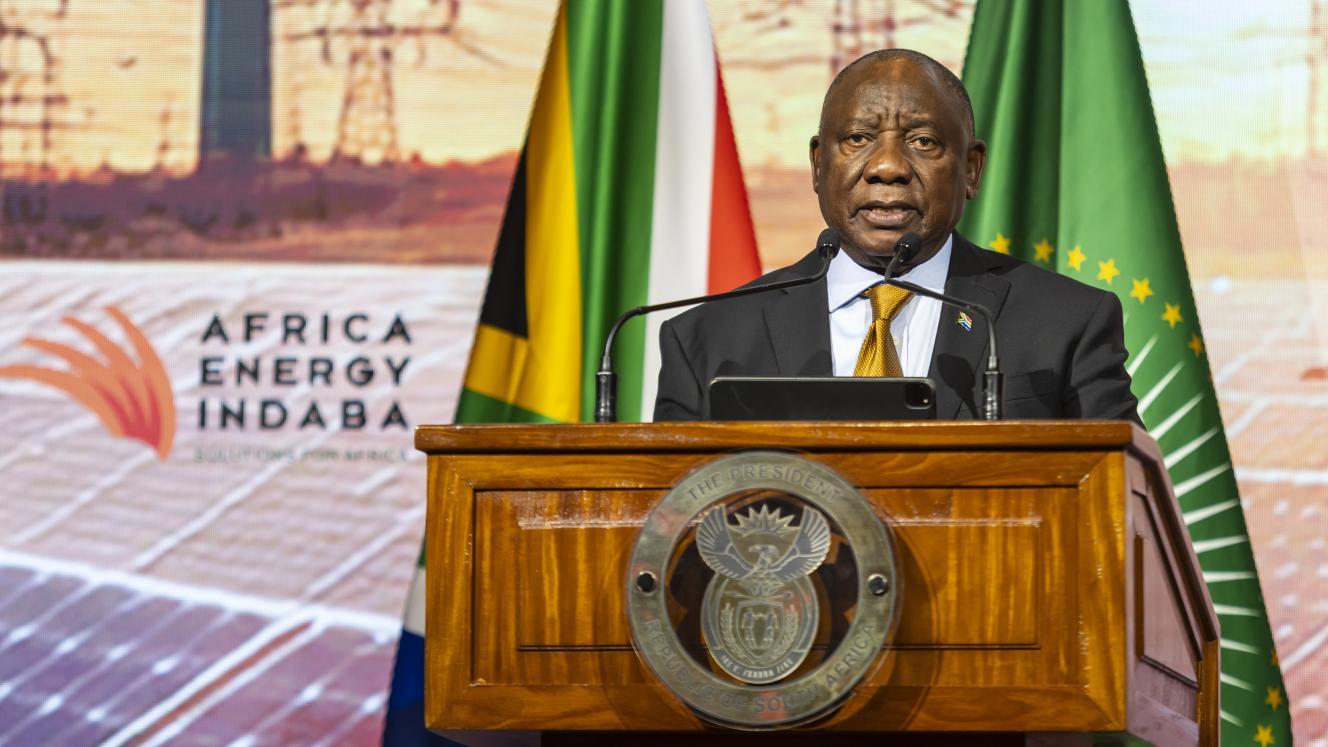
“President Cyril Ramaphosa has highlighted progress in South Africa’s structural economic reforms, particularly in the electricity sector, where government has opened the way for 4,600MW of battery energy storage and 5,000MW of gas-fired electricity generation. The developments form part of wider efforts to strengthen electricity supply, attract private investment, expand generation capacity and establish a more competitive electricity market.”
South Africa accelerates energy reforms as government advances battery storage, gas power and electricity market transformation
South Africa is accelerating efforts to transform its electricity sector as government advances major reforms aimed at strengthening energy security, attracting private investment and supporting long-term economic growth. President Cyril Ramaphosa has highlighted significant progress under the second phase of Operation Vulindlela, with developments in electricity generation, battery energy storage, gas-fired power and transmission infrastructure emerging as important components of the country’s energy strategy.
The announcement comes at a time when South Africa’s electricity system is showing signs of operational recovery following years of severe power shortages and widespread load-shedding. Government says the country has gone more than 550 consecutive days without load-shedding, while Eskom’s generation performance has improved considerably compared with 2022.
One of the most significant developments is a ministerial determination issued in October that creates a pathway for 4,600 megawatts (MW) of battery energy storage and 5,000MW of gas-fired electricity generation. These developments are expected to contribute to a more diversified electricity system capable of responding to changing demand, renewable energy variability and the country’s future industrial requirements.
Government places electricity reforms at the centre of economic recovery
Speaking in the National Council of Provinces, Ramaphosa reported progress across the second phase of Operation Vulindlela, the government’s structural reform programme.
According to the President, 60% of the programme’s 30 reform actions are either complete or on track. Another 30% are progressing, while the remaining 10% require targeted intervention.
The programme seeks to remove structural barriers that have restricted investment, economic expansion and employment creation. Energy is among its most important priorities because unreliable electricity has historically affected manufacturing, mining, agriculture, transport, small businesses and household livelihoods.
The government’s approach increasingly recognises that electricity security requires more than repairing existing power stations. It also requires investment in new generation technologies, stronger transmission infrastructure, effective regulation and greater participation by independent electricity producers.
The proposed expansion of battery storage and gas-fired generation therefore represents part of a wider transformation rather than an isolated infrastructure announcement.
Battery storage becomes a major energy investment priority
The planned 4,600MW battery storage capacity represents an important development in South Africa’s efforts to modernise its electricity system.
Battery energy storage systems can capture electricity when generation is plentiful and release it when demand increases or other generation sources become less available. This makes storage particularly valuable as solar and wind power become increasingly important contributors to the national electricity supply.
Solar generation is strongest during daylight hours, while electricity demand patterns can extend into the evening. Wind generation also changes depending on weather conditions. Consequently, electricity storage can help balance supply and demand by making renewable electricity available at different times.
For South Africa, this capability could improve the effectiveness of renewable energy investments while reducing pressure on conventional power stations during periods of higher demand.
Battery storage can also provide services such as frequency regulation and rapid response to changes in grid conditions. These services are important because electricity systems must maintain a continuous balance between electricity supplied and electricity consumed.
However, delivering 4,600MW of storage capacity will require substantial investment, appropriate procurement arrangements, suitable locations and connections to the national grid.
Government will also need to ensure that storage projects are commercially viable and supported by clear rules governing electricity trading, grid access and revenue arrangements.
The ministerial determination establishes an important policy pathway, but it should not be interpreted as confirmation that all the proposed battery capacity has already been financed, constructed or connected.
Gas-fired power forms part of the electricity diversification strategy
Alongside battery storage, government has opened the way for 5,000MW of gas-fired electricity generation.
Gas power is expected to provide another source of flexibility within the electricity system. Unlike solar and wind facilities, gas-fired plants can generally be dispatched when electricity is required, subject to fuel availability and plant operating conditions.
This flexibility could help balance fluctuations in renewable generation and support electricity supply during periods when demand rises.
South Africa’s energy strategy has increasingly involved discussions about the role of natural gas in supporting the transition towards a more diversified electricity mix.
Nevertheless, the proposed gas capacity raises important questions concerning fuel supply, infrastructure development, affordability and environmental sustainability.
Gas-fired power stations require reliable fuel sources and appropriate transportation or import infrastructure. Developing these systems could involve substantial investment in pipelines, storage facilities and liquefied natural gas import terminals.
A related development was reported on 23 November, when Reuters reported that a consortium led by Vitol’s Engen unit expected to begin construction in late 2028 on a South African liquefied natural gas-to-power project valued at approximately R40-billion.
The report did not specify the project’s location, generation capacity or expected completion date. Nevertheless, it illustrates the growing interest in gas-related energy infrastructure in South Africa.
The long-term success of gas-fired generation will depend on whether government and investors can establish dependable fuel supplies at prices that remain affordable for electricity consumers.
Eskom’s recovery creates opportunities for economic growth
Another important part of the country’s energy developments is Eskom’s improving operational performance.
Government reports that the electricity utility has recorded more than 550 consecutive days without load-shedding. Its planned performance has also improved by approximately 15 percentage points since 2022, while the utility has recorded two consecutive years of profitability.
These improvements are significant because electricity shortages previously forced many businesses to operate generators, reduce production, change working hours or postpone investment decisions.
According to Eskom’s November 23 update, its year-to-date Energy Availability Factor had reached 68.13%. The utility also reported approximately 4,274MW of surplus capacity above current electricity demand.
Furthermore, average unplanned outages had decreased by 7,090MW. Eskom attributed these developments to sustained improvements under its Generation Recovery Plan.
The stronger operating position could create opportunities for electricity-intensive industries, including mining, manufacturing and mineral processing.
Businesses that require dependable electricity may become more confident about expanding production and investing in new facilities.
However, maintaining this improvement will require continued maintenance, effective management of power stations, investment in infrastructure and responsible financial planning.
Renewable energy investment continues to expand
South Africa’s energy transformation is also being supported by growing private-sector participation and renewable energy installations.
Ramaphosa reported that more than 7 gigawatts (GW) of new generation capacity had been connected to the electricity grid.
In addition, households and businesses had installed more than 9GW of rooftop solar capacity. A further 36GW of projects were reportedly progressing through the grid connection process.
These figures demonstrate the growing importance of independent electricity generation.
Rooftop solar systems have become an increasingly attractive option for businesses seeking to manage electricity expenses and improve their energy security.
For industrial and commercial users, generating electricity independently can reduce exposure to interruptions and provide greater control over operating costs.
Nevertheless, renewable energy expansion creates additional requirements for electricity transmission and distribution infrastructure.
Solar and wind projects cannot always be constructed in locations where grid infrastructure has sufficient capacity. Consequently, transmission investment is essential to connect new generation facilities with businesses and households that need electricity.
The reported 36GW project pipeline therefore highlights both the investment opportunities and infrastructure challenges facing the sector.
Electricity market reforms seek to encourage competition
South Africa is also moving towards a more competitive electricity market.
Ramaphosa said that the first report on Eskom’s restructuring had been approved in August, with a detailed implementation plan being developed.
The broader objective is to stabilise Eskom’s financial position while creating the conditions for a competitive wholesale electricity market.
Under such arrangements, electricity trading can involve multiple generators and buyers rather than depending entirely on the traditional vertically integrated utility structure.
Government indicated that trading rules and the market code would be finalised in the coming months.
SAnews also reported that the competitive wholesale electricity market was moving towards an early launch in 2027, following external testing of its trading platform.
A functioning electricity market could provide independent producers with additional opportunities to sell electricity and encourage investment in generation capacity.
However, successful implementation will depend on transparent rules, fair market access, reliable settlement arrangements and effective regulatory oversight.
The transition must also protect electricity consumers from unnecessary costs while ensuring that Eskom remains financially sustainable.
Transmission infrastructure becomes increasingly important
Electricity generation alone cannot resolve South Africa’s energy challenges if the national grid cannot transport power efficiently.
Government has therefore identified transmission expansion as an important part of the reform programme.
Ramaphosa indicated that private capital would soon participate in grid expansion through the Independent Transmission Projects Programme.
He also confirmed that a detailed implementation plan for establishing an independent transmission system operator was expected to be finalised by the end of January.
The proposed restructuring seeks to separate transmission system operations from Eskom while ensuring that the utility’s financial position is not undermined.
This reform could help create a more independent and transparent framework for managing electricity transmission and connecting different generators to the national grid.
Remaining challenges include affordability and environmental sustainability
Despite the encouraging developments, South Africa still faces significant energy challenges.
Electricity infrastructure requires substantial long-term investment, and new projects must be developed without placing excessive financial pressure on households and businesses.
The expansion of gas-fired generation also raises questions about fuel security, import dependence and emissions.
Meanwhile, renewable energy development requires careful planning to address land use, grid availability, storage requirements and environmental considerations.
Eskom’s coal-fired power stations remain an important part of the electricity system, but their environmental performance continues to attract scrutiny.
The government will therefore need to balance electricity reliability, affordability, industrial development and environmental responsibilities.
In addition, municipalities must improve electricity distribution, infrastructure maintenance and financial management.
Ramaphosa indicated that proposed local government reforms would require municipal electricity and water providers to obtain operating licences and ring-fence revenue for infrastructure investment.
Conclusion
South Africa’s latest energy developments represent an important stage in the country’s efforts to build a more reliable, diversified and competitive electricity system.
The pathway for 4,600MW of battery storage and 5,000MW of gas-fired generation demonstrates government’s intention to expand flexible electricity resources while encouraging private investment.
At the same time, Eskom’s improving operational performance, growing rooftop solar installations, additional generation connections and planned electricity market reforms are creating opportunities for economic recovery.
Nevertheless, the success of these initiatives will depend on implementation. New generation projects must secure financing, obtain necessary approvals, connect to the grid and deliver electricity at sustainable prices.
For households, businesses and industries, the ultimate measure of success will be a reliable, affordable and increasingly sustainable electricity supply.
South Africa has made progress, but maintaining that momentum will require consistent investment, transparent regulation, infrastructure development and cooperation between government, Eskom, private investors and electricity consumers.
3. Energy sector implications for South Africa
The developments have implications across several important areas:
-
Electricity security: Battery storage and gas generation could improve the country’s ability to balance electricity supply and demand.
-
Business investment: Improved electricity reliability could encourage companies to expand manufacturing, mining and industrial operations.
-
Renewable energy: Additional storage and transmission infrastructure could support greater solar and wind integration.
-
Employment: Construction, engineering, maintenance and energy infrastructure projects could create employment opportunities.
-
Electricity competition: Wholesale market reforms could create opportunities for independent electricity producers and suppliers.
-
Energy affordability: The cost of new infrastructure and fuel supplies will remain important considerations for consumers.



