




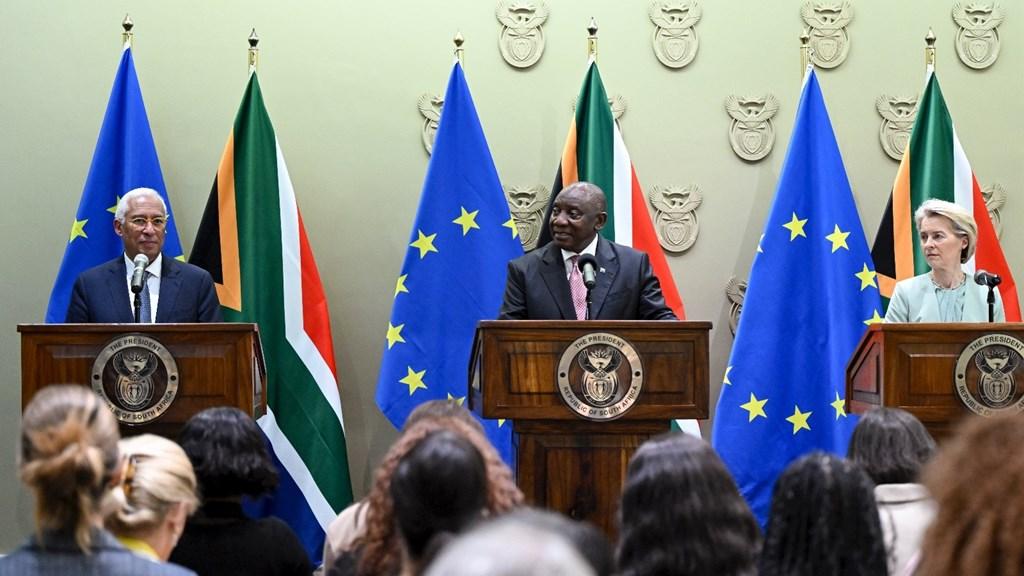
“South Africa is urging Europe and Africa to turn diplomatic commitments into practical cooperation while addressing disagreements over democracy, economic development, historical inequalities and competition for critical minerals. In a speech delivered in Pretoria on 12 October, Minister Ronald Lamola warned that unequal partnerships and great-power rivalry threaten trust, strengthening the case for cooperation based on sovereignty, mutual respect and shared economic benefits.”
South Africa Calls for a More Equal Europe–Africa Partnership Amid Global Power Rivalries
South Africa has renewed its call for a more balanced relationship between Europe and Africa, arguing that long-standing diplomatic promises must produce tangible economic and social benefits. The issue was highlighted by International Relations and Cooperation Minister Ronald Lamola in a keynote address delivered in Pretoria on 12 October 2026, in which he examined the pressures shaping relations between the two regions and the need for practical cooperation. His remarks place South Africa within a wider debate about sovereignty, democracy, development, strategic resources and the changing distribution of global power.
From diplomatic promises to practical results
Lamola’s central argument was that cooperation should move beyond declarations of shared intentions and deliver outcomes that people can see in their daily lives. For governments across Africa and Europe, this means evaluating partnerships through jobs, infrastructure, education, public services, investment and the ability of communities to benefit from economic activity. High-level meetings may establish common goals, but public confidence depends on whether those commitments are implemented.
The challenge is particularly significant in countries where unemployment, inequality and limited economic opportunity have weakened trust in political institutions. When democratic participation does not translate into improved living standards, frustration can deepen and political alternatives that reject established institutions may gain support.
Democracy, legitimacy and public trust
In his address, Lamola drew attention to concerns about democratic backsliding and the rise of misinformation and disinformation. False claims can spread rapidly when public trust is weak, making it harder for citizens to distinguish evidence from manipulation. Digital platforms and artificial intelligence can amplify this problem when used to mislead, intimidate or undermine confidence in institutions.
For South Africa and its European partners, protecting democracy therefore requires more than holding elections. It also involves strengthening independent institutions, improving transparency, defending freedom of expression and ensuring that public decisions can be scrutinised. Governments must respond to legitimate public grievances while resisting attempts to exploit those grievances through false narratives or political intimidation.
Sovereignty and the risks of great-power competition
Another major theme of the speech was intensifying competition among powerful states. Countries increasingly use trade measures, investment, technology restrictions and access to strategic resources to pursue geopolitical objectives. Lamola warned against an international environment in which rules are treated as optional, sovereignty is dismissed and negotiations become contests in which one side expects the other to submit.
For African states, this competition creates both opportunities and risks. Global demand for minerals and energy resources can attract investment, create jobs and strengthen public revenues. Yet competition can also reproduce extractive economic relationships if countries export raw materials without developing processing capacity, technical expertise and stronger domestic industries.
Critical minerals and Africa’s economic future
Critical minerals are increasingly important to technologies associated with renewable energy, electric vehicles, advanced manufacturing and digital infrastructure. Their strategic importance means that African countries could play a greater role in shaping global economic change. But resource wealth does not automatically produce broad prosperity. The benefits depend on how contracts are structured, where processing occurs, how workers are trained and whether communities receive lasting economic gains.
Lamola cautioned that competition over rare minerals could become another scramble for Africa if it is not managed with respect and prudence. The warning reflects a long-standing concern that external powers may compete for access to African resources without adequately supporting development on the continent. For South Africa and its neighbours, the priority is to attract investment while avoiding excessive dependence on any single market or geopolitical partner.
Historical grievances and unresolved tensions
South Africa’s appeal for a fairer partnership also sits within a complicated history between Europe and Africa. Colonialism, resource extraction and unequal political relationships continue to influence how cooperation is understood. Contemporary disputes over migration, trade, public health and access to technology can intensify questions about whether commitments to equality are reflected in practice.
Lamola referred to tensions exposed during the COVID-19 pandemic, including unequal access to vaccines, travel restrictions that disproportionately affected parts of the Global South and disputes over the production of generic medicines. Those experiences damaged confidence and raised questions about how international solidarity operates when national interests are under pressure.
Trade, investment and industrial development
Economic cooperation offers one of the clearest routes from diplomatic intention to practical results. Europe can remain a significant source of investment, technical expertise and market access, while African countries offer growing markets, a young workforce and opportunities in energy, infrastructure, agriculture and manufacturing. Yet trade relationships are most sustainable when benefits are widely distributed and local firms can participate.
South Africa can use its industrial capabilities and financial institutions to pursue partnerships that support production and export growth. That requires improving infrastructure, addressing energy and logistics constraints, developing workforce skills and providing predictable rules for investors. European investment can contribute, but South African institutions must ensure that projects are aligned with national priorities and produce measurable benefits.
The importance of mutual respect
A more effective Europe–Africa relationship must recognise that partners can share interests without agreeing on every policy question. South Africa’s foreign policy emphasises engagement across different international groupings and the ability to maintain relationships with countries that have different political systems. This approach can create diplomatic room for cooperation, although it also requires consistent explanations of national priorities and decisions.
Mutual respect should not mean avoiding criticism. It should mean addressing disagreements through dialogue, established institutions and evidence rather than public humiliation or demands for automatic alignment. African governments, for their part, must demonstrate that sovereignty goes together with responsible governance, transparent public administration and respect for the rights of their own citizens.
What happens next?
Lamola’s address sets out a political argument rather than announcing a single new treaty or funding package. Its significance lies in the questions it places before policymakers: how can democratic institutions regain public confidence, how can critical-mineral competition be managed fairly, and how can cooperation deliver better economic outcomes? Turning those questions into progress will require follow-up meetings, clear commitments and public reporting on implementation.
South Africa and European partners could begin by identifying a limited number of measurable priorities, such as skills programmes, clean-energy investment, mineral beneficiation, research partnerships and improved access for African products. Each initiative would need clear responsibilities, realistic timelines and transparent measures of success. Civil society, businesses, universities and local communities should have opportunities to assess whether projects meet their stated objectives.
For South Africa, the task is to preserve its policy independence while securing practical benefits from international engagement. For Europe, the challenge is to demonstrate that partnership with Africa means more than securing resources or promoting European priorities. A relationship built on mutual respect, shared value creation and accountable commitments would offer stronger foundations for both regions.
Ultimately, the message from Pretoria is that diplomatic intent must be measured by results today. Europe and Africa will not eliminate their differences, but they can manage them through honest negotiation and cooperation that improves lives. Whether the relationship becomes more equal will depend less on speeches than on the decisions, investments and institutions that follow.



