




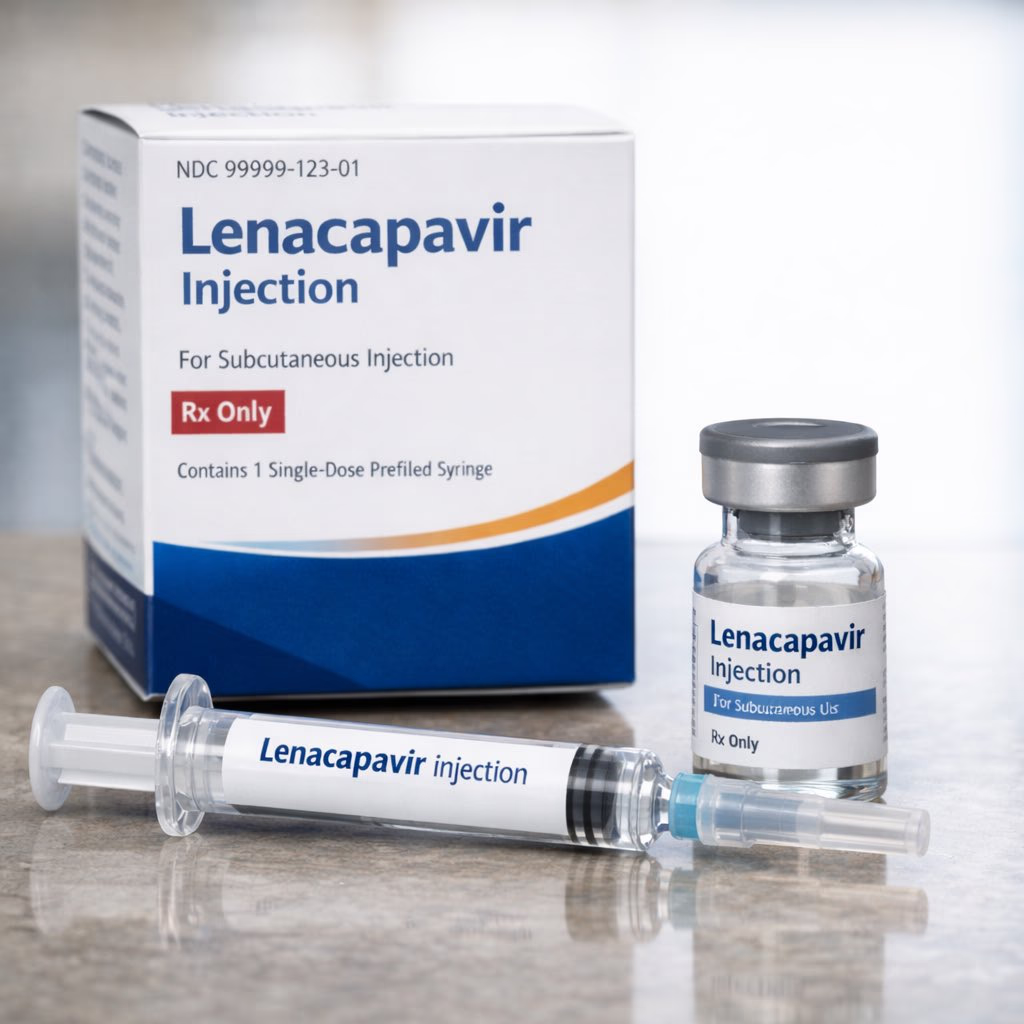
“South Africa has officially launched Lenacapavir, a revolutionary HIV prevention injection requiring only two doses per year, marking a major milestone in global HIV prevention. Backed by international funding and local manufacturing initiatives, the rollout aims to reach millions of citizens by 2027, offering hope in a country with the world’s highest HIV burden.”
South Africa has taken a historic step in the global fight against HIV with the official rollout of Lenacapavir, a long-acting injectable drug that promises to transform prevention strategies in the country. President Cyril Ramaphosa, speaking at the launch event in Secunda earlier this month, described the introduction of Lenacapavir as “a turning point in South Africa’s national healthcare story,” emphasizing its potential to save lives and restore hope in communities devastated by HIV.
Lenacapavir, developed by Gilead Sciences, is administered just twice a year. This innovation addresses one of the most persistent challenges in HIV prevention: adherence. Traditional oral pre-exposure prophylaxis (PrEP) requires daily pills, which many patients struggle to maintain due to stigma, forgetfulness, or logistical barriers. By reducing the burden to two injections annually, Lenacapavir offers a practical, discreet, and highly effective alternative. Clinical trials conducted in South Africa and Uganda demonstrated 100% effectiveness in preventing HIV infection over six months, a result hailed as groundbreaking by researchers.
The rollout is supported by a R1.3 billion investment from the South African government, the Global Fund, and the Children’s Investment Fund Foundation (CIFF). This funding ensures that the drug will be accessible across 360 public health facilities in six provinces and 24 high-burden districts, with the ambitious target of reaching one million people by 2027 and three million within three years. Ramaphosa stressed that lifesaving medicines must not be reserved for the wealthy, pledging to expand access through affordable generics, technology transfer, and local manufacturing. This aligns with the African Union’s broader goal of producing 60% of the continent’s health products locally by 2040.
South Africa, home to over 8 million people living with HIV, continues to face one of the world’s highest burdens of the virus, with 140,000–170,000 new infections annually. The introduction of Lenacapavir could dramatically reduce these numbers if delivered equitably and at scale. Health experts, including Leila Mansoor of the University of KwaZulu-Natal, have emphasized that equitable distribution will be key to ensuring the drug’s success.
Beyond its medical impact, Lenacapavir represents a symbol of scientific triumph. Ramaphosa described it as more than just a drug, calling it “the triumph of science over despair” and “the power of innovation to save lives.” For many South Africans, the launch carries personal significance. Young people like 19-year-old Olwam Plaatjie, who participated in clinical trials, have spoken about how the drug offers freedom from the daily burden of pills and the fear of infection that has haunted communities for decades.
The rollout also highlights South Africa’s role as a leader in global HIV research and treatment. Having contributed significantly to the clinical trials that proved Lenacapavir’s efficacy, the country now stands at the forefront of implementing this breakthrough. International observers note that South Africa’s success could serve as a model for other nations grappling with high HIV prevalence.
Challenges remain, however. Ensuring consistent supply, overcoming stigma, and educating communities about the benefits of the injection will require sustained effort. Advocacy groups have already called for increased doses to meet demand, arguing that South Africa deserves more given its central role in developing the drug.
Nevertheless, the launch of Lenacapavir marks a new chapter in HIV prevention. With strong political will, international support, and scientific innovation, South Africa is poised to make significant strides toward reducing new infections and ultimately ending the HIV epidemic. As Ramaphosa declared, “Every HIV infection prevented is a life protected. A family preserved. A future secured.”



