




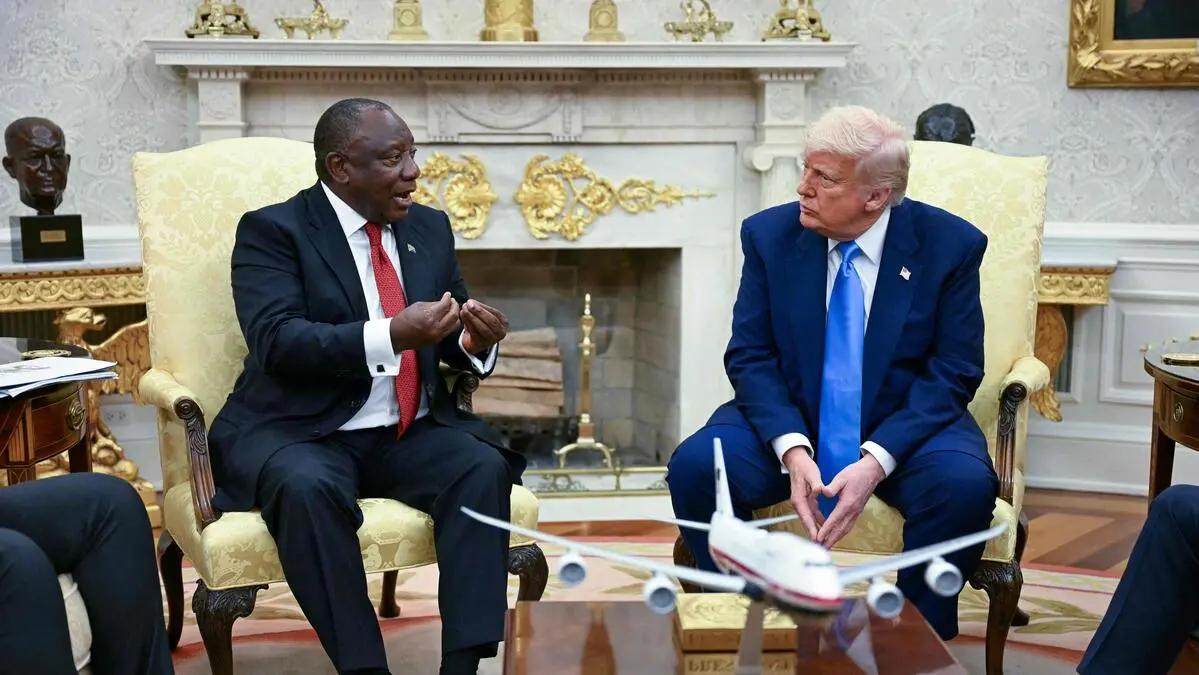
“President Cyril Ramaphosa has warned that South Africa must prepare for the possibility of losing preferential access to the US market under the African Growth and Opportunity Act, as political disagreements continue to strain relations between Pretoria and Washington. His government is pursuing negotiations with the United States while exploring alternative export markets, particularly China and India, to reduce the potential economic damage.”
South Africa–US diplomatic tensions intensify as AGOA uncertainty threatens trade and employment
Introduction: A diplomatic dispute with economic consequences
South Africa’s relationship with the United States has become a major foreign-policy challenge, placing trade, employment, investment and diplomatic independence at the centre of national debate. The latest development is President Cyril Ramaphosa’s warning that the country must prepare for the possibility of losing preferential access to the American market under the African Growth and Opportunity Act (AGOA). His remarks, reported on 19 October 2026, reflect growing concern that political disagreements could have consequences extending far beyond diplomatic exchanges.
The issue is significant because the United States remains an important economic partner for South Africa. Preferential market access helps eligible African countries export qualifying products to the American market under favourable tariff arrangements. For South African exporters, the programme has supported commercial relationships, production planning and access to customers in a major international economy.
Consequently, the possibility of exclusion presents a challenge for the government. Pretoria must try to preserve constructive relations with Washington while protecting its constitutional principles, domestic policy choices and independent approach to international affairs.
The situation also raises a broader question about South Africa’s place in an increasingly competitive international environment: how can the country maintain relationships with Western economies while expanding cooperation with China, India, BRICS partners and other developing nations?
What is at stake for AGOA?
The African Growth and Opportunity Act was established to support economic cooperation between the United States and eligible sub-Saharan African countries by offering preferential access for qualifying goods. Its benefits can help exporters compete by reducing or eliminating tariffs on covered products.
South Africa’s participation is particularly important because its economy has substantial manufacturing, agricultural, automotive and mineral-processing capabilities. Access to the US market can support businesses that have invested in production facilities, logistics, certification and long-term commercial relationships.
However, eligibility for preferential treatment cannot be treated as permanently guaranteed. Political decisions and the terms of the programme can influence the commercial environment in which exporters operate.
In October, Ramaphosa said South Africa had to prepare for a possible loss of benefits, acknowledging that such an outcome could be devastating for employment. His government was continuing discussions with American counterparts while looking for additional markets for South African goods.
The warning does not mean that exclusion has already occurred. Rather, it reflects uncertainty over the future of the trade relationship and the need for contingency planning.
For businesses, that uncertainty can be damaging in itself. Exporters must decide whether to expand production, retain workers, enter new contracts or invest in equipment without complete clarity about future market conditions. Even if preferential access ultimately continues, prolonged uncertainty can affect investment decisions.
Political disagreements complicate trade negotiations
The trade dispute cannot be understood separately from the wider political relationship. Washington and Pretoria have disagreed over South Africa’s domestic policies, its international partnerships and its positions on major geopolitical questions.
The administration of US President Donald Trump has criticised South African policies, including Black economic empowerment and land reform. It has also challenged Pretoria’s foreign-policy positions, including its legal action against Israel at the International Court of Justice and its relations with countries such as Iran.
The South African government rejects claims that its policies amount to persecution of white citizens and maintains that its domestic framework is rooted in constitutional democracy and the effort to address inequalities inherited from apartheid. International Relations and Cooperation Minister Ronald Lamola has also defended the country’s non-aligned foreign policy, while stressing that the United States remains an important partner.
These differences create a difficult negotiating environment. Trade discussions ordinarily focus on tariffs, market access, standards, investment and the treatment of particular industries. When political disagreements become intertwined with economic negotiations, however, it becomes harder for businesses and investors to distinguish commercial questions from broader strategic considerations.
South Africa’s ambassador to the United States, Roelf Meyer, described the relationship as being at a stalemate in an interview published by Semafor on 21 October. He said Pretoria had not received sufficiently clear explanations of what Washington considered inadequate in its trade proposals.
That reported concern points to a practical obstacle: negotiations are difficult to resolve when the parties do not share a clear understanding of the changes or commitments being sought.
Diplomatic protocol and national sovereignty
Relations have also been strained by disagreements over diplomatic conduct. On 30 September, South Africa summoned US Ambassador Leo Brent Bozell III for what officials described as a third formal diplomatic protest since he assumed his duties. The matter prompted concern from Parliament’s Portfolio Committee on International Relations and Cooperation.
The committee argued that foreign diplomats should respect South African law, constitutional institutions and established diplomatic channels. It maintained that disagreements over domestic policy should be raised through formal engagement rather than public commentary that might inflame tensions.
Diplomatic protests, sometimes called demarches, are formal instruments through which governments communicate objections or concerns to representatives of other states. They do not automatically mean diplomatic relations have been severed, but repeated protests can indicate a serious deterioration in trust.
For Pretoria, sovereignty is central to the dispute. The government maintains that foreign partners can question or criticise its policies, but that disagreements should be addressed through respectful negotiation.
Washington, meanwhile, has its own political priorities and concerns about South Africa’s direction. Rebuilding the relationship will therefore require more than public statements. Both governments need channels through which specific disagreements can be identified, discussed and, where possible, resolved.
The potential impact on jobs and industry
The economic implications of losing preferential trade access could be substantial, although the precise effects would depend on which products were affected, the tariffs applied and how quickly businesses could adapt.
Exporters that rely on favourable access to American customers could face higher costs. If those costs were passed on to buyers, South African products might become less competitive. If exporters absorbed them, profit margins could shrink, leaving less money available for wages, investment and expansion.
The consequences would vary between industries. Agricultural producers must manage growing seasons, perishability and strict market requirements. Automotive manufacturers operate through complex supply chains, while industrial exporters often depend on long-term contracts and substantial fixed investments.
A sudden change in trade conditions could therefore affect suppliers, transport companies, logistics providers and workers as well as the businesses directly exporting goods.
Employment is especially important in South Africa, where persistent unemployment makes the protection and creation of jobs a major policy priority. Ramaphosa’s warning reflects the concern that trade disruption could undermine businesses and employment opportunities.
Nevertheless, the full impact should not be overstated before the details of any actual exclusion or tariff changes are known. Trade outcomes would depend on the scope of the measures, the products concerned and the responses of exporters and their customers.
The government therefore faces two connected tasks: continue trying to preserve favourable access to the US market and prepare businesses for less favourable conditions if negotiations fail.
China and India emerge as alternative trade partners
As uncertainty surrounding the United States grows, South Africa is looking to diversify its international economic relationships. China and India are among the markets attracting attention as Pretoria seeks to reduce its exposure to changes in American trade policy.
China is particularly significant because of its position as a major trading partner for African economies. A zero-tariff initiative for qualifying African products has created opportunities for exporters seeking greater access to Chinese consumers. South African agricultural products, including apples and wine, have been cited among the goods benefiting from new market opportunities.
Reporting published by Reuters on 21 October also highlighted South African cherry producers’ interest in expanding exports to China. The opportunity illustrates how geopolitical tensions can accelerate the search for new customers, although agricultural exporters must still meet Chinese import requirements and establish reliable distribution networks.
India offers another potential avenue for diversification. South Africa and India have resumed discussions concerning a preferential trade agreement, creating the possibility of closer economic cooperation if negotiations produce a mutually acceptable arrangement.
However, diversifying trade is not a simple replacement exercise. Companies cannot necessarily redirect goods designed for one market to another without adjusting packaging, certification, distribution, pricing and marketing. Some products may face different technical standards or stronger competition in alternative destinations.
Moreover, expanding trade with China and India does not eliminate the value of the American market. The strategic objective is to create additional opportunities, allowing South African exporters to serve several markets rather than depend excessively on any single partner.
South Africa’s non-aligned foreign policy
The disagreement with Washington also highlights South Africa’s longstanding commitment to an independent foreign policy.
Pretoria describes its approach as non-alignment: maintaining relationships with different international powers while making decisions according to its national interests. This position allows South Africa to cooperate with Western economies while participating in BRICS and strengthening ties with other developing countries.
Lamola defended this approach during discussions hosted by the Council on Foreign Relations in September. He presented trade, investment, critical minerals and cooperation through multilateral institutions as areas where South Africa and the United States could still find common ground.
Critical minerals offer a particularly important opportunity. South Africa possesses substantial mineral resources and an established industrial base that could support processing and value addition. Partnerships in these areas could create commercial opportunities for both countries, provided agreements are transparent and economically beneficial.
The challenge is to prevent differences over geopolitical alignment from undermining areas where cooperation remains possible.
South Africa must also demonstrate that diversification produces practical results. New diplomatic relationships are valuable, but businesses need signed agreements, accessible markets, reliable infrastructure and predictable regulations. Without these foundations, political announcements may not translate into increased exports or employment.
The importance of negotiation and multilateral cooperation
Despite the tensions, the relationship with the United States is not necessarily beyond repair. Both countries have reasons to preserve constructive engagement, including commercial interests, investment opportunities and cooperation on shared international concerns.
A workable diplomatic process would require clarity about the outstanding disagreements, realistic negotiating positions and a willingness to distinguish technical trade questions from broader political disputes.
For South Africa, this means presenting clear proposals, explaining the economic effects of potential restrictions and identifying areas where mutually beneficial compromises are possible. For Washington, transparent expectations would help Pretoria understand which issues can be resolved through negotiation.
The role of diplomatic institutions is equally important. DIRCO must coordinate foreign-policy engagement, communicate South Africa’s positions and maintain appropriate channels with foreign governments. Parliament also has a responsibility to scrutinise the conduct and effectiveness of international relations.
At the international level, South Africa continues to support multilateral cooperation and reform of global institutions. Its participation in African and Global South initiatives reflects the government’s view that developing countries can strengthen their influence by negotiating collectively rather than acting entirely alone.
Nevertheless, multilateral engagement cannot remove every bilateral disagreement. South Africa will still need to manage its individual relationships carefully, particularly where trade, investment and employment are directly affected.
What happens next?
The immediate priority is to clarify the future of South Africa’s AGOA eligibility and the status of negotiations with Washington. The possibility of exclusion should be treated as a serious risk, not as an outcome that has already been confirmed.
The government will also need to assess which sectors are most exposed, consult exporters and workers, and prepare measures to help businesses adapt if market access deteriorates. Expanding trade with China, India and other partners can form part of that response, but new markets will take time to develop.
Equally, diplomatic engagement should remain active. A breakdown in communication could deepen uncertainty and make it harder to resolve both commercial and political disagreements.
For South African businesses, the coming period calls for careful planning, realistic assessments of market risks and greater attention to export diversification. For policymakers, it requires balancing national sovereignty with the practical need to preserve international partnerships.
Conclusion: A defining test for South African diplomacy
South Africa’s strained relationship with the United States represents more than a disagreement over trade preferences. It is a test of the government’s ability to protect employment, defend its policy independence and maintain productive relations with a major economic partner.
Ramaphosa’s warning about possible AGOA exclusion underscores the seriousness of the challenge. At the same time, efforts to expand trade with China and India demonstrate that Pretoria is exploring alternatives rather than relying exclusively on a single diplomatic outcome.
The most constructive path forward would combine persistent negotiations with practical economic preparation. South Africa needs clear communication with Washington, credible contingency planning for exporters and a broader strategy for developing sustainable international markets.
Ultimately, the country’s foreign-policy success will depend not simply on defending its positions, but on converting diplomatic relationships into tangible benefits for its citizens. Protecting jobs, attracting investment, expanding exports and maintaining constitutional independence will remain central measures of whether South Africa can navigate this period of international uncertainty successfully.



