




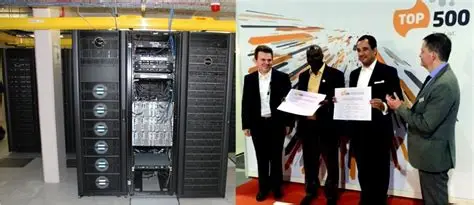
South Africa is investing R292 million to replace its Lengau supercomputer with a 4-petaflop high-performance computing system, overseen by the National Integrated Cyberinfrastructure System (NICIS). The phased rollout will begin in November 2026, with full deployment expected by March 2027, ensuring continuity for critical research across Africa.
South Africa has announced a landmark investment in computing infrastructure: a R292 million supercomputer project that will replace the country’s current flagship system, Lengau. This initiative, spearheaded by the Department of Science and Innovation (DSI) and the Council for Scientific and Industrial Research (CSIR), represents a critical step in maintaining South Africa’s competitiveness in global research and innovation.
Background: The Legacy of Lengau
Lengau, launched in 2016, was once the most powerful supercomputer in Africa. Named after the Setswana word for “cheetah,” it delivered 1.3 petaflops of performance and supported diverse applications, including:
- Weather and seismic modeling
- Drug discovery and genomics
- Fluid dynamics and computational chemistry
- Astronomy projects like the Square Kilometre Array (SKA) and MeerKAT telescope
During the COVID-19 pandemic, Lengau played a vital role in genomic sequencing of SARS-CoV-2, underscoring its importance in public health research. However, after a decade of service, it has become a “legacy environment,” prompting the urgent need for replacement.
The New Supercomputer: Technical Leap
The upcoming system will deliver 4 petaflops of compute power, making it 300% more powerful than Lengau. This leap will enable South Africa to:
- Handle big data analytics at unprecedented speed
- Advance artificial intelligence (AI) research in healthcare, manufacturing, and public services
- Support climate modeling and renewable energy innovation
- Strengthen biotechnology and genomics research
The phased installation ensures continuity:
- Phase 1: Operational by November 2026
- Full deployment: Completed by March 2027
Strategic Importance
This investment aligns with South Africa’s Decadal Plan (2022–2032), which prioritizes science, technology, and innovation (STI) as drivers of economic growth. By upgrading computing infrastructure, South Africa aims to:
- Raise gross expenditure on R&D to 1.5% of GDP
- Develop high-level skills through initiatives like the Presidential PhD Programme
- Forge public-private partnerships in STI-intensive sectors
- Position itself as a hub for innovation-led industrialization across Africa
Challenges and Delays
Despite the excitement, challenges remain. Reports indicate that components worth R500 million have been sitting in storage at the CSIR for over a year due to delays in site readiness, procurement, and governance. These delays highlight the complexity of deploying such advanced infrastructure while ensuring Lengau remains operational during the transition.
Economic and Social Impact
The new supercomputer is expected to:
- Enhance scientific competitiveness across Africa
- Support innovation in renewable energy, reducing reliance on fossil fuels
- Strengthen pandemic preparedness through advanced biomanufacturing and genomic analysis
- Provide equitable access to computing resources for researchers in both urban and rural communities
Global Positioning
South Africa’s investment is not just domestic—it is about strengthening partnerships across Africa and the Global South. By aligning with transformative technologies such as quantum computing, biotechnology, and green energy, the country aims to establish itself as a global leader in innovation.
Conclusion
The deployment of a R292 million supercomputer marks a turning point in South Africa’s computing landscape. While challenges in deployment remain, the project promises to revolutionize research capacity, drive innovation, and reinforce South Africa’s role as a continental leader in high-performance computing.



