




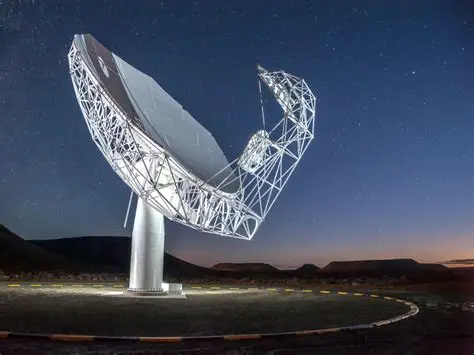
“Astronomers using South Africa’s MeerKAT radio telescope have discovered the most distant hydroxyl megamaser ever detected, located in a violently merging galaxy over 8 billion light-years away. This discovery provides unprecedented insight into galaxy interactions and extreme star-forming environments during the universe’s “toddler” stage.”
South Africa has once again demonstrated its growing importance in global astronomy. The MeerKAT radio telescope, located in the Karoo region, has achieved a groundbreaking discovery: the detection of the most distant hydroxyl megamaser ever observed. This signal, originating from a galaxy merger more than 8 billion light-years away, represents a new frontier in radio astronomy and offers scientists a rare opportunity to study the early universe.
What is a Hydroxyl Megamaser?
A hydroxyl megamaser is a naturally occurring “cosmic laser” that emits powerful radio waves. Unlike ordinary masers found in nearby galaxies, megamasers are millions of times more luminous. They are typically associated with galaxies undergoing violent mergers, where intense star formation and turbulent environments amplify radio emissions.
The newly detected megamaser is extraordinary not only for its luminosity but also for its distance. At over 8 billion light-years away, the signal allows astronomers to peer back in time, observing the universe as it was when it was less than half its current age.
The Role of MeerKAT
MeerKAT, operated by the South African Radio Astronomy Observatory (SARAO), is one of the most advanced radio telescopes in the world. Its wide bandwidth and sensitivity enabled the detection of this rare signal in just five hours of observation — a feat that would normally require hundreds of hours.
The discovery was further aided by gravitational lensing, a phenomenon where massive objects bend and magnify light from distant sources, boosting the signal enough for detection.
Scientific Significance
This detection is more than just a record-breaking achievement. It provides critical data about:
- Galaxy evolution: The merging galaxy offers clues about how galaxies interacted and evolved in the early universe.
- Star formation: The extreme environments revealed by megamasers highlight the conditions under which stars were born billions of years ago.
- Cosmic history: Observing signals from 8 billion years ago helps scientists reconstruct the timeline of the universe’s development.
Voices from the Research Team
Dr. Thato Manamela, a postdoctoral researcher at the University of Pretoria, emphasized the importance of the discovery: “We are seeing the universe as it was in its toddler years. These signals give us a window into a time when galaxies were far more chaotic and dynamic than they are today.”
Professor Roger Deane, director of the Inter-University Institute for Data Intensive Astronomy, added: “This is a new frontier in space research. The ability to detect such distant signals demonstrates the power of MeerKAT and South Africa’s leadership in radio astronomy.”
South Africa’s Growing Role in Space Science
This achievement underscores South Africa’s rising stature in global space exploration. The country has invested heavily in astronomy infrastructure, with MeerKAT serving as a precursor to the Square Kilometre Array (SKA) — the world’s largest radio telescope project, which will further expand humanity’s ability to study the cosmos.
South Africa’s geographic location, clear skies, and technical expertise make it an ideal hub for deep-space research. The discovery of the hydroxyl megamaser adds to a growing list of scientific milestones achieved by the nation’s astronomers.
Broader Implications
- International Collaboration: The discovery strengthens South Africa’s partnerships with global institutions, positioning the country as a key player in space science.
- Technological Innovation: Advances in radio astronomy contribute to broader technological development, including data processing and signal analysis.
- Educational Impact: Breakthroughs like this inspire the next generation of scientists and highlight the importance of investment in science education.
Conclusion
The detection of the most distant hydroxyl megamaser is a landmark achievement for South Africa and the global scientific community. It not only expands our understanding of the early universe but also showcases the capabilities of the MeerKAT telescope and the dedication of South African researchers.
As preparations continue for the Square Kilometre Array, discoveries like this signal a bright future for astronomy in South Africa — one where the nation continues to unlock the mysteries of the cosmos and contribute to humanity’s quest for knowledge.



