




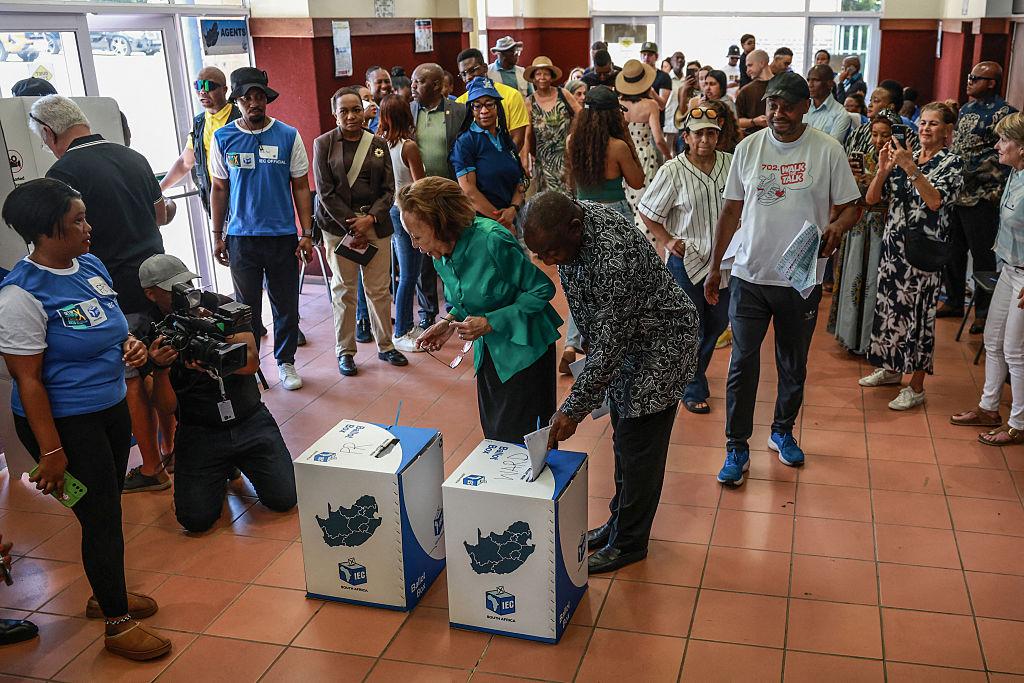
“South Africa’s ANC is heading towards its weakest municipal election performance yet, with preliminary results showing approximately 32% nationally against the Democratic Alliance’s 25% after 71% of votes had been counted. Opposition gains, particularly in major metropolitan areas, are increasing the likelihood of coalition governments and intensifying pressure on the governing party to respond to public dissatisfaction with crime, unemployment, corruption and failing municipal services.”
South Africa’s ANC Faces Historic Election Setback as Opposition Parties Gain Ground
A historic political shift emerges from municipal elections
South Africa’s African National Congress (ANC) is facing one of the most consequential political setbacks in its democratic history following the country’s 2026 local government elections. Preliminary results released on Friday, 6 November, indicate that the party is heading towards its weakest municipal election performance, as voters increasingly turn to opposition parties amid dissatisfaction with municipal services, unemployment, corruption and crime.
The emerging results represent another major challenge for the ANC, which has governed South Africa since the end of apartheid in 1994. The party previously lost its parliamentary majority in the 2024 national elections, forcing it into a Government of National Unity arrangement with the Democratic Alliance (DA) and other political parties.
According to Reuters, with approximately 71% of votes counted, the ANC had secured around 32% of the national vote, compared with approximately 25% for the DA. If these figures hold, the ANC will have lost approximately 14 percentage points compared with its already historic low performance in the 2021 municipal elections.
The results demonstrate a changing political environment in which traditional party loyalties are increasingly challenged by demands for effective governance and improved living conditions.
Voters punish municipal failures
Service delivery has emerged as one of the most important issues influencing voter behaviour during the elections.
Across South Africa, residents have expressed frustration over unreliable electricity, water shortages, deteriorating roads, overflowing sewage systems and inconsistent refuse collection.
These challenges have particularly affected major metropolitan municipalities, where ageing infrastructure, population growth and administrative weaknesses have placed considerable pressure on local governments.
Johannesburg, Pretoria and Durban have experienced recurring service delivery problems, including water interruptions, infrastructure maintenance backlogs and electricity disruptions.
Reuters reported before the elections that water infrastructure failures, unemployment, crime and housing affordability were among the principal concerns facing voters in the country’s largest cities.
For many residents, municipal elections represent an opportunity to hold political leaders accountable for the quality of essential services.
The declining ANC vote suggests that some voters are no longer prepared to support the party simply because of its historical role in the liberation struggle.
Instead, electoral decisions increasingly reflect practical concerns about whether elected representatives can improve daily living conditions.
Opposition parties strengthen their positions
The Democratic Alliance has emerged as one of the principal beneficiaries of the changing political landscape.
Preliminary results indicate that the DA is strengthening its position in several metropolitan municipalities, particularly Johannesburg, Tshwane and Ekurhuleni.
The party is also projected to retain strong control in Cape Town and the broader Western Cape.
Its electoral performance reflects an attempt to expand its political influence beyond its traditional support base while presenting itself as an alternative to ANC-led municipal administrations.
DA leaders have focused their campaigns on service delivery, municipal accountability, infrastructure maintenance and financial management.
However, the party’s ability to translate electoral gains into effective governing arrangements will depend on whether it can secure sufficient support from coalition partners in municipalities where it lacks an outright majority.
The DA has also faced the challenge of convincing voters across different communities that it can represent their interests beyond its established electoral strongholds.
The election results suggest that opposition parties are increasingly competing for voters who previously supported the ANC or remained outside the electoral process.
Johannesburg becomes a critical political battleground
Johannesburg has emerged as one of the most important political contests following the elections.
The economic centre of South Africa faces significant challenges, including water shortages, deteriorating infrastructure, unemployment and financial pressures affecting municipal services.
Preliminary results indicate that the DA has established a strong position in the city, while the ANC has experienced a substantial decline in support.
The outcome could place the DA’s Helen Zille in a position to seek the Johannesburg mayoralty through coalition negotiations.
However, securing the mayoral position will depend on negotiations with smaller political parties and the distribution of seats within the municipal council.
The possibility of cooperation between the DA and ActionSA has attracted considerable attention, although disagreements between their political leadership have complicated discussions.
The ANC may also explore alternative arrangements with other parties to retain influence in the city.
The resulting negotiations will be particularly important because Johannesburg’s municipal administration plays a significant role in the national economy.
Investors, businesses and residents depend on reliable electricity, water, transport infrastructure and municipal financial management.
The election therefore represents not only a political contest but also a critical test of whether competing parties can establish a stable administration capable of addressing the city’s challenges.
Tshwane and Ekurhuleni face coalition uncertainty
Other major Gauteng municipalities are experiencing similar political fragmentation.
In Tshwane, which includes Pretoria, the distribution of votes suggests that no single political party may secure an outright majority.
Ekurhuleni is also experiencing significant competition among political parties, with the DA strengthening its position and the ANC facing pressure.
The possibility of hung councils means that coalition negotiations will become central to municipal governance.
Political parties will need to negotiate agreements involving mayoral positions, council leadership, committee appointments and policy priorities.
Such arrangements can provide opportunities for cooperation, but they also create risks of political instability.
South Africa has experienced several municipal coalition breakdowns in recent years, with disagreements between governing partners sometimes resulting in changes of leadership and disruptions to administration.
The 2026 election results could therefore usher in another period of complicated coalition politics.
MK Party reshapes KwaZulu-Natal politics
KwaZulu-Natal has emerged as another major centre of political change.
The uMkhonto weSizwe Party (MK Party), founded by former president Jacob Zuma, has demonstrated considerable electoral strength in the province.
Its performance is particularly significant because KwaZulu-Natal was historically an important stronghold for the ANC and the Inkatha Freedom Party.
The MK Party’s rise reflects the growing influence of political movements challenging the ANC from within its traditional support base.
Preliminary results have placed the party ahead in the provincial contest, although the final distribution of seats and municipal control remains dependent on the completed count.
The municipality of eThekwini, which includes Durban, is particularly important because of its economic significance and large electorate.
The outcome could determine whether the MK Party gains substantial influence over municipal administration in the province.
Political negotiations involving the ANC, MK Party, IFP and DA are expected to shape the governing arrangements in several municipalities.
Increased turnout reflects public frustration
The elections also recorded an improvement in voter participation compared with the previous municipal contest.
According to the Mail & Guardian, more than 15.9 million South Africans participated in the 2026 elections, representing approximately 54.5% of registered voters. This compares with approximately 45.87% turnout in 2021.
The increase suggests that more voters were willing to participate in determining the future of their municipalities.
However, analysts caution that the higher turnout does not necessarily indicate a broad revival of political enthusiasm.
Instead, frustration with deteriorating services may have encouraged some residents to participate in order to express dissatisfaction with existing administrations.
The turnout figures also reveal continuing challenges in encouraging participation among younger voters.
Some young South Africans remain uncertain about which political parties best represent their interests, particularly concerning employment, education, housing and economic opportunities.
The election therefore presents political parties with an important challenge: converting increased participation into sustained engagement with citizens between elections.
ANC faces pressure to rebuild public confidence
The ANC’s declining electoral performance has intensified pressure on its leadership to reassess its political strategy.
The party has acknowledged that voter dissatisfaction contributed to its weakened position and that rebuilding public confidence will require renewed attention to governance and service delivery.
The results also raise questions about the ANC’s ability to maintain its influence ahead of the 2029 national elections.
Its loss of parliamentary dominance in 2024 already demonstrated that South African voters were increasingly prepared to support alternative political movements.
The municipal elections provide further evidence that the party’s historical dominance can no longer be taken for granted.
Political analysts have argued that the ANC must address the underlying concerns driving voter dissatisfaction rather than rely primarily on historical achievements.
This includes strengthening municipal leadership, improving accountability, addressing corruption and ensuring that public resources are used effectively.
The party’s performance in the coming months could influence internal debates over leadership, political alliances and electoral strategy.
Electoral Commission continues verification
The Independent Electoral Commission of South Africa continues to process and verify election results.
The commission has emphasised that preliminary figures should not be treated as final until the necessary verification procedures have been completed.
SABC News reported on Friday that counting had entered a critical phase, with approximately 68% of votes captured nationally at an earlier stage of the process.
The IEC has also reported progress in resolving electoral and operational complaints through its systems for managing election-related incidents.
The final results will determine the allocation of council seats and the political arrangements required to establish municipal administrations.
The verification process is particularly important in closely contested municipalities where relatively small differences in votes could influence the distribution of seats.
Coalition negotiations will determine municipal leadership
As the results become clearer, attention is increasingly shifting towards coalition negotiations.
Political parties will need to determine whether they can establish stable governing arrangements capable of surviving disagreements over policy and leadership.
The DA has indicated that coalition discussions should prioritise residents and the effective administration of municipalities.
However, ideological differences among parties could complicate negotiations.
Disagreements over economic policy, racial redress, immigration, public procurement and municipal priorities may influence which alliances become possible.
Smaller parties could also gain considerable bargaining power in councils where larger parties fall short of a majority.
The challenge will be to ensure that coalition agreements establish clear commitments to service delivery and administrative stability.
Residents will ultimately judge these arrangements according to whether they improve municipal performance.
Implications for South Africa’s democratic future
The 2026 local government elections represent a significant moment in South Africa’s democratic development.
The results suggest that political competition is becoming increasingly fragmented, with voters demonstrating greater willingness to challenge established parties.
The ANC’s declining support, the DA’s expanding influence and the emergence of parties such as the MK Party and ActionSA indicate that the country’s political landscape is evolving.
These developments may have important implications for the 2029 national elections.
Political parties will need to demonstrate that they can deliver credible policies, effective leadership and measurable improvements in people’s lives.
The elections also underline the importance of municipal governance in shaping public confidence in democracy.
Local governments are responsible for essential services that directly affect households, businesses and communities.
When municipalities fail to provide reliable services, dissatisfaction can quickly translate into electoral consequences.
Conversely, effective municipal administration can strengthen political legitimacy and encourage greater public participation.
Conclusion: A new chapter in South African politics
South Africa’s 2026 municipal elections are revealing a major shift in political power.
The ANC’s historic decline demonstrates that voters are increasingly prepared to hold governing parties accountable for their performance.
The DA’s gains, the MK Party’s strength in KwaZulu-Natal and the growing influence of smaller political parties are reshaping the country’s municipal landscape.
The immediate challenge will be to establish stable coalitions capable of addressing service delivery failures and improving public administration.
For the ANC, the elections represent a critical opportunity to confront the reasons behind its declining support and rebuild relationships with voters.
For opposition parties, the results create new opportunities to demonstrate that political alternatives can deliver better governance.
Ultimately, the significance of the elections will depend on whether the emerging political leadership can translate electoral victories into meaningful improvements in the lives of South Africans.
The results are still being verified, but one conclusion is already clear: South Africa’s political future is becoming increasingly competitive, and no party can assume permanent electoral dominance.



