




“South Africa is facing renewed macroeconomic pressure as rising international oil prices, persistent inflation and geopolitical uncertainty weigh on the rand, household purchasing power and business confidence, despite the government’s latest fiscal update offering some reassurance about public finances. The government’s temporary fuel levy reductions and improving revenue position may provide short-term relief, but the economy’s projected 1.2% growth in 2026 highlights the continuing challenge of creating jobs, stimulating investment and achieving stronger, more inclusive economic growth.”
Introduction: External shocks challenge South Africa’s economic outlook
South Africa’s economic outlook has come under renewed pressure as rising global oil prices, inflationary risks and geopolitical tensions complicate the country’s recovery. Developments reported on 25 October 2026 highlight the difficult balance facing policymakers: maintaining fiscal discipline while protecting households and businesses from escalating living costs.
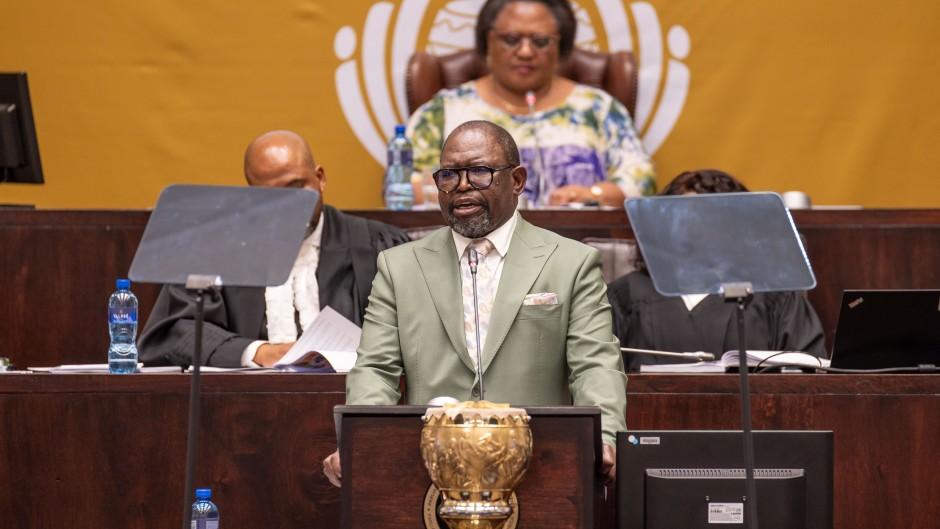
The government’s latest Medium-Term Budget Policy Statement (MTBPS), presented by Finance Minister Enoch Godongwana on 21 October, offered encouraging signals about revenue collection and the management of public debt. However, these improvements have been overshadowed by renewed uncertainty in international energy markets and concerns about the consequences for domestic prices, interest rates and economic activity.
According to The National, Brent crude oil traded at approximately $113.55 a barrel on Friday morning, while the rand stood at R16.51 against the US dollar at the opening of trading. These figures illustrated the pressures confronting South Africa as it attempts to strengthen domestic economic conditions while remaining exposed to developments beyond its borders.
Rising oil prices increase inflationary risks
International oil prices have become one of the most significant risks to South Africa’s economic outlook. Because the country imports most of its fuel requirements, changes in global petroleum prices can quickly affect domestic transport costs, production expenses and consumer prices.
When crude oil becomes more expensive, the consequences extend beyond motorists filling their vehicles. Businesses that depend on road freight, agricultural machinery, aviation, delivery services and industrial transport may face higher operating expenses. Companies can absorb some of these increases, but others pass at least part of the additional cost to customers.
Consequently, an international energy shock can affect the wider economy through several channels. Higher transport costs raise the cost of moving goods, while manufacturers and retailers may encounter increasing distribution expenses. Agricultural producers can also face pressure from fuel, logistics and other energy-related inputs.
These developments are particularly concerning when economic growth remains weak and household budgets are already under strain.
The latest reporting indicates that geopolitical tensions in the Middle East have increased uncertainty about energy supplies and contributed to higher oil prices. For South Africa, prolonged disruption could increase the national fuel import bill, put pressure on the rand and complicate efforts to contain inflation.
Inflation threatens household purchasing power
South Africa’s annual consumer inflation rate increased to 4.5% in September 2026, compared with 4.4% in August and 4.3% in July, according to Statistics South Africa, as reported by Reuters and The National.
Although the September reading was below some economists’ expectations, the direction of travel raised concerns about the months ahead. Transport inflation accelerated to 10.8% year on year, reflecting the effects of higher fuel costs. Economists warned that the substantial petrol price increase in October could push headline inflation above 5%, although that outcome remained a forecast rather than a confirmed figure.
Inflation affects households by reducing the amount of goods and services their income can purchase. When petrol, public transport, groceries and electricity-related expenses become more expensive, families may have less money available for education, healthcare, housing and discretionary spending.
Lower-income households are particularly vulnerable because necessities account for a relatively large proportion of their budgets. Even moderate increases in essential expenses can therefore force difficult financial choices.
Higher prices can also affect businesses indirectly. As consumers redirect more of their income towards necessities, demand for other goods and services may weaken. Retailers, restaurants, entertainment businesses and small enterprises can experience slower sales, potentially discouraging expansion and recruitment.
Nevertheless, not all inflation components are moving in the same direction. Reporting on September’s figures noted that food inflation remained relatively contained and rental inflation had slowed, providing some relief. The central concern is whether higher energy costs will spread into a broader range of goods and services.
The rand reflects conflicting economic signals
The performance of the rand illustrates the interaction between domestic fiscal policy and global financial conditions.
Following the presentation of the MTBPS, the currency initially benefited from investor confidence in the government’s commitment to fiscal discipline. However, renewed geopolitical concerns and rising oil prices subsequently placed pressure on the exchange rate.
At Friday’s opening, the rand traded at R16.51 to the US dollar, R22.11 to the British pound and R18.51 to the euro, according to The National. These figures are time-specific market observations rather than current live exchange rates.
A weaker rand can make imported products and inputs more expensive. This matters for fuel, machinery, electronics, pharmaceuticals and other goods purchased internationally. When import costs increase, businesses may raise prices, contributing to domestic inflation.
Currency weakness can also complicate monetary policy. If exchange-rate movements add to inflationary pressure, the South African Reserve Bank may have less room to reduce interest rates quickly.
However, exchange-rate movements do not affect every sector in the same way. Exporters can benefit from receiving foreign-currency revenues that translate into more rand, although their advantage depends on imported input costs, commodity prices and other operating conditions.
The broader issue is whether South Africa can build sufficiently strong domestic investment, productivity and export capacity to make its economy less vulnerable to repeated external shocks.
Government introduces temporary fuel levy relief
The government has responded to rising fuel costs by announcing temporary reductions in fuel levies. Reuters reported on 21 October that the relief package would cost approximately R10 billion and operate across two periods, beginning in November and continuing into early January 2027.
The initial reductions announced were R3 per litre for diesel and R1.50 per litre for petrol from 4 November to 1 December. Smaller reductions of R1.50 for diesel and R1 for petrol were scheduled to continue until 5 January.
The intervention aims to reduce immediate pressure on motorists, transport operators and businesses that depend heavily on fuel. Lower fuel levies can moderate the price paid at the pump relative to what it would otherwise have been, potentially limiting some of the pass-through from international oil prices.
Nevertheless, the relief is temporary. Its actual benefit will depend partly on movements in global petroleum prices, the exchange rate and other components of regulated fuel pricing. If international oil prices rise sharply, the levy reduction may not fully offset the increase.
There is also an important fiscal trade-off. Revenue forgone through lower levies cannot simultaneously be used for other government priorities unless additional resources are available. Policymakers must therefore balance short-term cost-of-living relief against infrastructure spending, public services and debt management.
The measure demonstrates how fiscal policy can help cushion an external shock. It does not, however, resolve South Africa’s underlying dependence on imported fuel or the structural weaknesses limiting economic growth.
Improved public finances offer some reassurance
Despite the difficult economic environment, the MTBPS provided evidence of an improving fiscal position.
Reuters reported that National Treasury identified a R54.1 billion revenue overrun, reflecting collections above previous budget expectations. The government indicated that additional resources would support infrastructure, address spending pressures, strengthen reserves and reduce debt. The consolidated budget deficit for the financial year was projected at 3.9% of gross domestic product, slightly below the 4.0% forecast in February.
These developments matter because persistent deficits and rising public debt can increase government borrowing costs and reduce the resources available for productive investment.
A stronger revenue position creates room for the government to meet some obligations without borrowing as much as it otherwise might. It can also help reassure investors that the authorities remain committed to managing public finances responsibly.
However, higher revenue alone does not establish that the economy is becoming structurally stronger. Revenue windfalls can reflect temporary commodity-market conditions or other factors that may not persist.
The Sunday Times editorial published on 25 October similarly highlighted the improvement in public finances while criticising the lack of sufficiently ambitious measures to accelerate economic growth. It noted that public debt had stabilised at around 78% of GDP and that additional revenue had helped the government finance spending priorities and temporary fuel relief.
The long-term test will be whether improved fiscal conditions support productive investment, better public infrastructure and employment rather than merely easing immediate financial pressures.
Weak growth remains the central macroeconomic challenge
The most serious underlying concern is South Africa’s subdued economic growth. Treasury’s latest outlook projected growth of 1.2% in 2026, down from the 1.6% forecast in February, according to Reuters.
Slow growth limits the pace at which businesses expand, new jobs are created and household incomes rise. It also complicates government finances because the economy generates a smaller increase in taxable activity than would occur under a stronger expansion.
The relationship between growth and employment is especially important. Businesses generally need confidence in future demand before committing to new factories, equipment, shops or additional employees. When demand is uncertain and operating expenses are rising, companies may postpone investment decisions.
Weak growth can therefore reinforce itself: limited investment restrains productivity and job creation, while weak employment growth constrains consumer spending.
South Africa needs a more durable expansion driven by productive private investment, reliable electricity, efficient transport networks, competitive industries and improved workforce capabilities. Progress in these areas could help businesses produce more efficiently and participate more effectively in domestic and international markets.
Fiscal discipline is valuable, but it cannot substitute for measures that improve the economy’s capacity to grow. Similarly, temporary fuel relief may protect spending power in the short term, yet it cannot independently generate a sustained increase in production or employment.
Business confidence and investment decisions
The pressures on the broader economy are also visible in business confidence. The South African Chamber of Commerce and Industry’s Business Confidence Index fell by 0.8 points to 134.3 in September. Despite the monthly decline, the index remained 10.9 points higher than a year earlier, according to The National.
The mixed result suggests that the business environment contains both encouraging and worrying signals. Stronger tourism, vehicle sales, retail activity and merchandise exports supported confidence, while higher energy prices, weaker import volumes and a decline in the real value of approved building plans weighed on the index.
For companies, oil-price uncertainty makes financial planning more difficult. Businesses must estimate future transport expenses, supplier charges, sales volumes and financing needs before deciding whether to hire staff or invest in new capacity.
If inflation remains elevated, interest rates could also stay higher for longer. That would increase borrowing costs for businesses and households, potentially restraining property purchases, capital expenditure and consumer demand.
Conversely, greater certainty about energy supplies, public infrastructure and fiscal policy could improve the conditions for investment. Consistent policy implementation and a more predictable operating environment would be important in converting business confidence into actual spending and job creation.
Monetary policy faces a difficult balancing act
Inflationary pressure creates a challenge for the South African Reserve Bank. If fuel prices push overall inflation higher and inflation expectations become entrenched, the central bank may need to maintain restrictive interest rates or consider further increases.
Economists quoted in the latest reporting warned that another 25-basis-point increase could be possible if inflation persists. However, the decision was uncertain, with the outlook depending on subsequent inflation readings, global energy prices and broader economic conditions.
Higher interest rates can help contain demand and prevent inflation from becoming entrenched. However, they also increase borrowing costs and can slow economic activity. This creates a difficult balance between protecting price stability and avoiding unnecessary pressure on an already weak economy.
If inflationary pressures prove temporary and underlying inflation remains contained, policymakers may have reason to avoid responding too aggressively. If higher energy costs spread broadly through prices and expectations, maintaining price stability could require a firmer response.
The trajectory of oil prices, the rand and domestic inflation will therefore be important indicators to watch over the coming weeks.
Conclusion: Fiscal stability must translate into stronger growth
South Africa enters the final months of 2026 facing a complicated macroeconomic environment. Rising international oil prices, a weaker rand and renewed inflationary risks threaten household purchasing power and business confidence, while subdued growth continues to constrain employment and investment.
The latest budget update offers reasons for cautious optimism. Stronger-than-expected revenue collection, a slightly improved deficit forecast and temporary fuel levy relief demonstrate that the government has some capacity to respond to immediate pressures.
However, these measures do not eliminate the country’s underlying economic vulnerabilities. Sustained progress will require reliable infrastructure, stronger private investment, productive job creation, effective public spending and continued fiscal credibility.
For households, the immediate priority is managing rising essential expenses. For businesses, the challenge is protecting margins while maintaining investment plans. For policymakers, the task is to prevent temporary external shocks from undermining longer-term recovery.
Ultimately, South Africa’s macroeconomic success will depend not only on stabilising public finances and containing inflation, but also on converting those gains into stronger production, better employment opportunities and more inclusive economic growth.



