




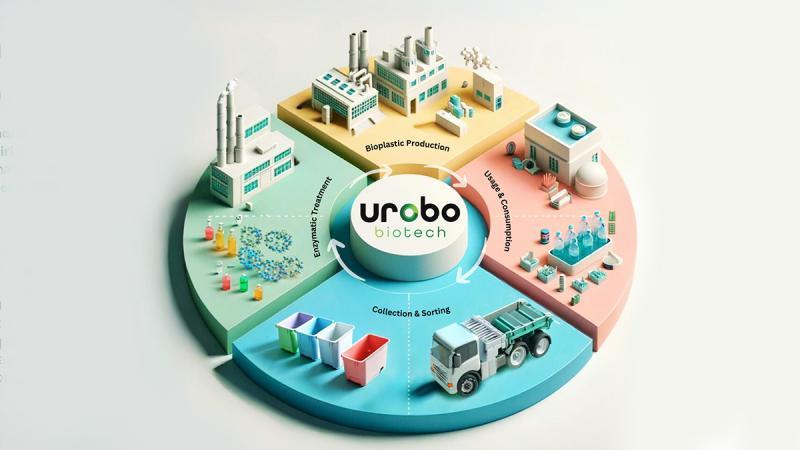
“Urobo Biotech, a Stellenbosch University spinout, has received the R100,000 grand prize at SWEAT Africa for its technology designed to use engineered enzymes and microbes to break down bioplastic waste and recover valuable chemicals. The company aims to bring its technology to South African waste-processing facilities, although commercial-scale performance and its projected environmental benefits still require further validation.”
South African Biotechnology Startup Urobo Biotech Advances Enzyme-Based Solutions for Bioplastic Waste
A homegrown biotechnology innovation targets a growing waste-management challenge
STELLENBOSCH, South Africa — A biotechnology startup originating at Stellenbosch University is seeking to change how bioplastic waste is handled, using engineered enzymes and microorganisms to transform discarded packaging into potentially valuable industrial materials.
Urobo Biotech has attracted attention for developing a process that aims to break down bioplastics within existing waste-treatment facilities. The company received a R100,000 grand prize at SWEAT Africa, a biotechnology and hard-technology pitching competition, according to a report published on 24 October 2026. Its ambition is to move beyond experimental demonstrations and establish a commercially viable approach to recovering useful resources from materials that might otherwise be discarded or incinerated.
The development highlights a broader role for biotechnology in South Africa’s environmental innovation sector. Rather than relying exclusively on conventional mechanical recycling or disposal, researchers are investigating how biological processes can help address waste-management challenges while creating opportunities for new products, industrial activity and scientific entrepreneurship.
However, the technology remains in development. Its ultimate impact will depend on whether the process can operate reliably, safely and economically at industrial scale.
Why bioplastic waste presents a growing challenge
Bioplastics are often promoted as alternatives to conventional petroleum-based plastics. Nevertheless, the term covers different materials, including plastics made partly or entirely from biological resources and plastics designed to biodegrade under specific conditions.
These characteristics are not interchangeable. A material made from plant-derived feedstocks does not necessarily biodegrade readily, while a biodegradable plastic may require particular temperatures, moisture levels, microorganisms or industrial processing conditions to break down efficiently.
Consequently, replacing conventional packaging with bioplastics does not automatically eliminate the problem of plastic waste.
Stellenbosch University has previously highlighted the difficulties associated with managing discarded bioplastics, including the risk that these materials can disrupt organic-waste processing when facilities are not equipped to handle them. The university’s research background identifies the need for better ways to manage bioplastic products at the end of their useful lives.
Waste-treatment operators can face additional sorting, processing and disposal costs when bioplastic packaging enters waste streams that were designed for other materials. If recovery systems cannot handle the incoming waste efficiently, potentially useful resources may be lost.
This creates an opportunity for biotechnology to contribute practical solutions. By using biological catalysts to break down selected materials, researchers hope to recover chemical building blocks and improve the efficiency of waste-processing operations.
For South Africa, such innovations could be relevant to municipalities, organic-waste processors, packaging manufacturers and businesses seeking more sustainable approaches to managing production and consumer waste.
How Urobo Biotech’s technology works
Urobo Biotech’s approach centres on enzymes, which are biological catalysts capable of accelerating specific chemical reactions.
Plastics consist of long molecular chains. Depending on the material, specialised enzymes can help break the chemical bonds connecting these chains, producing smaller molecules that may be suitable for subsequent processing.
According to the published report, Urobo is developing engineered enzymes that can break down bioplastic waste within a reactor integrated with existing waste-treatment infrastructure. The process is intended to reduce the need for separate sorting and washing steps in the relevant waste stream.
After the material has been broken down, microorganisms can help convert the resulting liquid into useful chemicals, including lactic acid. Lactic acid has industrial applications and can serve as a building block in the production of certain bioplastics.
The intended result is a system in which waste becomes a potential feedstock for new production instead of remaining a disposal liability.
The company’s approach also seeks to make use of infrastructure that waste operators already have. Rather than requiring every facility to construct an entirely new processing plant, the proposed system could use a dedicated reactor alongside an existing operation.
That integration could be commercially important. New environmental technologies often face significant adoption barriers because businesses must consider installation costs, maintenance, production interruptions, operational complexity and the reliability of recovered products.
A process that fits into existing infrastructure may be easier to evaluate than one requiring a complete reconstruction of a facility. Nevertheless, practical integration will depend on the composition of incoming waste, reactor performance, energy and resource requirements, and the quality of the recovered materials.
From university research to commercial biotechnology
Urobo Biotech’s development illustrates how university research can become the foundation of a commercial technology.
The company’s work grew out of research associated with Stellenbosch University and the University of Padova in Italy. The published background describes how research into enzymes capable of degrading bioplastics informed the company’s efforts to develop an industrial application.
Moving from academic research to a commercial product, however, requires more than demonstrating that an enzyme can break down a material in a laboratory.
Researchers must determine how the process performs with real waste, which may contain different types of bioplastics, food residues, contaminants and other materials. They must also establish whether the process remains effective under variable operating conditions.
A commercial system needs predictable results, manageable operating costs and appropriate quality controls. Companies must further demonstrate that the recovered chemicals can meet buyers’ specifications and be sold at a price that supports the business model.
These challenges explain why biotechnology startups often require sustained investment, access to specialised facilities and partnerships with industrial customers.
Recognition at SWEAT Africa offers Urobo visibility and prize funding as it works towards commercial deployment. However, winning a competition is an early milestone rather than proof that a technology is already operating successfully across commercial waste facilities.
The distinction matters for investors, prospective customers and public authorities evaluating emerging environmental technologies.
Potential economic and environmental benefits
If successfully commercialised, enzyme-based recycling could create benefits for both waste operators and manufacturers.
The first potential benefit is improved resource recovery. Instead of treating selected bioplastic waste solely as a material that must be disposed of, a facility could potentially convert it into feedstocks for further industrial use.
The second is the possibility of reducing disposal expenditure. Where suitable bioplastic waste currently has to be removed or incinerated, a recovery process could offer an alternative. Whether this generates savings will depend on treatment costs, equipment requirements, waste volumes and the value of the resulting products.
The third potential benefit is support for a circular economy, in which materials are recovered and returned to productive use rather than discarded after a single application.
Urobo’s published technology description also identifies the potential to integrate recovered material with anaerobic digestion processes. Under appropriate conditions, this could help facilities recover additional value from organic waste streams.
The environmental implications could be significant if the system diverts waste from disposal and reduces emissions associated with existing treatment methods.
Nevertheless, environmental performance must be measured rather than assumed. The full assessment should consider electricity consumption, water use, enzyme production, reactor operation, transport, chemical recovery and the eventual use of the recovered products.
The company has reported modelled estimates of avoided emissions and waste diversion. Those figures should be treated as projections, not as independently confirmed results from large-scale commercial operations.
A credible evaluation would compare the new process with the actual alternatives available at a particular facility, including composting, anaerobic digestion, incineration and other recycling methods.
Opportunities for South Africa’s biotechnology industry
South Africa has universities, research organisations and emerging companies working to translate biological science into practical industrial applications.
Urobo Biotech’s work reflects one way that expertise in microbiology, enzyme engineering and process development can contribute to the country’s broader bioeconomy.
A stronger biotechnology sector could create opportunities for highly skilled employment, specialist manufacturing, scientific partnerships and technology exports. It could also help local businesses develop solutions tailored to regional waste streams and industrial needs.
For these opportunities to materialise, research institutions and companies need access to funding, technical infrastructure, trained personnel and suitable commercial partners.
Entrepreneurs must also understand the markets they intend to serve. Waste operators will want clear evidence that a new process can handle their particular materials, meet operating requirements and deliver financial or environmental benefits.
Manufacturers purchasing recovered chemicals will similarly require reliable product quality and consistent supply.
Partnerships between universities, technology developers, waste-management companies and chemical producers could therefore be essential to establishing a viable market.
Public-sector support may also help, particularly where pilot projects can demonstrate performance under South African conditions. However, any support should be accompanied by transparent reporting of costs, results and environmental claims.
Scientific and commercial hurdles remain
Despite its promise, enzyme-based recycling faces technical questions that must be resolved before widespread adoption.
First, enzymes are selective. A process developed for one type of polymer may not perform equally well on another. Mixed waste streams can therefore complicate treatment and reduce predictability.
Second, biological catalysts must remain effective under practical operating conditions. Temperature, acidity, contamination and the presence of other substances can influence performance. Enzyme stability and the cost of replacing or replenishing catalysts may affect the overall economics.
Third, the recovery process must deliver products of sufficient purity and value. Producing a liquid containing chemical building blocks is not necessarily the same as producing a saleable industrial ingredient. Additional separation, purification and quality-control steps may be necessary.
Fourth, the technology must demonstrate that it can operate at scale. A successful small pilot does not automatically establish that a process will perform equally well when treating larger quantities of heterogeneous waste.
The next phase of development should therefore establish throughput, recovery rates, reliability, operating costs and environmental performance using representative waste materials.
Independent testing and transparent reporting would help potential customers and investors assess whether the process offers an advantage over established treatment options.
What the recognition means for the road ahead
Urobo Biotech’s R100,000 SWEAT Africa prize provides recognition for a South African biotechnology venture addressing a practical environmental problem. Its technology also demonstrates how research in enzyme engineering and microbial processes can generate ideas for new industrial applications.
The next important milestone is evidence of repeatable performance at a larger demonstration scale, followed by commercial deployment where technical and economic conditions support it.
For the company, progress will require balancing scientific innovation with the realities of waste-management operations. For potential customers, the central questions will concern reliability, affordability, product quality and measurable environmental benefits.
For the wider South African biotechnology sector, the project provides an example of how university research can be developed into a business seeking to address a challenge with both environmental and commercial dimensions.
The innovation should not be understood as a complete solution to plastic pollution. Reducing unnecessary packaging, designing products for recovery, improving waste collection and selecting appropriate materials remain important parts of responsible waste management.
However, better processing technologies could complement these measures by addressing materials that existing systems struggle to manage.
Conclusion: Urobo Biotech represents a promising example of South African biotechnology entrepreneurship, applying enzyme-based science to the challenge of bioplastic waste. Its long-term significance will depend on whether the company can demonstrate safe, cost-effective and environmentally beneficial performance at commercial scale.



