




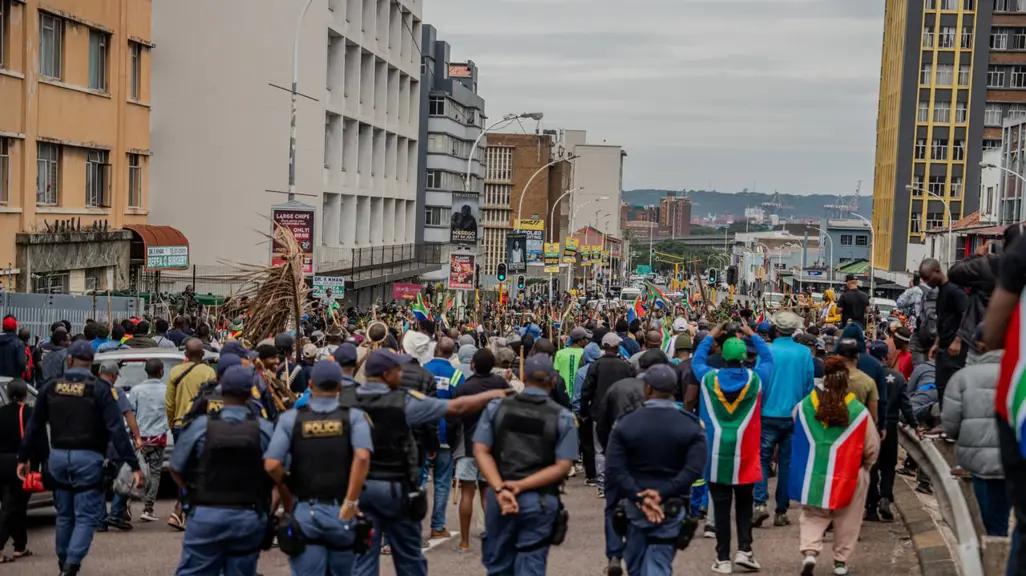
“The Siyafana Sonke Action Campaign has called for stronger police action against those allegedly responsible for violence against foreign nationals in KwaZulu-Natal, arguing that arrests made so far have not adequately addressed the people believed to have organised the attacks. The controversy highlights the difficult balance between protecting the constitutional right to peaceful protest, addressing public concerns about immigration and ensuring that migrants and other vulnerable communities are protected from violence.”
Activism, police accountability and the protection of vulnerable communities in South Africa
South Africa’s ongoing debate over immigration, public safety and constitutional rights has placed civil society activism under renewed scrutiny. Recent anti-immigration protests in KwaZulu-Natal and Gauteng have raised questions about the responsibilities of law enforcement, the limits of public demonstrations and the protection of foreign nationals facing threats and violence. At the centre of the latest developments is the demand by the Siyafana Sonke Action Campaign for police to pursue those allegedly responsible for organising violent incidents, rather than focusing exclusively on people already arrested or questioned.
According to an Eyewitness News report published on 24 October 2026, the campaign believes that police investigations have not yet adequately addressed the alleged organisers of violence against foreign nationals in KwaZulu-Natal. Police, meanwhile, have indicated that investigations remain ongoing. The disagreement highlights an important issue for political activism in South Africa: whether public pressure can help ensure accountability while also encouraging lawful, evidence-based investigations.
Civil society calls for stronger accountability
Activism plays a significant role in South Africa’s democratic system. Community organisations, advocacy groups, trade unions and human rights movements regularly challenge government decisions, demand improved services and call for authorities to address perceived injustices.
In this case, the Siyafana Sonke Action Campaign has questioned whether law enforcement efforts are sufficient to deter further violence. Its concerns reflect the wider role of civil society organisations in monitoring public institutions and demanding explanations when communities believe authorities have failed to protect people.
The campaign’s position also raises an important distinction between responding to individual offences and investigating the broader circumstances surrounding organised violence. Arresting people suspected of participating in an attack can be an important step. However, where evidence indicates that violence may have been coordinated, investigators may also need to establish whether other individuals encouraged, organised or facilitated criminal conduct.
Such allegations must be investigated carefully. A public accusation does not establish criminal responsibility, and any person suspected of an offence remains entitled to due process. Nevertheless, the demand for comprehensive investigations is a legitimate matter of public interest.
For activists, the challenge is to maintain pressure on authorities without prejudging the outcome of investigations. For police, the challenge is to demonstrate that complaints are being addressed impartially and that investigations are guided by evidence rather than political pressure.
Protests over immigration have intensified tensions
The latest calls for accountability follow a series of protests over the processing of asylum applications at Department of Home Affairs facilities. During October, demonstrations in Durban and Soweto escalated into violence, including vehicle burnings and the looting of shops belonging to foreign nationals.
South African authorities have warned that the right to demonstrate does not provide permission to destroy property, threaten residents or attack other people. Reporting by SAnews on 9 October described the police response to the unrest and outlined government efforts to clarify a Constitutional Court ruling concerning access to the asylum system.
The protests were associated with confusion surrounding a judicial decision that addressed procedural barriers preventing some people from accessing asylum procedures. Authorities stressed that access to the application process does not automatically grant refugee status, permanent residence or unrestricted permission to remain in the country.
The distinction matters because public debate about immigration can become distorted when legal procedures are misunderstood or deliberately misrepresented. People may have legitimate concerns about administrative capacity, border management, employment opportunities and the delivery of public services. However, those concerns do not justify violence against individuals based on their nationality or perceived immigration status.
Activists working on migration and human rights therefore face a difficult task: addressing public anxiety while defending the principle that everyone deserves protection from unlawful violence.
Human rights and the protection of migrants
The safety of foreign nationals has become a central concern amid reports of threats, assaults and attacks on businesses. GroundUp reported on 9 October that immigrant shopkeepers in Pretoria faced threats during anti-immigration demonstrations, including threats directed at women and children.
Such incidents demonstrate how political rhetoric can affect people who have little power to influence government policy. Shopkeepers, workers, families and other residents may become targets even when they have no involvement in the legal or administrative disputes driving demonstrations.
The protection of vulnerable communities is therefore not separate from the broader debate about public order. It is one of the responsibilities that democratic institutions must uphold while responding to public grievances.
South Africa’s constitutional framework protects equality, dignity and freedom of expression, assembly and association. These protections allow citizens to organise campaigns, criticise government policy and participate in demonstrations. At the same time, constitutional rights do not remove the obligation to respect the rights and safety of others.
A peaceful demonstration against immigration policy remains fundamentally different from a gathering where people are assaulted, threatened or prevented from accessing lawful services through intimidation.
For civil society organisations, defending peaceful activism also means rejecting violence that could undermine the credibility of their demands. Clear opposition to attacks and intimidation can help preserve the distinction between legitimate protest and criminal conduct.
Police investigations and public confidence
Police accountability is another major dimension of the unfolding controversy. When communities believe that authorities have failed to identify those responsible for violence, public confidence may weaken. This can lead to further demonstrations, demands for explanations and pressure for visible enforcement action.
However, effective policing requires more than making arrests quickly. Investigators must collect evidence, interview witnesses, examine available records and establish the circumstances of alleged offences. Suspected organisers must be identified through evidence rather than assumptions about political affiliation, community membership or public statements.
The Siyafana Sonke Action Campaign’s criticism places these questions firmly in the public debate. Its concerns should be assessed alongside the police account that investigations are continuing. The available reporting does not establish that investigators have definitively failed to identify every person responsible, nor does it establish the guilt of any individual who has not been convicted.
Independent scrutiny can nevertheless encourage transparency. Police can strengthen public confidence by communicating verified developments, explaining investigative progress where legally appropriate and treating complaints consistently.
Civil society groups can contribute by documenting incidents responsibly, supporting witnesses, reporting threats and avoiding the circulation of unverified allegations. These steps can help preserve evidence while reducing the risk that rumours will provoke further confrontations.
The influence of misinformation
Misinformation has also complicated the immigration debate. Government representatives have linked the October unrest to false claims about the Constitutional Court ruling and the legal consequences of applying for asylum.
Reuters reporting published on 9 October described how protests in Durban and Soweto turned violent amid disputes over the processing of asylum applications and government warnings about disinformation.
When legal judgments are reduced to misleading slogans, complex questions can become sources of public fear. People may incorrectly believe that a procedural change automatically grants citizenship or removes every immigration requirement. Others may share unverified claims about crime, employment or access to public services.
Activism can help counter this problem when organisations communicate reliable information, explain legal decisions in accessible language and challenge claims unsupported by evidence. Equally, activists have a responsibility to verify information before publishing it, particularly when accusations could put individuals or entire communities at risk.
Journalists, community leaders and public institutions also have a role in correcting inaccuracies without dismissing legitimate questions about immigration administration. Accurate information can make public debate more constructive and help communities distinguish between policy disagreements and incitement to violence.
Socioeconomic frustrations and political responsibility
Immigration protests also take place against the background of wider socioeconomic difficulties. Unemployment, poverty, unequal access to services and dissatisfaction with public administration can contribute to public frustration.
These problems deserve serious attention from policymakers. Communities should be able to demand effective border management, fair employment practices, functioning municipal services and transparent public administration.
Nevertheless, attributing complex socioeconomic problems to foreign nationals as a group risks overlooking the many factors that influence economic opportunity and service delivery. It can also shift attention away from the responsibilities of government institutions, employers and other decision-makers.
Political activism is most constructive when it identifies specific problems and proposes practical remedies. For example, campaigns can call for transparent immigration procedures, better-resourced administrative offices, effective action against exploitation and clearer public communication about legal requirements.
Such demands allow people to challenge policy without treating an entire population as responsible for national difficulties. They also create opportunities for engagement between residents, community organisations and government officials.
What the developments mean for South African democracy
The recent unrest presents a test for democratic participation. South Africa must protect the ability of people to organise, assemble and challenge government policy while ensuring that public demonstrations do not become vehicles for intimidation or attacks.
Civil society organisations can help maintain this balance by monitoring police conduct, supporting peaceful protest, documenting alleged abuses and insisting that public institutions explain their decisions. Their work is particularly important when vulnerable people believe they cannot safely report threats or access public services.
Government institutions, in turn, must respond to public concerns with accurate information, fair administration and consistent enforcement of the law. Ignoring grievances can deepen distrust, while responding to pressure without regard for constitutional protections can create further harm.
The current dispute also demonstrates why accountability must apply to every participant. Police should investigate credible allegations of violence, organisers should discourage unlawful conduct, public officials should communicate clearly, and individuals who commit offences should face appropriate legal processes.
No campaign’s political popularity should determine whether alleged crimes are investigated. Similarly, no person’s nationality should determine whether they receive protection under the law.
Conclusion: Peaceful activism remains essential
The calls by the Siyafana Sonke Action Campaign for stronger action against those allegedly responsible for anti-immigrant violence underline the continuing importance of accountability in South Africa. Although the latest report located for this article was published on 24 October rather than 25 October 2026, the issues it raises remain central to the country’s political and civic debate.
The immediate priorities are credible investigations, protection for threatened communities, accurate public information and a clear commitment to peaceful democratic participation. Activists must be able to challenge government policy without facing unlawful intimidation, while foreign nationals and South African residents alike must be protected from violence.
Ultimately, the strength of South Africa’s democracy will depend not on whether public disagreement disappears, but on whether disagreements can be expressed safely, investigated fairly and addressed through lawful institutions. Civil society activism can play a vital role in achieving that outcome when it combines public pressure with reliable evidence, respect for human dignity and an unwavering commitment to accountability.



