




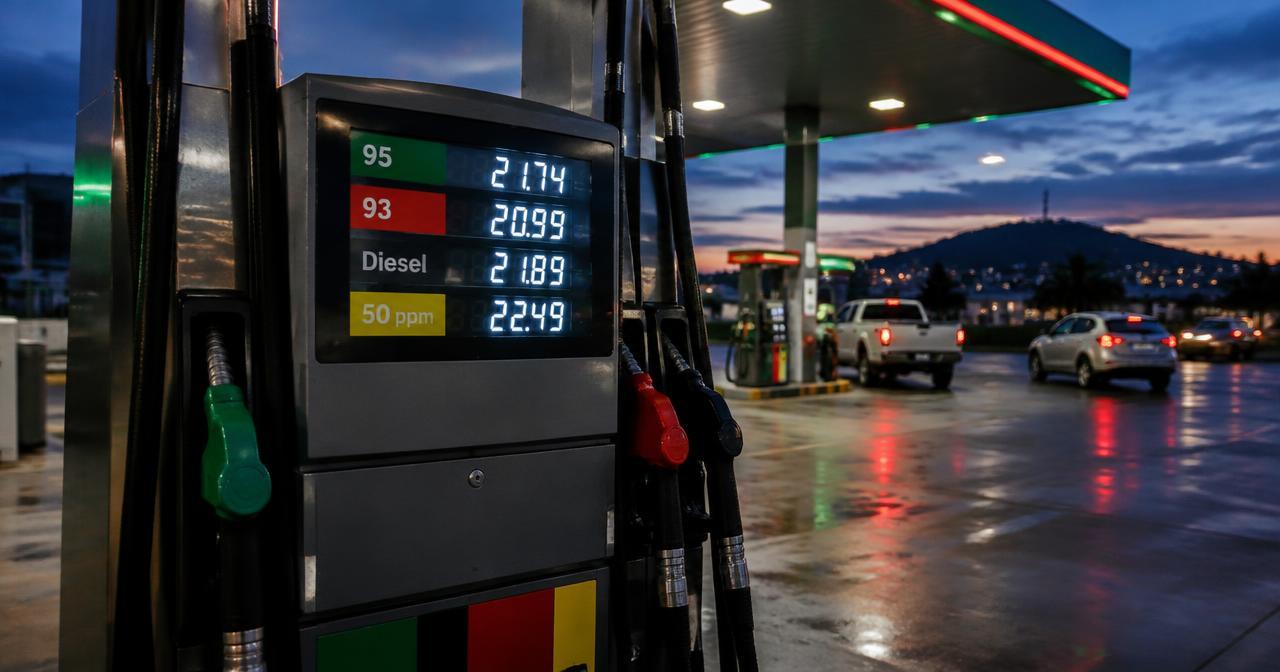
”South Africa is facing another major macroeconomic shock as petrol prices rise by more than R3 a litre from Wednesday, with 95-grade petrol reaching R30.25 a litre in inland regions, while diesel prices also climb sharply. The increase, driven primarily by higher international oil prices and global supply disruptions, threatens to push up transport, food and business costs just as the economy is dealing with weak growth and elevated inflation risks.”
South Africa’s fuel shock reaches a new economic threshold
South Africa’s economy is entering October under renewed pressure as an exceptionally large increase in fuel prices takes effect on Wednesday, 7 October. The adjustment will push inland 95-grade petrol above the psychologically important R30-a-litre threshold for the first time, marking one of the clearest signs yet of how international energy-market instability is feeding directly into household finances and domestic economic conditions.
According to the Department of Mineral and Petroleum Resources, 93-grade petrol will increase by R3.12 a litre, while 95-grade petrol will rise by R3.33 a litre. Diesel will increase by between R2.84 and R3.24 a litre, while illuminating paraffin will also become substantially more expensive.
For motorists in Gauteng and other inland areas, the new price of 95 petrol will be R30.25 a litre. At the coast, the price will rise to R29.38. Inland 93 petrol will cost R29.88, compared with R29.09 at the coast.
The significance of the increase extends well beyond motorists. Fuel is a fundamental input into transportation, agriculture, logistics, manufacturing, retail and services. Consequently, a sharp rise in petroleum prices can spread through the economy, raising operating costs for companies and eventually increasing prices paid by consumers.
That makes the October fuel increase a major macroeconomic development, rather than simply a motoring story.
International oil prices are at the centre of the shock
The immediate cause of the latest increase is the sharp rise in international oil and petroleum-product prices.
The South African government said the average Brent crude oil price increased from $87.89 to approximately $101 a barrel during the relevant review period. The department attributed the increase to continued tensions involving the United States and Iran, uncertainty surrounding oil flows through the Strait of Hormuz, higher shipping costs and declining inventories.
Because South Africa imports crude oil and finished petroleum products, international energy-market movements have a direct effect on domestic prices.
The country’s fuel-pricing system uses international prices and the rand-dollar exchange rate as important components in determining domestic fuel costs. Therefore, when crude oil becomes more expensive internationally, South African consumers can eventually experience that increase at local petrol stations.
Reuters reported that the latest increase will lift the regulated petrol pump price by as much as 12%, while wholesale diesel prices will also rise significantly.
The effect illustrates an important vulnerability in South Africa’s economy: domestic households and businesses remain exposed to developments over which the country has little direct control.
Even though the rand’s average exchange rate during the latest fuel-price calculation period was relatively stable, the sharp rise in international oil prices was more than enough to overwhelm the benefit of currency stability. The government reported that the average rand-dollar exchange rate was virtually unchanged at around R16.21 to the dollar during the review period.
The rand provides only limited protection
The currency is another crucial factor in South Africa’s macroeconomic outlook.
On Tuesday, the rand was relatively resilient despite a stronger US dollar and weaker gold and platinum prices. Reuters reported that the currency held steady early in trading even as commodity prices weakened.
That resilience is important because South Africa is heavily exposed to commodity markets. Gold and platinum are major export commodities, meaning changes in their prices can affect export earnings, the trade balance and investor sentiment.
However, currency stability cannot completely shield consumers from a global oil shock.
South Africa purchases petroleum in international markets, where transactions are heavily influenced by the US dollar. If the dollar strengthens substantially against the rand, the domestic cost of imported fuel can rise even if the international oil price remains unchanged.
Conversely, a stronger rand can provide some relief.
The current situation demonstrates the limits of that protection. The government said the rand’s small appreciation during the review period reduced the basic fuel-price contribution only marginally, while the increase in crude and petroleum-product prices added substantially to the cost.
This combination leaves policymakers facing a difficult environment in which external inflationary pressures can quickly become domestic economic problems.
Inflation is the biggest macroeconomic concern
The most important consequence of the fuel increase could be its impact on inflation.
Fuel prices directly affect household transportation costs. However, their indirect effect can be considerably larger because virtually every sector of the economy depends on transportation.
Trucks need diesel to move goods. Farmers use fuel to operate machinery and transport agricultural products. Manufacturers require transportation to receive inputs and distribute finished products. Retailers depend on logistics networks to move merchandise between warehouses and stores.
When diesel becomes more expensive, businesses face higher costs across their supply chains.
Those costs may eventually be passed on to consumers.
Business Day reported that the latest fuel-price increase is expected to raise transportation and food costs while reducing workers’ real purchasing power. The newspaper also noted that 95 petrol will be almost 50% more expensive than it was in March, before the latest sequence of fuel-price increases.
The South African Reserve Bank is therefore confronted with an increasingly complicated inflation environment.
The Reserve Bank raised its policy rate by 25 basis points in September to 7.25%, citing renewed inflation risks. The central bank said inflation was 4.4% and warned that fuel and services inflation could keep inflation elevated into 2027.
The Reserve Bank currently expects inflation to return to its 3% target only towards the end of 2027.
That timeline could become more challenging if higher fuel prices generate broader second-round inflation effects.
Interest rates could remain restrictive
The fuel shock creates a difficult policy dilemma.
If higher fuel prices temporarily increase inflation but do not produce persistent inflation, the Reserve Bank may eventually be able to look through the shock.
However, if businesses respond to higher transportation and energy costs by raising prices across a broad range of goods and services, inflation could become more entrenched.
That would make it harder for the central bank to reduce interest rates.
Higher interest rates have consequences for households and businesses. Consumers with variable-rate loans can face higher monthly repayments, while companies may delay investment because borrowing becomes more expensive.
South Africa therefore risks facing a combination of higher inflation and weak economic growth, an environment that can be particularly difficult for policymakers.
The economy has already shown signs of weakness.
The Reserve Bank’s September Quarterly Bulletin reported that real GDP contracted by 0.2% in the second quarter of 2026, following six consecutive quarters of expansion. The contraction was associated with declines in mining and manufacturing, while the broader economy faced pressure from higher fuel and transportation costs.
Annual economic growth has subsequently been projected at only 1.2% for 2026, down from an earlier projection of 1.4%.
The latest fuel shock therefore arrives at a particularly vulnerable point in the economic cycle.
Consumers face a squeeze on purchasing power
For households, the most immediate effect will be felt at petrol stations.
A driver who fills a 60-litre tank with 95 petrol will pay approximately R199.80 more for a full tank at the new inland price compared with the previous price, based on the R3.33-per-litre increase.
That additional expenditure reduces the money available for groceries, education, entertainment, debt repayments and other household expenses.
The impact is particularly serious for lower-income workers who depend heavily on private vehicles or public transport to reach employment.
Labour federation Cosatu has argued that workers can spend a substantial portion of their wages on transportation and warned that the latest fuel increase could effectively erase wage gains for some households.
The problem becomes even greater when public-transport operators face higher fuel bills.
Taxi operators, bus companies and delivery businesses cannot simply absorb every increase indefinitely. Some costs are likely to be transferred to passengers and customers through higher fares and delivery charges.
Consequently, the fuel-price shock can become a broader cost-of-living shock.
Businesses are also under pressure
Small and medium-sized businesses may be particularly vulnerable.
A large corporation may have greater capacity to hedge fuel exposure, negotiate supply contracts or absorb temporary cost increases. Smaller businesses often operate with narrower margins.
A restaurant that relies on daily food deliveries, a construction company operating diesel-powered machinery, a courier company managing a fleet of vehicles or a farmer transporting produce can all experience immediate cost increases.
The pressure can also affect employment.
If companies cannot raise prices without losing customers, they may attempt to control costs by reducing working hours, delaying expansion or cutting staff.
Recent business indicators already suggest a challenging operating environment. South Africa’s private-sector PMI fell to 49.0 in September from 50.5 in August, indicating contraction. New orders declined sharply, while businesses reported intensified supply-chain pressures and higher fuel-related input costs.
The combination of weaker demand and higher operating costs is therefore an important warning sign for economic growth.
Transport and food prices could become the next pressure points
Food represents one of the areas where fuel-price increases could become particularly visible.
Agricultural products often travel considerable distances before reaching consumers. Fuel is required for tractors, harvesting equipment, trucks, cold-storage logistics and distribution.
Even when the price of the agricultural product itself remains unchanged, higher transport costs can raise its final retail price.
Diesel is particularly important because commercial transport relies heavily on diesel-powered vehicles.
The October adjustment will increase wholesale diesel prices by up to R3.24 a litre, according to the government announcement.
The increase in illuminating paraffin also has social implications because some lower-income households continue to use it for cooking and lighting.
The government has confirmed a R3.58-per-litre increase in wholesale illuminating paraffin.
This means the latest energy shock is not restricted to motorists.
South Africa’s growth outlook becomes more complicated
The broader economic challenge is that South Africa needs stronger growth while simultaneously confronting inflationary pressure.
The country needs investment, employment creation, improved infrastructure and higher productivity to lift long-term economic growth.
Yet higher fuel costs can make investment more expensive.
Companies considering new factories, distribution facilities or transport operations must factor higher operating costs into their business models. International investors may also examine whether South Africa can maintain stable inflation and predictable economic conditions.
The country’s recent GDP contraction makes the situation more concerning.
The Reserve Bank said real economic activity contracted in several important sectors during the second quarter, including mining and manufacturing.
At the same time, the private-sector PMI indicates that businesses entered the final quarter of the year facing weaker demand and increasing cost pressures.
That leaves South Africa needing to manage two competing priorities: protecting price stability while supporting economic activity.
What happens next will depend heavily on global energy markets
The immediate outlook for South African fuel prices will depend heavily on what happens to international oil prices and geopolitical tensions.
If oil prices decline substantially, some of the pressure could eventually ease.
However, if disruptions to global oil supplies persist, fuel prices could remain elevated for longer.
The Department of Mineral and Petroleum Resources has emphasised that international crude prices, petroleum-product prices, shipping costs and exchange-rate movements all influence the domestic fuel calculation.
The Reserve Bank will consequently continue monitoring whether the shock remains temporary or becomes embedded in inflation expectations.
The central bank has already indicated that it is committed to bringing inflation back to its 3% target.
That commitment could mean interest rates remain restrictive if inflation expectations rise.
A major test for South Africa’s economic resilience
The October 2026 fuel-price increase represents more than another expensive month for motorists. It is a test of South Africa’s broader macroeconomic resilience.
The country’s economy is simultaneously dealing with weak growth, elevated unemployment, fragile consumer finances, higher operating costs and renewed inflation risks.
The latest GDP data show that real GDP contracted by 0.2% in the second quarter, while the official unemployment rate stood at 33.6%.
Against that backdrop, a fuel increase of more than R3 a litre creates a significant additional burden.
For households, it means less disposable income. For businesses, it means higher costs. For government, it creates pressure to consider whether additional relief measures are affordable. And for the Reserve Bank, it creates another challenge in the effort to control inflation without unnecessarily weakening economic activity.
The immediate priority will therefore be to monitor whether the fuel-price shock remains concentrated in energy costs or spreads into transport, food, services and broader consumer prices.
If global oil prices stabilise and the rand remains resilient, some of the pressure could eventually fade. If geopolitical tensions continue to disrupt energy markets, however, South Africa may face a prolonged period of higher inflation and weaker growth.
For now, the crossing of the R30-a-litre petrol threshold is a powerful symbol of the economic pressures facing South Africa in October 2026. The country’s ability to absorb the shock without triggering a broader inflationary cycle will be one of the most important macroeconomic questions in the months ahead.



