




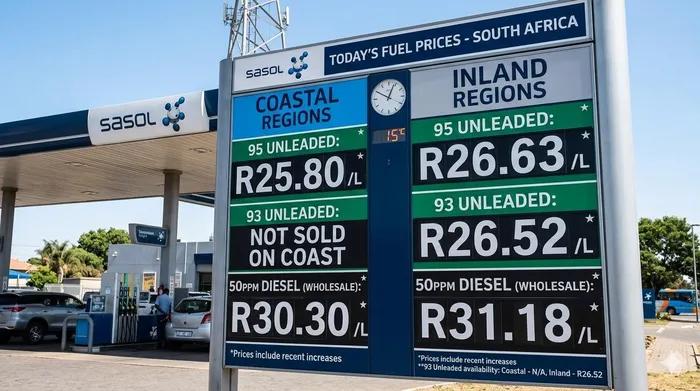
“South African households and businesses are facing a major microeconomic shock as petrol prices rise by more than R3 a litre from 7 October, taking inland 95-grade petrol to R30.25 a litre and increasing diesel prices by as much as R3.24 a litre. The increase is expected to reduce consumers’ disposable income, raise transportation and distribution costs and encourage households to change what, where and how they buy goods and services.”
South African consumers are entering October under renewed financial pressure as record fuel-price increases begin filtering through household budgets, transport costs and everyday purchasing decisions. From Wednesday, 7 October 2026, inland motorists will pay R30.25 a litre for 95-grade petrol, following an increase of R3.33 a litre. The price of 93-grade petrol will rise by R3.12 to R29.88 a litre, while wholesale diesel prices will increase by between R2.84 and R3.24 a litre.
The immediate issue is not simply the amount motorists will pay at filling stations. From a microeconomic perspective, the fuel shock affects how households allocate scarce income, how firms determine prices, how consumers respond to higher costs and how businesses adjust production, transport and distribution decisions.
The latest increase was announced by the Department of Mineral and Petroleum Resources after international oil prices climbed sharply. The government said the average Brent crude price increased from about $87.89 to $101 a barrel during the relevant review period. Higher international petroleum-product prices, shipping costs, uncertainty around oil supplies and declining global inventories all contributed to the increase.
South Africa’s dependence on imported crude oil and refined petroleum products means international energy-market movements can quickly affect domestic consumers. Reuters reported that the country’s regulated petrol price is rising by as much as 12%, while wholesale diesel is increasing by about 10%.
For households, the first effect is a reduction in disposable income. A motorist who previously spent R1,000 filling a vehicle will need substantially more money to purchase the same quantity of fuel. Although the exact impact varies according to tank size, vehicle efficiency and driving patterns, the principle is straightforward: when the price of an essential input rises, consumers have less money available for other goods and services.
That creates an important substitution effect. Households may respond by reducing unnecessary journeys, combining shopping trips, using public transport more frequently, carpooling or postponing purchases that are not essential. Consumers who previously purchased particular brands may also switch to cheaper alternatives as their budgets become tighter.
This behaviour is already visible in South Africa’s retail market. Research from the Bureau of Market Research has described South African consumers as increasingly value-conscious, with households comparing prices, switching brands, making greater use of promotions and loyalty programmes and becoming more selective about purchases.
The fuel shock could intensify those trends.
One of the most significant microeconomic consequences is the effect on transport demand. Fuel is an important operating cost for private motorists, taxi operators, delivery companies, logistics firms and other businesses that depend on road transport. When fuel becomes more expensive, the cost of providing transport services increases.
Businesses then face a difficult choice. They can absorb the additional cost and accept lower profit margins, pass some or all of the cost to customers through higher prices, reduce operating expenses or change the way their services are delivered.
For logistics companies, for example, diesel is a major operating input. Higher diesel prices increase the cost of moving products from ports and warehouses to retailers. That additional expense can eventually appear in the prices consumers pay for groceries, clothing, appliances and other products.
The same process applies to agricultural products. Food must move through multiple stages before reaching consumers. Farmers require fuel and other energy inputs, while processors, wholesalers, transporters and retailers also face logistics expenses. Consequently, a sharp increase in fuel prices can affect the entire supply chain rather than only motorists.
This is why the current fuel increase has become a major cost-of-living issue. Business Day reported that higher transport and food prices are expected to place additional pressure on workers’ real incomes.
The effect is particularly important for lower-income households. Wealthier consumers may have more flexibility to absorb an increase in transport expenses, whereas low-income households frequently devote a much larger share of their income to necessities. If transport costs rise, a household may have little choice but to reduce spending elsewhere.
Transport itself is an important household expenditure. Workers who commute long distances can face substantial additional costs, particularly where affordable public transport alternatives are limited.
The latest increase therefore has implications for labour-market decisions as well. Higher commuting costs can influence where people are willing to work, whether employees accept jobs farther from home and how much of their wages effectively remains after transport expenses. In economic terms, the real purchasing power of wages can decline even when nominal wages remain unchanged.
Businesses are also likely to reassess their operating models. Companies with vehicle fleets may look for more fuel-efficient vehicles, optimise delivery routes, consolidate shipments or increase delivery charges. Some may accelerate investments in electric vehicles or other technologies that reduce exposure to petrol and diesel prices.
The automotive market provides another example of changing consumer preferences. A recent South African survey found that fuel efficiency has become the second-most important consideration for car buyers after purchase price, reflecting growing sensitivity to running costs.
This demonstrates how prices influence consumer behaviour over time. A temporary fuel-price increase may change how much people drive. Persistent increases can change what people buy.
A household considering a new vehicle, for instance, may increasingly favour a smaller hatchback, hybrid or more fuel-efficient model rather than a larger vehicle. Businesses may similarly reconsider fleet composition.
The impact also extends to retailers. Consumers facing higher fuel bills may shop closer to home, make fewer long-distance shopping trips and concentrate purchases around promotions. Research published this week indicates that South African households are already making more frequent but smaller grocery trips. Households made an average of 108 grocery trips in the year to June 2026, compared with 105 a year earlier, while packs purchased per trip declined from 6.55 to 6.37.
That behaviour illustrates an increasingly important feature of the South African consumer economy: people are not necessarily withdrawing completely from the market. Instead, they are changing how they spend.
This distinction matters for businesses. A retailer may experience continued sales even while individual consumers become more price-sensitive. Companies that offer competitive prices, convenient locations, loyalty rewards and smaller affordable pack sizes may therefore be better positioned to retain customers.
The fuel-price increase could also influence inflation expectations. Higher transport and logistics costs can feed into prices across the economy, potentially complicating the South African Reserve Bank’s efforts to contain inflation. Business Day reported that the latest fuel shock could keep pressure on inflation and potentially contribute to expectations of further monetary-policy tightening.
Higher interest rates would create another burden for households already dealing with expensive fuel. Consumers could then face a combination of higher transport costs and higher repayments on mortgages, vehicle finance and other forms of credit.
This interaction demonstrates why a change in the price of one product can produce broader economic effects. Fuel is not simply another item in a household shopping basket. It is an input into transportation, production, distribution and many everyday economic activities.
The government previously introduced temporary fuel-levy relief to cushion households and businesses against earlier price shocks. However, those measures have not been reinstated despite the latest increase. Business Day reported that the earlier relief resulted in an estimated R17.2 billion in forgone government revenue.
For policymakers, the challenge is therefore to balance consumer relief against fiscal constraints. A lower fuel levy could reduce the immediate burden on motorists, but it would also reduce government revenue unless compensated elsewhere.
Ultimately, the record petrol price represents more than a new number displayed at South African filling stations. It is a powerful microeconomic signal that is changing household budgets, business costs and consumer preferences.
The immediate response is likely to be greater price sensitivity. Consumers may compare retailers more carefully, purchase fewer discretionary products, seek cheaper transport options and favour fuel-efficient vehicles. Businesses, meanwhile, will face pressure to control costs while deciding how much of the increase can be passed on to customers.
The scale of the adjustment makes the issue particularly significant. The government has confirmed increases of R3.12 a litre for 93-grade petrol, R3.33 for 95-grade petrol and up to R3.24 for diesel from 7 October.
For South African households already managing constrained disposable incomes, these increases could accelerate a shift from consuming more to spending smarter.
The central microeconomic story is therefore one of adaptation. Consumers will respond to higher prices by changing purchasing decisions, businesses will reconsider costs and pricing strategies, and policymakers will face difficult choices over taxation, inflation and household support. As fuel becomes more expensive, the competition for every rand in the household budget is likely to become even stronge



