




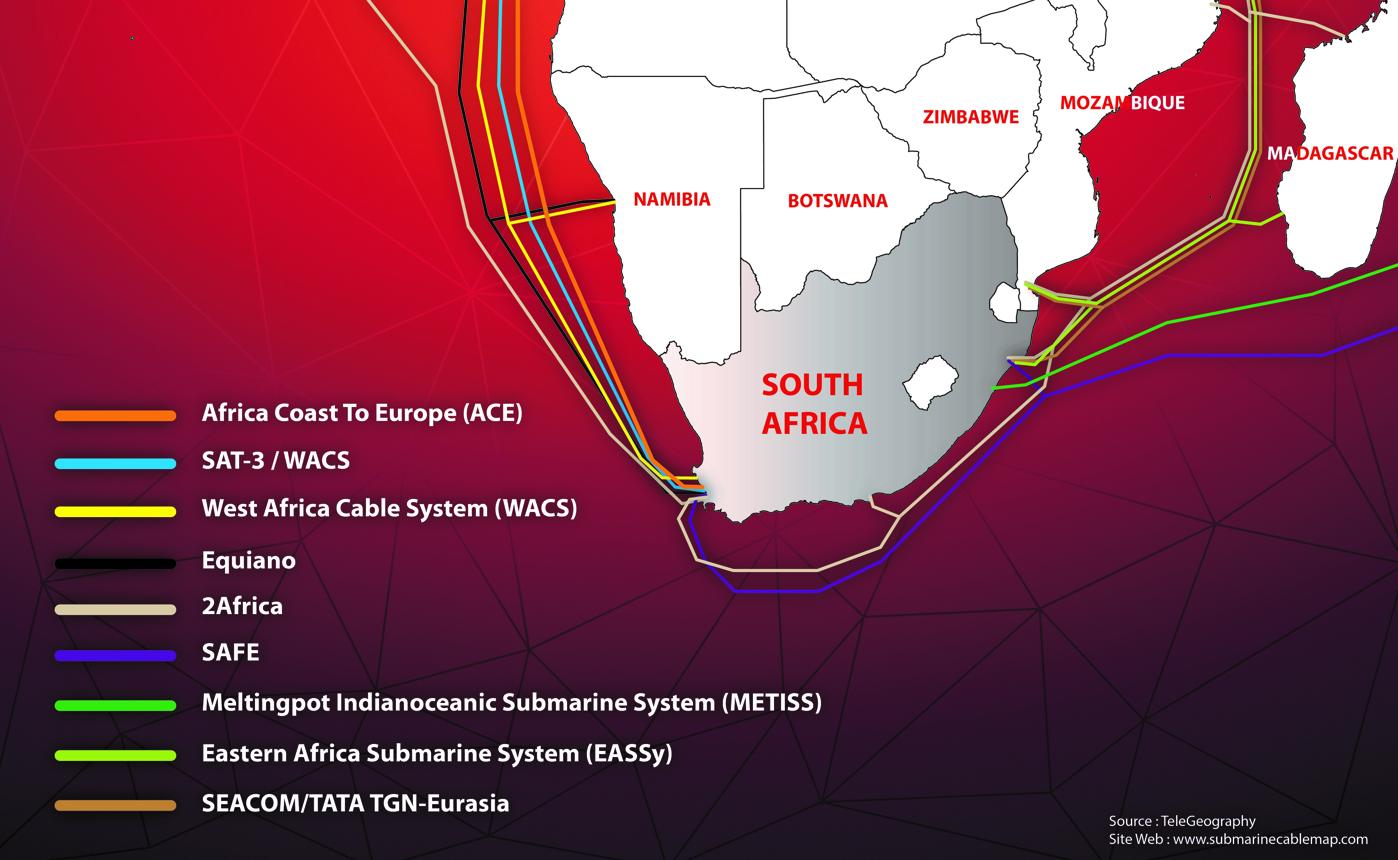
“South African internet users can experience significant online delays even when subscribed to high-speed fibre packages because international internet traffic must travel thousands of kilometres to reach overseas servers. The problem, highlighted through online gaming and international connectivity, demonstrates why local data centres, domestic hosting infrastructure and reduced network latency are becoming increasingly important to South Africa’s digital economy.”
South Africa’s 500 Mbps Internet Problem: Why Faster Fibre Cannot Eliminate International Latency
High-Speed Internet Meets a Geographic Challenge
South Africa’s rapidly expanding fibre infrastructure has transformed the country’s internet connectivity landscape. Households, businesses, educational institutions and technology companies increasingly have access to high-speed broadband services capable of supporting demanding digital applications. However, despite these improvements, an important computing challenge remains unresolved: international internet latency.
A report published by MyBroadband on 9 November 2026 highlights how even a 500 Mbps fibre connection cannot eliminate delays experienced when South African internet users communicate with servers located overseas. The issue demonstrates that internet performance depends on more than download speeds, particularly when applications require immediate responses from distant computing systems.
For South African consumers, the distinction between bandwidth and latency has become increasingly important. While bandwidth determines how much information a connection can transfer over a particular period, latency measures how long information takes to travel between its source and destination.
Consequently, purchasing a faster internet package does not automatically produce a more responsive connection.
This distinction is becoming particularly significant as South Africa expands its participation in cloud computing, international software development, online gaming, digital entertainment and artificial intelligence services.
Understanding Internet Latency
Internet latency refers to the time required for data packets to travel between two points across a network. It is commonly measured in milliseconds, with lower figures generally indicating faster responsiveness.
When someone accesses a website hosted locally in Johannesburg, the information might travel a relatively short distance before reaching the user’s computer. However, accessing a server located in Europe or North America introduces substantially longer transmission distances.
According to MyBroadband, connections between Johannesburg and Pretoria can experience only a few milliseconds of latency under suitable conditions, while connections between Johannesburg and Cape Town can take approximately 20 milliseconds.
International connections introduce a considerably larger delay.
South African users connecting to European servers can experience latency of approximately 150 milliseconds or more. Connections to servers in the United States may exceed 200 milliseconds.
These delays reflect the country’s geographical position relative to major international computing and internet infrastructure hubs.
Although fibre-optic cables transmit information extremely quickly, they cannot eliminate the physical limitations associated with distance.
Moreover, internet traffic does not always follow the shortest geographical route. International submarine cable systems connect multiple countries and landing stations, creating complex pathways through which information travels.
Why Fibre Speed Cannot Solve Everything
South Africa’s broadband market has become increasingly competitive, with internet service providers offering fibre packages ranging from entry-level connections to gigabit services.
These improvements provide considerable advantages for downloading files, streaming video, operating cloud applications and supporting multiple connected devices.
However, bandwidth and latency measure different aspects of network performance.
A 500 Mbps connection can download large files rapidly when the relevant server and network infrastructure can provide sufficient capacity. Nevertheless, an online application requiring repeated communication with a distant server may remain affected by latency.
For example, online games frequently require players’ computers to communicate with game servers whenever users move characters, fire weapons or interact with virtual environments.
When those servers are located overseas, every command must travel internationally before the game can process the action and return the response.
The result can be noticeable delays, commonly described as lag.
Increasing bandwidth does not necessarily resolve this problem because the principal limitation is the time required for information to travel between the player and the server.
This distinction also matters for businesses operating international cloud platforms, video conferencing systems and interactive software.
Online Gaming Illustrates the Problem
One of the most visible examples of international latency affecting South African computing users is online gaming.
MyBroadband highlighted the experience of South African PC gamers attempting to access official European servers for the multiplayer first-person shooter Wardogs.
The game’s developers introduced a ping restriction of 175 milliseconds for official servers. South African players reportedly experienced approximately 180 milliseconds when connecting to European servers, placing them beyond the permitted threshold.
As a result, affected players faced difficulties accessing the official gaming environment despite having high-speed internet connections.
The situation demonstrates how geographical distance can influence access to international digital services.
South African gaming communities responded by establishing local Wardogs servers, with some enthusiasts investing their own time and resources to maintain alternative environments.
These local servers reportedly delivered latency of approximately 40 milliseconds, providing a significantly more responsive experience than international alternatives.
The comparison illustrates the practical advantages of placing computing infrastructure closer to users.
Local servers reduce the distance data must travel and can improve responsiveness without requiring consumers to upgrade their broadband packages.
South Africa’s Growing Data Centre Industry
The expansion of South Africa’s data centre industry represents an important development in addressing international latency challenges.
Data centres provide facilities where companies can host computing systems, applications, databases and digital services. When these facilities are located closer to consumers, they can reduce the distance between users and the services they access.
South Africa has increasingly attracted international technology companies seeking to establish regional infrastructure.
Communications and Digital Technologies Minister Solly Malatsi has previously highlighted South Africa’s position as Africa’s leading data centre destination.
The country’s established telecommunications infrastructure, submarine cable connections, electricity infrastructure and growing digital economy contribute to its attractiveness as a regional technology hub.
Teraco, one of South Africa’s largest data centre operators, has expanded its infrastructure through the development of additional facilities and the expansion of existing sites.
Digital Realty completed its acquisition of a 55% stake in Teraco in 2022, in a transaction that valued the company at approximately R57.6 billion at the prevailing exchange rate when announced.
Such investments demonstrate the strategic importance of South African computing infrastructure to international technology companies.
Beyond direct investment, expanding data centre capacity can support employment, telecommunications development, cloud adoption and the growth of locally hosted digital products.
Local Cloud Services Improve Digital Responsiveness
International cloud providers have already established important infrastructure in South Africa.
Microsoft and Google operate local cloud infrastructure, enabling businesses and consumers to access certain services without necessarily communicating with overseas servers for every transaction.
Netflix and Facebook also use local content delivery infrastructure to distribute digital content more efficiently.
Content delivery networks store frequently accessed information closer to users, allowing websites, applications and entertainment platforms to deliver information more quickly.
This approach is particularly useful for services involving video streaming, software updates, website images and other frequently requested digital content.
Nevertheless, local infrastructure does not eliminate every latency problem.
Some applications still depend on overseas databases, authentication systems, computing resources or software components. Consequently, even when a service has a local presence, certain operations may require international communication.
The continued expansion of local computing infrastructure therefore needs to be accompanied by better network interconnection, application optimisation and intelligent infrastructure planning.
Submarine Cables Remain Critical
South Africa’s international connectivity depends heavily on submarine fibre-optic cable systems linking the country to global internet networks.
These cables provide the international transmission capacity required for communication with overseas data centres, cloud platforms, websites and computing services.
The Africa Coast to Europe cable, commonly known as ACE, is one example.
The system stretches approximately 17,000 kilometres and connects Europe, West Africa and South Africa through multiple landing stations.
Its international route illustrates how geographical distance and network design influence the performance of communications between South Africa and overseas computing infrastructure.
Other submarine cable systems also contribute to South Africa’s international connectivity.
However, submarine cables can experience physical damage, technical failures and maintenance interruptions.
When cable systems become unavailable, network operators must redirect traffic through alternative routes. Such rerouting can increase latency and reduce available capacity, particularly during major disruptions.
The importance of network resilience became particularly evident during the March 2024 submarine cable failures that affected several African countries, including South Africa.
Those disruptions demonstrated the consequences of international connectivity problems for cloud services, businesses and everyday internet users.
Computing Infrastructure and Economic Development
The latency challenge has implications extending beyond entertainment and consumer broadband.
South African companies increasingly depend on cloud computing, international collaboration platforms, remote working systems and digital business applications.
Financial institutions, software developers, logistics companies, educational institutions and healthcare providers all rely on reliable digital communication.
For software developers, latency can influence the responsiveness of remote development environments, cloud-hosted databases and application testing systems.
For businesses operating internationally, delays can affect communication between offices, cloud platforms and customers.
Meanwhile, educational institutions increasingly use digital learning platforms that require dependable access to online resources.
These developments reinforce the importance of investing in computing infrastructure that supports responsive digital services.
Local hosting, efficient routing and improved interconnection can contribute to a more competitive business environment.
The Importance of Local Gaming Infrastructure
Gaming offers an important commercial opportunity for South Africa’s technology industry.
A growing domestic gaming community creates demand for local servers, hosting services, cloud computing infrastructure and specialised network management.
Game developers and publishers that establish South African servers can potentially improve the experience for local players while strengthening their commercial presence in the region.
Local infrastructure may also encourage participation among consumers who experience difficulties accessing overseas servers.
However, establishing servers requires investment in hardware, electricity, network capacity, maintenance and technical support.
Gaming companies must evaluate the size of their South African user base, operational expenses and commercial sustainability before establishing permanent infrastructure.
Partnerships with South African data centre operators and telecommunications companies could help reduce these challenges.
What South African Internet Users Should Understand
The continuing latency problem highlights several important considerations for consumers.
First, users should recognise that higher broadband speeds do not guarantee lower international latency.
Second, choosing a reliable internet service provider and maintaining an efficient home network can improve overall connectivity, although these measures cannot eliminate geographical transmission delays.
Third, users should consider whether the applications they rely on are hosted locally or internationally.
For activities such as competitive online gaming, remote computing and interactive applications, server location may matter more than headline broadband speed.
Finally, consumers should understand that internet performance depends on several interconnected factors, including routing efficiency, network congestion, server availability and physical distance.
South Africa’s Digital Future Depends on More Than Speed
South Africa’s internet infrastructure continues to develop, creating opportunities for businesses, consumers and technology companies.
Nevertheless, the country’s geographical position presents challenges that cannot be resolved simply by increasing fibre speeds.
Reducing latency requires a broader strategy involving local data centres, submarine cable investment, improved interconnection, regional computing infrastructure and more efficient network management.
As cloud computing and digital applications become increasingly central to economic activity, these investments will become even more important.
The country’s growing data centre industry provides a foundation for improving digital responsiveness while strengthening South Africa’s position as a regional technology hub.
Ultimately, the central lesson of the 500 Mbps fibre problem is straightforward: internet performance is determined not only by how much data a connection can carry, but also by how quickly that information reaches the systems responsible for processing it.
For South African consumers and businesses, the future of computing will therefore depend on combining faster broadband with smarter infrastructure, closer servers and more resilient international connectivity.
That combination offers the strongest opportunity to improve the country’s digital experience and support the next phase of South Africa’s technological development.



