




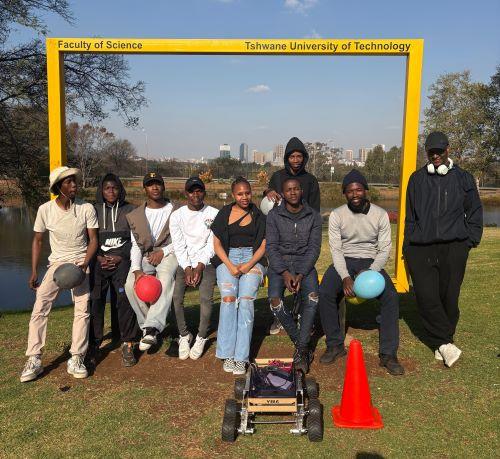
“Engineering students from Tshwane University of Technology (TUT) have won two major awards at the 2026 Cars4Mars African Rover Challenge, with Team Wall-E taking Best Traversal Mission and RoboTechAura winning Best AI Mission. The achievement highlights the growing role of South African students in robotics, artificial intelligence, mechatronics and space-technology development, following a competition involving about 120 participants from South Africa, Kenya and Zimbabwe.”
TUT Students Put South African Robotics in the Spotlight With Double Mars Rover Victory
South Africa’s robotics and engineering community is celebrating a major student achievement after two teams from Tshwane University of Technology secured top honours at the 2026 Cars4Mars African Rover Challenge. Team Wall-E won the Best Traversal Mission Award, while RoboTechAura took the Best AI Mission Award, demonstrating the country’s growing capabilities in robotics, artificial intelligence, mechanical engineering and autonomous systems.
The achievement is particularly significant because the Cars4Mars challenge is designed to move robotics education beyond classroom theory. Instead of simply studying mechanical systems, electronics or programming, participants must design, build, test and operate functioning rover prototypes under demanding conditions.
The results announced by TUT on 8 October 2026 provide a strong example of how practical engineering programmes can prepare young South Africans for emerging technology industries. The university’s two winning teams were made up of final-year students in the Faculty of Engineering and the Built Environment’s Department of Mechanical and Mechatronics Engineering.
A continental robotics competition
The Cars4Mars African Rover Challenge brought together approximately 120 students and learners representing 18 finalist teams from South Africa, Kenya and Zimbabwe. Those finalists emerged from an initial field of about 100 teams representing 11 African countries.
The competition is designed to expose African students to robotics, artificial intelligence, engineering and space technologies through practical experience. According to the organisers, participants receive mentoring during the approximately five-month development process, giving them an opportunity to design and build their own rover prototypes.
The competition does not require students to build an actual space-qualified vehicle. Rather, participants construct small mobile robots that can operate wirelessly and independently from a battery-powered system. The approach allows students to recreate important aspects of planetary exploration while working within the resources available to educational institutions.
For African students, that practical focus is particularly valuable. Robotics requires knowledge across multiple disciplines, including mechanical design, electrical engineering, software development, communication systems, sensors, computer vision and artificial intelligence.
Wall-E conquers the difficult terrain
One of TUT’s winning teams, Wall-E, was recognised for its performance during the Traversal Mission.
The mission required teams to remotely operate their rovers across rugged terrain while completing assigned tasks. The course was constructed in the Mars Yard at the South African National Space Agency’s Space Operations facility in Hartebeesthoek, Gauteng. Approximately 40 tonnes of red sand were used to create an environment resembling the difficult and unpredictable surface conditions associated with Mars.
The challenge placed considerable pressure on the physical design of each rover. Vehicles needed sufficient traction and stability to negotiate uneven ground while their communication and control systems had to remain reliable.
Wall-E’s success followed months of development that began in February. Team members divided responsibilities across areas including coding, electronics and mechanical design, with SolidWorks used in the development process.
Team leader Reabetswe Maila described the experience as an opportunity to transform theoretical engineering knowledge into a working machine. That transition from theory to physical implementation is one of the most important elements of competitions such as Cars4Mars.
Students can understand the principles of motors, electronics, programming and mechanical structures in a classroom. However, integrating those systems into one functioning robot introduces a completely different level of complexity.
A motor may perform differently under load. A communication system may experience interference. A wheel can lose traction. Software can behave differently once it interacts with physical hardware. Engineers must therefore identify problems, make adjustments and test their solutions repeatedly.
That process was central to Wall-E’s success.
RoboTechAura brings artificial intelligence into the competition
While Wall-E demonstrated strength in physical navigation, TUT’s RoboTechAura team focused on a different challenge: artificial intelligence and computer vision.
The AI Autonomous Mission required participating rovers to use onboard cameras, computer-vision technology and AI algorithms to identify objects according to characteristics such as shape, colour and position.
This represents a significant step beyond basic remote-controlled robotics.
A remotely operated robot relies heavily on a human operator to interpret its surroundings and determine where it should move. An autonomous system, by contrast, must process information from its environment and use that information to make decisions.
In the Cars4Mars competition, the rover’s camera effectively became its eyes. Software then had to interpret what the camera was seeing and determine which objects were relevant to the mission.
SANSA’s account of the competition explains that teams were challenged to identify objects including a hammer, tennis ball, traffic cone and balloons of different colours. Additional points could be earned when systems accurately determined an object’s location within the camera image.
For RoboTechAura, the achievement required the integration of several technical disciplines.
According to TUT, the team worked across mechanical design, electronics, software development, wireless communication and artificial intelligence. The systems then had to be integrated into a single operational mechatronic platform.
That multidisciplinary requirement mirrors the way modern robotics companies develop commercial machines.
Why the achievement matters for South Africa
The significance of the TUT victory extends beyond a student competition.
South Africa is increasingly looking toward advanced technologies as potential drivers of industrial development, research and economic growth. Robotics can contribute to sectors including mining, manufacturing, logistics, agriculture, healthcare, defence and space technology.
However, sophisticated robotic systems require highly skilled engineers and technicians.
Competitions such as Cars4Mars therefore provide a valuable pipeline for developing those skills. Students are not merely learning individual technologies; they are learning how different technologies interact within a complete system.
The experience also develops less visible skills.
Participants have to manage deadlines, divide responsibilities, communicate technical information, troubleshoot failures and make decisions when resources are limited. These are capabilities that are important in professional engineering environments.
TUT supervisor Johan Benade highlighted the importance of adaptability, noting that students had to troubleshoot and adjust when things did not go according to plan.
That lesson is especially important in robotics because failure is often part of the development process.
A robot can look successful during a design review but fail when its wheels encounter unexpected terrain. A computer-vision algorithm can perform well on test images but struggle with changing lighting conditions. A wireless communication system can work in a laboratory but experience problems in a crowded outdoor environment.
Successful roboticists must therefore be capable of diagnosing failures and improving their systems.
A Mars Yard built for African innovation
The physical final at SANSA provided an unusual but valuable testing environment.
The Hartebeesthoek Mars Yard gave teams the opportunity to place their prototypes in a realistic obstacle-course setting rather than simply demonstrating them on a smooth laboratory floor.
SANSA reported that the competition involved a five-month process in which students designed, engineered, built, tested and refined their rover prototypes before travelling to the final.
The agency also described the competition as a platform for developing Africa’s emerging engineering and technology talent.
That regional dimension is important.
The event was not exclusively South African. Students from Kenya and Zimbabwe also competed, creating an environment in which young engineers could compare approaches, exchange ideas and test their abilities against teams from other countries.
The wider results also demonstrate the diversity of African robotics talent. Zimbabwe’s Milestone High School team, Cyberstorm, won first place overall, while South Africa’s Inadeptus Mechanicus from Rhodes University and Stellenbosch University placed second. Bryanston High School’s Tech Tonic took third place. Kenya’s Jomo Kenyatta University of Agriculture and Technology won Best Design.
TUT’s double award therefore represents both a South African achievement and part of a broader African robotics movement.
From university projects to future industries
One of the most important questions raised by the competition is what happens after students graduate.
The skills demonstrated through Cars4Mars can potentially transfer into numerous industries.
Mechanical and mechatronics engineers can contribute to automated manufacturing systems. Software specialists can work on machine vision and autonomous navigation. Electronics engineers can develop sensors and control systems. AI specialists can build algorithms that allow machines to interpret their environments.
The same foundations can also support emerging fields such as autonomous vehicles, drones, agricultural robotics and space robotics.
South Africa already has a strong scientific and engineering ecosystem, including SANSA and universities conducting research in engineering and technology. Events such as Cars4Mars create a bridge between education and practical innovation.
The competition’s organisers say their objective is to expose young people to opportunities in robotics, automation, artificial intelligence and space technology while helping them develop skills relevant to future workplaces.
The importance of hands-on engineering
The TUT victory also reinforces a broader lesson about technology education: students need opportunities to build things.
Reading about robotics can introduce concepts. Simulations can help students understand how systems should behave. However, physically constructing a machine reveals problems that are difficult to anticipate.
Wires need to be routed. Motors need to be mounted. Batteries need to provide sufficient power. Cameras need to be positioned correctly. Software must communicate with hardware. Mechanical components need to survive repeated movement.
Those practical challenges teach students how engineering works in the real world.
The Cars4Mars format deliberately encourages this type of learning. Its official competition description says the challenge requires students to design and build a rover prototype while providing a mentoring environment intended to support multidisciplinary engineering and innovation.
For South Africa, expanding access to these experiences could help strengthen the country’s future technology workforce.
Looking ahead
TUT’s double victory is therefore more than a pair of competition trophies. It is evidence that South African students can design, integrate and operate sophisticated robotic systems while competing successfully against teams from across Africa.
Team Wall-E demonstrated the importance of mechanical engineering, remote control and reliable navigation. RoboTechAura demonstrated how computer vision and artificial intelligence can give robots greater autonomy.
Together, the achievements illustrate the multidisciplinary nature of modern robotics.
The competition also shows why partnerships between universities, technology organisations and national scientific institutions matter. By providing students with access to real testing environments, mentorship and demanding engineering challenges, these programmes can turn classroom concepts into practical capabilities.
For the next generation of South African engineers, the lesson is clear: robotics is no longer simply a subject for experimentation. It is becoming an important part of the country’s technological future.
As artificial intelligence, automation and autonomous machines continue to develop, South Africa will need engineers capable of designing systems that work reliably in challenging environments. The achievements of TUT’s Wall-E and RoboTechAura teams provide an encouraging example of the talent that can emerge when students receive the opportunity to build, test, fail, improve and compete.
The Mars rover may have been a prototype, but the skills developed through building it could eventually find applications much closer to home — from factories and mines to farms, hospitals and transport systems.
For South Africa’s robotics ambitions, that may be the most important result of all.



