




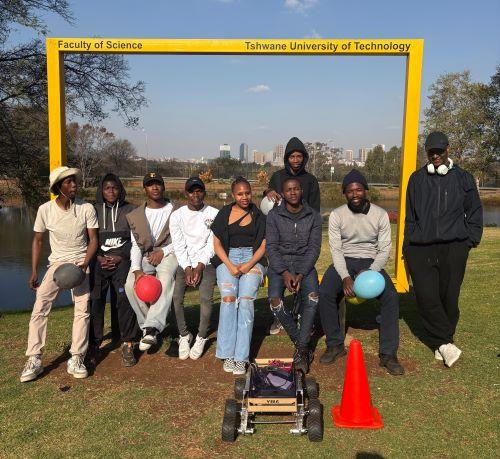
“Engineering students from Tshwane University of Technology (TUT) have secured two major awards at the 2026 Cars4Mars African Rover Challenge, highlighting South Africa’s growing capabilities in robotics, artificial intelligence, mechatronics and space-related innovation. Team Wall-E won the Best Traversal Mission Award, while RoboTechAura took the Best AI Mission Award after demonstrating autonomous rover technology using cameras, computer vision and artificial intelligence.”
South African engineering students have delivered a significant innovation achievement on the African technology stage after two teams from Tshwane University of Technology emerged as winners at the 2026 Cars4Mars African Rover Challenge. The achievement places the university’s student innovators at the centre of a competition designed to develop practical skills in robotics, artificial intelligence, electronics, software engineering and mechanical design.
The competition culminated at the South African National Space Agency’s (SANSA) Space Operations facility in Hartebeesthoek, Gauteng, where young innovators tested self-built rover prototypes against challenging simulated Martian conditions. According to TUT, Team Wall-E won the Best Traversal Mission Award, while RoboTechAura won the Best AI Mission Award.
The results are important beyond the competition itself because they demonstrate how hands-on engineering programmes can turn classroom knowledge into practical technological solutions. The Cars4Mars challenge requires participants to design, build, test and refine working robotic systems rather than simply present theoretical concepts.
A major platform for African innovation
The 2026 Cars4Mars competition brought together approximately 120 students and learners representing 18 finalist teams from South Africa, Kenya and Zimbabwe. These teams had progressed from an initial field of approximately 100 teams representing 11 African countries.
The competition was structured around the development of small, mobile Mars rover prototypes. The official Cars4Mars programme explains that participants must create remotely controlled robotic platforms with independent power supplies. The competition is designed specifically to encourage students to develop practical expertise while exploring robotics, automation, artificial intelligence and space technologies.
For South Africa, the event provides a valuable environment in which young engineers can compete against peers from across the continent while working with technologies that are increasingly important to the global economy.
Robotics and AI are no longer restricted to specialist laboratories. They are becoming central to manufacturing, mining, healthcare, agriculture, logistics, defence, telecommunications and space exploration. Competitions such as Cars4Mars therefore offer students an opportunity to develop skills that can eventually be applied across multiple industries.
TUT teams demonstrate practical engineering
Team Wall-E’s victory in the Best Traversal Mission category reflected the students’ ability to design a rover capable of navigating difficult terrain while completing assigned tasks.
The simulated Mars environment presented significant engineering challenges. The Mars Yard used for the final was constructed with approximately 40 tonnes of red sand to reproduce some of the difficult terrain associated with a Martian environment. Participants had to control their vehicles remotely while dealing with obstacles and completing mission objectives.
The Wall-E team spent months developing and testing its rover. According to TUT, students were responsible for different elements of the project, including coding, electronics and mechanical design. They also used SolidWorks during the development process.
For the students involved, the project provided an opportunity to move beyond theoretical engineering principles. Instead of simply learning how mechanical systems, electronic components and software work individually, they had to combine those disciplines into one functioning machine.
That integration is one of the most valuable aspects of the competition. Modern engineering problems rarely fit neatly into a single academic discipline. Autonomous vehicles, drones, industrial robots and spacecraft all require mechanical engineering, electronics, software, communications and artificial intelligence to work together.
AI takes centre stage
The RoboTechAura team faced an even more technologically demanding mission by competing in the AI Autonomous Mission.
The challenge required the rover to use onboard cameras, computer vision and artificial intelligence algorithms to identify objects according to characteristics such as shape, colour and location.
This represents a significant step beyond traditional remote-controlled robotics. Instead of relying entirely on a human operator to interpret the environment and control the rover, the system had to process visual information and make decisions using its onboard technology.
RoboTechAura therefore brought together several areas of modern technology. Its members worked across mechanical design, electronics, software development, wireless communication and artificial intelligence.
The team’s success illustrates the increasing importance of multidisciplinary skills in innovation. A sophisticated AI system is only useful when it can operate within a physical environment. Similarly, a mechanically advanced robot cannot perform autonomous tasks without reliable software, sensors and decision-making capabilities.
The students’ ability to combine these elements into one working system was central to their success.
Turning classroom knowledge into working technology
One of the most important lessons from the competition is the value of experiential learning.
TUT team leader Reabetswe Maila explained that the project required students to translate knowledge gained in class into a functioning engineering system. The process involved designing components, developing software, testing systems, identifying failures and making adjustments.
That process mirrors the realities of professional engineering.
In the real world, innovative products rarely work perfectly on the first attempt. Engineers must repeatedly test prototypes, identify weaknesses and improve designs. They must also work within limitations involving budgets, materials, time, energy and technical expertise.
The TUT students experienced many of these pressures during the competition.
Team leader Rofhiwa Mudau explained that RoboTechAura had to make the most of limited resources while ensuring that its rover could navigate rough terrain, communicate wirelessly and perform autonomous tasks in real time.
These experiences can be extremely valuable for students entering South Africa’s technology sector.
Supporting South Africa’s future innovation economy
South Africa needs a strong pipeline of engineers, scientists, programmers and technology entrepreneurs if it is to compete in increasingly digital and automated industries.
The Cars4Mars achievement provides an example of how universities can contribute to that pipeline.
TUT’s success also reflects the broader importance of partnerships between educational institutions, industry and scientific organisations. The 2026 competition was hosted at a SANSA facility, providing students with access to an environment connected to South Africa’s national space programme.
SANSA has described the competition as an important platform for developing practical skills among young African innovators. The agency’s partnership with Cars4Mars also establishes its Hartebeesthoek facility as a permanent venue for future finals.
Such partnerships can help narrow the gap between education and industry.
Students who work on real engineering projects graduate with more than academic qualifications. They also gain experience in teamwork, project management, troubleshooting, communication, prototyping and technical problem-solving.
These capabilities are increasingly valuable as companies adopt automation and artificial intelligence.
Innovation beyond the competition
The significance of the TUT achievement extends beyond winning two awards.
The technologies developed during competitions like Cars4Mars can encourage students to consider careers and businesses in robotics, AI, aerospace, software development and advanced manufacturing.
South Africa has a growing need for locally developed technological solutions. In many sectors, companies still rely heavily on imported equipment and technologies. Building domestic engineering capabilities can therefore contribute to technological independence and economic resilience.
Young engineers who learn how to design and build their own systems are better positioned to create locally relevant solutions.
For example, technologies developed for autonomous navigation could eventually have applications in mining, agriculture, disaster response, logistics and industrial inspection. Computer vision systems can be adapted for manufacturing quality control, security and medical applications. Wireless communication technologies can support connected infrastructure and remote monitoring.
Consequently, an educational robotics project can become a foundation for innovation far beyond its original purpose.
Africa’s growing technology talent
The participation of teams from South Africa, Kenya and Zimbabwe also demonstrates the importance of continental collaboration.
Africa has a young population and an expanding technology sector, but the continent continues to face challenges involving access to advanced equipment, technical training and research infrastructure.
Competitions that allow students to collaborate and compete across national borders can help create a stronger African technology ecosystem.
Cars4Mars describes its mission as inspiring African youth to participate in robotics, space technologies and artificial intelligence. The programme provides students with a platform to develop prototypes, receive mentoring and apply their knowledge to practical challenges.
The 2026 competition also showed that African students can produce sophisticated technological projects when given appropriate opportunities and support.
Building a culture of experimentation
Perhaps the most important innovation lesson from the TUT victory is that technological progress depends on experimentation.
Students were required to build physical systems, test them under pressure and respond when things went wrong. According to TUT supervisor Johan Benade, the students demonstrated resilience by troubleshooting problems, adapting their designs and working together when projects did not initially perform as expected.
That culture of experimentation is essential to innovation.
Research and development require people who are willing to test new ideas, accept failure and learn from unsuccessful attempts. Universities therefore have an important role not only in teaching established knowledge but also in creating environments where students can experiment with new ideas.
What the achievement means for South Africa
The TUT victory comes at a time when artificial intelligence, robotics and automation are rapidly changing the global economy.
South Africa’s ability to benefit from these changes will depend partly on whether it can develop enough skilled people to design, operate and improve emerging technologies.
The achievements of Wall-E and RoboTechAura suggest that there is significant talent within South African universities.
However, talent must be supported by investment in laboratories, research infrastructure, mentorship, funding and industry partnerships. Competitions provide an effective starting point, but sustained innovation requires long-term support.
The next challenge is therefore to ensure that students who demonstrate exceptional technical ability have pathways into research, entrepreneurship and industry.
A promising signal for the next generation
The 2026 Cars4Mars African Rover Challenge has provided more than a competition victory for TUT. It has demonstrated what can happen when students are given the opportunity to design, build and test real technological systems.
Team Wall-E’s success in rover traversal and RoboTechAura’s achievement in AI demonstrate complementary areas of engineering excellence. Together, they highlight the importance of combining mechanical engineering, electronics, software, communications and artificial intelligence.
As South Africa prepares for a future increasingly shaped by automation, AI and advanced engineering, achievements like these offer a positive signal.
The country’s next generation of innovators is already experimenting with the technologies that will define tomorrow’s economy.
For TUT and the wider South African innovation ecosystem, the message is clear: when young engineers receive the opportunity, resources and practical challenges needed to turn ideas into working technologies, they can compete successfully on an African and potentially global stage.



