




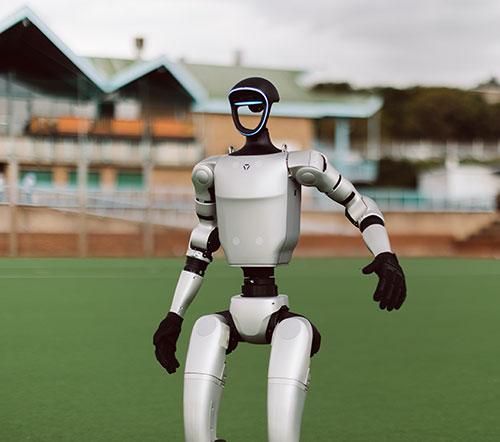
“Tshwane University of Technology (TUT) has introduced Nyiko, its second humanoid robot, as part of an expanding robotics and artificial intelligence research programme designed to strengthen South Africa’s technological capabilities. The Unitree R1 bipedal robot will support research, engineering skills development and investigations into adaptive decision-making, helping researchers explore how intelligent robotic systems could contribute to manufacturing, education and other sectors.”
Introduction: South Africa Strengthens Its Robotics Research Capabilities
South Africa’s ambition to strengthen its technological capabilities is receiving another boost following the introduction of Nyiko, the second humanoid robot at Tshwane University of Technology (TUT). The new robotic platform represents an investment in research, artificial intelligence, engineering education and the development of specialised technological skills.
Named after the Xitsonga word meaning “gift”, Nyiko reflects TUT’s vision of using emerging technologies to create new research opportunities and contribute to solutions addressing South Africa’s developmental challenges.
The robot is a Unitree R1 bipedal humanoid developed by Unitree Robotics. It joins TUT’s existing collection of robotic platforms, which includes the Unitree G1 humanoid robot and a quadruped robotic dog called Dexter.
The development highlights the growing importance of robotics within South Africa’s university research environment, where institutions are increasingly exploring the practical applications of artificial intelligence, automation and intelligent machines.
Although humanoid robots remain an emerging technology globally, their growing presence in research laboratories offers opportunities to investigate how machines can interact with people, understand environments and perform tasks under changing conditions.
For TUT, Nyiko is more than an additional technological acquisition. It represents an opportunity to expand research capabilities and prepare students for a future in which robotics and artificial intelligence are increasingly integrated into industrial and commercial activities.
Nyiko Expands TUT’s Humanoid Robotics Programme
The introduction of Nyiko builds on TUT’s existing investment in robotic technologies.
The university previously introduced a humanoid robot to strengthen AI training, teaching and research. Its robotics collection also includes a quadruped platform capable of navigating environments that may be difficult or dangerous for humans.
Nyiko adds another opportunity for researchers to investigate humanoid movement, perception, interaction and adaptive behaviour.
Bipedal robots are particularly interesting because their physical structure resembles the basic arrangement of the human body. They use two legs for movement and can potentially interact with environments designed primarily for people.
However, reproducing human movement is technically challenging. Robots must maintain balance, coordinate multiple joints, interpret sensor information and respond appropriately when their surroundings change.
Researchers therefore use humanoid platforms to study the relationship between mechanical engineering, computer vision, artificial intelligence and autonomous decision-making.
TUT’s growing collection provides opportunities to investigate these interconnected technologies in practical experimental environments.
The university’s AI Hub, together with the French South African Institute of Technology and the South African Research Chairs Initiative, contributes to the development of research capabilities, experimental platforms and specialised talent in intelligent robotic systems.
These institutional partnerships are important because robotics requires expertise extending beyond a single engineering discipline. Mechanical systems, software development, sensor integration and intelligent algorithms must work together to produce reliable robotic behaviour.
Adaptive Decision-Making Becomes a Major Research Priority
One of the important research areas highlighted by TUT is adaptive decision-making.
This capability allows robotic systems to respond appropriately when tasks, environments, operating conditions or available resources change.
A robot operating in a laboratory may encounter relatively predictable conditions. However, real-world environments are considerably more complicated.
Objects can move unexpectedly, surfaces may be uneven, obstacles can appear, and people may change their behaviour without warning.
Robotic systems therefore require more than programmed movement sequences. They need mechanisms that allow them to interpret information, assess circumstances and adjust their actions.
Adaptive decision-making involves coordinating several interconnected processes.
First, robots must perceive their surroundings using sensors and other information-gathering technologies. Second, they must interpret that information to understand the situation. Third, they must determine an appropriate response and execute it through their mechanical systems.
Finally, they must evaluate whether their actions have produced the intended outcome.
This process becomes particularly important when robots operate alongside humans.
For example, a collaborative robot working near an employee must respond to movement and changing task requirements while maintaining appropriate safety conditions.
Nyiko provides TUT with another platform for exploring these challenges, including the relationship between physical movement, perception, computing resources and behavioural responses.
Research into adaptive systems could contribute to developing robots capable of operating more reliably outside controlled laboratory environments.
Robotics and South Africa’s Industrial Development Agenda
TUT’s investment in humanoid robotics aligns with South Africa’s Science, Technology and Innovation Decadal Plan for 2022–2032.
The national framework identifies artificial intelligence, robotics and other Fourth Industrial Revolution technologies as important contributors to industrial modernisation, economic development and inclusive growth.
One of its central ambitions is to strengthen South Africa’s ability to develop technological solutions rather than remain predominantly a consumer of technologies developed elsewhere.
Robotics could contribute to this objective by improving the country’s research infrastructure and expanding the technical capabilities of engineers, scientists and entrepreneurs.
Industrial automation is already an important application of robotics internationally.
Manufacturing companies use robotic systems for repetitive operations, material handling, inspection and other activities requiring consistency and precision.
As intelligent systems become more capable, opportunities may expand into additional areas requiring environmental awareness, flexible movement and interaction with human workers.
South African universities can help investigate how these technologies might be adapted to local industrial conditions.
For example, research could explore robotic assistance in manufacturing, agricultural monitoring, industrial inspection and other applications where automation may improve productivity or safety.
However, successfully implementing these technologies requires more than acquiring advanced machines.
It also requires research expertise, technical infrastructure, reliable software, maintenance capabilities and an understanding of the economic conditions influencing industrial adoption.
TUT’s expanding robotics programme provides a foundation for investigating these requirements.
Potential Applications Beyond the Research Laboratory
Humanoid robotics attracts attention because its applications may extend beyond traditional industrial automation.
Robots with human-like movement could eventually assist in environments where existing infrastructure is designed around human workers.
Nevertheless, practical deployment requires careful consideration of the tasks involved.
Manufacturing is one potential area of interest.
Researchers can investigate how robots might assist with assembly, material handling or repetitive activities while working alongside employees.
Such applications require dependable movement, accurate perception and appropriate safety mechanisms.
Agriculture represents another possible research area.
South African agricultural operations face different environmental conditions, including uneven terrain, changing weather and dispersed working locations.
Robotic systems could potentially support monitoring, inspection and selected operational activities. TUT has previously highlighted interest in environmental monitoring and applications involving livestock industries.
Healthcare also presents opportunities for assistive technologies.
Robots may eventually contribute to certain support functions, although medical applications require particularly rigorous safety, reliability and regulatory considerations.
It is important to distinguish these possible applications from confirmed deployments.
Nyiko’s introduction establishes a research opportunity, not evidence that the robot is already performing commercial manufacturing, agricultural or healthcare duties.
The value of the platform lies in enabling researchers to investigate capabilities, limitations and potential applications systematically.
Such experimentation can help identify where robotics offers genuine advantages and where conventional approaches remain more practical.
Developing Skills for the Future Robotics Economy
The introduction of Nyiko also highlights the importance of technical education.
Robotics development requires a combination of mechanical engineering, electrical engineering, computer science, artificial intelligence and systems integration.
Students working with robotic platforms can gain practical exposure to concepts that might otherwise remain theoretical.
They can investigate how sensors interact with software, how algorithms influence movement and how engineering decisions affect the performance of physical machines.
This experience may prove valuable as businesses increasingly seek employees capable of understanding automation technologies.
In addition, research platforms can encourage collaboration between students, academics and industry partners.
Such partnerships may create opportunities for applied research projects, internships, technical demonstrations and entrepreneurial initiatives.
South Africa’s universities consequently have an important role in developing the skills required to support emerging technological industries.
TUT’s robotics programme, supported by its AI Hub and research partnerships, contributes to this broader objective.
The development of skilled researchers and engineers is especially significant because imported robotic equipment cannot automatically produce local technological independence.
Countries need people capable of adapting systems, developing software, conducting research and maintaining sophisticated equipment.
Building these capabilities requires sustained investment in education, research and practical experimentation.
Nyiko therefore represents both a technological platform and an opportunity to strengthen South Africa’s human capital.
Challenges Facing Humanoid Robotics
Despite the opportunities, humanoid robotics continues to face significant technical and economic challenges.
Reliable movement remains difficult, particularly when robots encounter uneven surfaces, unexpected obstacles or changing environmental conditions.
Battery endurance, processing requirements, maintenance costs and mechanical complexity can also limit practical deployment.
Safety is another critical consideration.
Robots operating alongside people must be designed to minimise the risk of collisions, unexpected movement and equipment failures.
Researchers must also consider how robotic systems interpret human actions and communicate their intentions.
These challenges demonstrate why research platforms are important.
They allow engineers to test capabilities, identify weaknesses and improve systems before attempting broader deployment.
For South African institutions, another consideration is the cost of maintaining advanced research equipment.
Robotics programmes require funding for hardware, software, training, laboratory infrastructure and technical support.
Sustaining these investments will be important if institutions want to translate research into practical applications.
The long-term value of Nyiko will therefore depend not simply on its presence at the university, but on the quality of research, experimentation and collaboration it enables.
South Africa’s Robotics Future
TUT’s introduction of Nyiko reflects a wider movement towards expanding South Africa’s technological research capabilities.
The university’s growing collection of humanoid and quadruped robots offers researchers opportunities to investigate different approaches to intelligent movement, environmental awareness and human-machine interaction.
These efforts align with national ambitions to strengthen innovation, improve industrial capabilities and develop specialised technical skills.
However, the broader success of robotics in South Africa will depend on continued collaboration between universities, government, businesses and research organisations.
Industry participation can help identify practical problems requiring technological solutions.
Government support can contribute to research infrastructure and innovation programmes.
Universities can develop the expertise and experimental capabilities necessary to investigate emerging technologies.
Entrepreneurs and technology companies can then explore opportunities to commercialise successful innovations.
This process is unlikely to produce immediate transformation. Robotics development requires sustained research, testing, investment and learning.
Nevertheless, initiatives such as TUT’s expanding AI Hub demonstrate how educational institutions can contribute to building the foundations of a more technologically capable economy.
Conclusion: Nyiko Represents an Investment in Innovation
Nyiko’s arrival at Tshwane University of Technology is an important development for South African robotics research.
The Unitree R1 humanoid strengthens the university’s experimental capabilities and provides additional opportunities to investigate intelligent robotic systems.
Its potential contribution extends beyond the machine itself.
The platform can support research into adaptive decision-making, human-machine interaction and robotic movement while providing students with exposure to advanced engineering technologies.
Furthermore, the initiative aligns with South Africa’s ambition to strengthen domestic technological capabilities and develop solutions addressing industrial and societal challenges.
Although practical applications will require further research and validation, Nyiko represents a meaningful investment in the country’s robotics knowledge base.
As South Africa continues exploring artificial intelligence and automation, universities such as TUT will remain important centres for developing the expertise, innovation and technical skills needed to shape the future of robotics.
The university’s vision of Nyiko as a gift captures this ambition: an investment intended to generate lasting benefits through research, learning and technological progress.



