




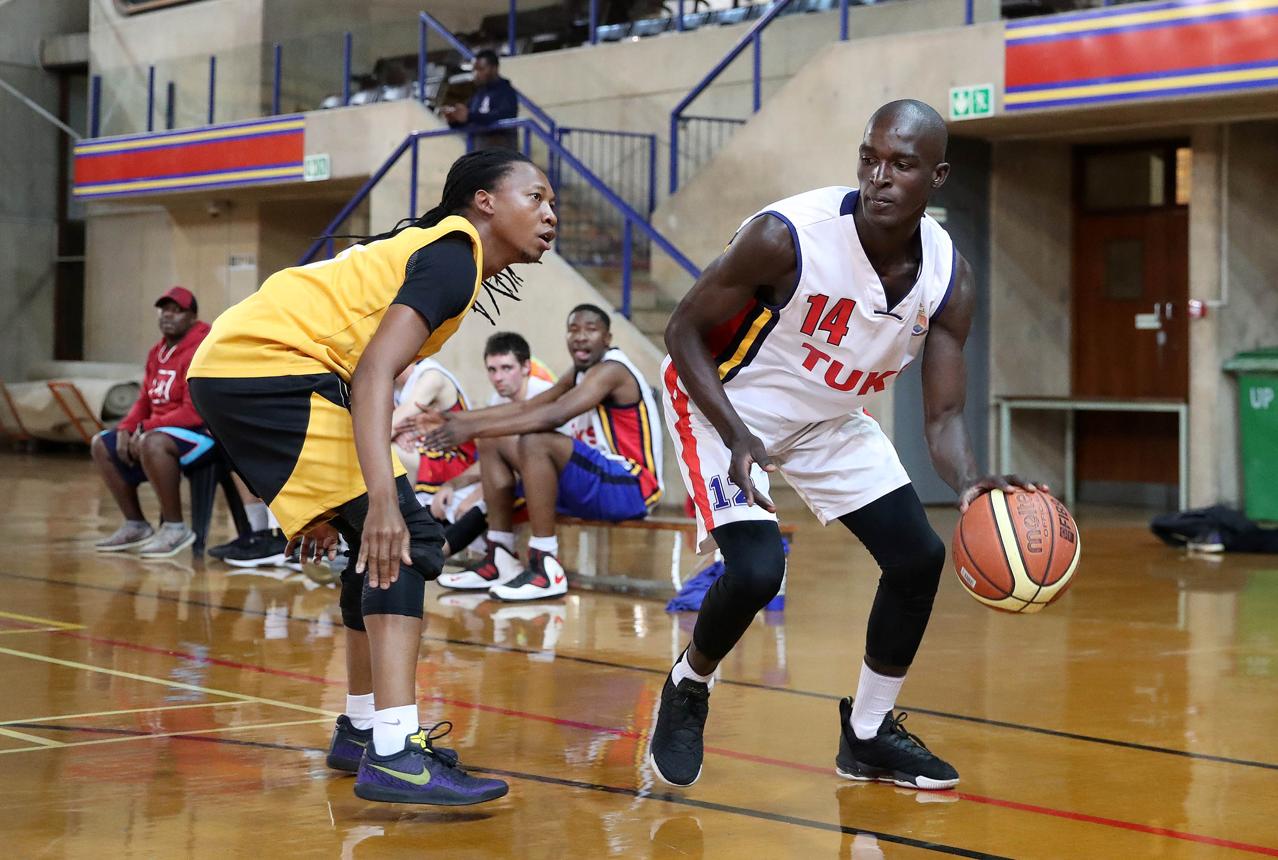
“University of Pretoria (Tuks) men’s basketball captain Thuto Mogotsi is determined to lead his team to its first-ever medal finish in the USSA 5×5 Basketball Tournament as the competition approaches at Wits University. Following a fourth-place finish last year and overcoming injury concerns, the team hopes to transform its considerable talent into a historic championship achievement.”
Tuks men’s basketball prepares for a defining championship challenge
The University of Pretoria’s men’s basketball team is preparing for an important opportunity to change its competitive history as captain Thuto Mogotsi leads the squad into the University Sport South Africa (USSA) 5×5 Basketball Tournament at the University of the Witwatersrand (Wits).
For Mogotsi, the competition represents considerably more than another university sporting event. It is an opportunity to establish a new identity for a team that has repeatedly demonstrated its ability but struggled to translate its potential into championship success.
The captain believes Tuks possesses the quality required to challenge South Africa’s strongest university basketball programmes. However, the team must demonstrate consistency, discipline and composure when facing opponents in high-pressure situations.
According to the original report published by Insight News Network on 10 November, Mogotsi is determined to move beyond the disappointment of previous campaigns and establish a new chapter in Tuks basketball history.
A talented team determined to overcome its history
Tuks men’s basketball has developed a reputation for possessing talented players capable of competing against leading university teams.
Nevertheless, the traditional 5×5 basketball competition has presented a persistent challenge for the Pretoria-based university.
Although the team has frequently approached the medal positions, it has not yet achieved the breakthrough its players and supporters desire.
The situation has created an unusual description for the squad: “The Greatest That Never Did It.”
Mogotsi believes the nickname captures the frustration associated with a talented team that has repeatedly fallen short of its ultimate objective.
He has publicly challenged his teammates to move beyond that reputation and demonstrate their capabilities when the opportunity presents itself.
The captain’s determination reflects a broader sporting principle. Talent creates possibilities, but successful teams must combine individual ability with tactical preparation, communication and collective responsibility.
For Tuks, the upcoming tournament offers another opportunity to demonstrate that its players can compete successfully against the country’s leading university basketball teams.
Previous success in 3×3 basketball provides encouragement
Although the men’s 5×5 team has struggled to secure a USSA medal, Tuks has achieved considerable success in the shorter 3×3 basketball format.
The university’s men’s 3×3 team won the 2026 USSA championship after defeating the University of Johannesburg in the final.
The victory demonstrated that Tuks players can perform under pressure and compete successfully for national university honours.
The women’s 3×3 programme has also enjoyed championship success, further demonstrating the university’s ability to develop competitive basketball teams.
However, 3×3 and 5×5 basketball require different tactical approaches.
The shorter format emphasises quick decisions, individual creativity, rapid transitions and efficient scoring opportunities. Traditional 5×5 basketball requires more extensive coordination between teammates, structured offensive movements, defensive rotations and sustained tactical discipline.
Consequently, success in one format does not automatically guarantee success in another.
Tuks must therefore ensure that its championship ambitions are supported by preparation specifically designed for the demands of the traditional game.
The university’s previous 3×3 achievements nevertheless provide an important source of confidence as the men’s team approaches its next competitive challenge.
Fourth-place finish provides motivation
The team’s fourth-place finish at the previous USSA 5×5 tournament remains an important reference point.
Despite suffering several injuries during the competition, Tuks managed to remain competitive and narrowly missed the opportunity to finish among the medal winners.
For Mogotsi, the experience demonstrated both the team’s potential and the importance of maintaining a healthy squad throughout a demanding tournament.
The injuries disrupted the team’s preparations and affected its ability to perform consistently when the competition reached its decisive stages.
Nevertheless, finishing fourth provided evidence that Tuks was capable of challenging stronger opponents.
Rather than treating the result as a failure, the captain has used it as motivation for the upcoming campaign.
The squad now faces the challenge of converting that experience into improved performances.
A medal would represent a significant achievement for the programme, while also providing a foundation for future championship ambitions.
Mogotsi’s recovery provides an important boost
The captain’s availability has been another important consideration in Tuks’ preparations.
Mogotsi previously injured his little finger during a match against Angola at the Confederation of University and College Sports Associations Games in Botswana.
The injury created uncertainty about whether he would be available for the upcoming tournament.
However, the report indicates that medical advice subsequently confirmed sufficient recovery for him to return to action.
His availability is an important development because captains frequently play significant roles in maintaining team confidence and organising players during difficult moments.
Mogotsi’s experience also provides the squad with a player capable of adapting to different tactical situations.
His return therefore represents an encouraging development as the university prepares to compete against its strongest rivals.
The Swiss Army Knife brings tactical versatility
One of Mogotsi’s most distinctive qualities is his versatility on the basketball court.
The fourth-year Education student describes himself as capable of playing all five basketball positions.
This adaptability has earned him the nickname “The Swiss Army Knife.”
In basketball, the five positions generally include point guard, shooting guard, small forward, power forward and centre.
Each position has particular responsibilities involving ball handling, shooting, defensive coverage, rebounding and offensive organisation.
Players who understand multiple positions can provide coaches with additional tactical options.
For example, a versatile player may help compensate for an injury, support defensive adjustments or provide additional ball-handling opportunities when opponents apply pressure.
Mogotsi’s basketball intelligence and willingness to fulfil different responsibilities could therefore become valuable assets during the tournament.
His approach also reflects the importance of understanding basketball beyond individual scoring statistics.
A successful team requires players who recognise when to facilitate scoring opportunities, defend effectively, secure rebounds and support teammates.
For Tuks, the captain’s flexibility could prove particularly important when facing opponents with different playing styles.
Match fitness remains a concern
Despite his optimism, Mogotsi has acknowledged that the team’s limited exposure to competitive 5×5 basketball represents a potential disadvantage.
According to the captain, Tuks has played relatively few traditional basketball matches during the year.
This creates concerns about match fitness and team chemistry.
Competitive basketball requires players to develop an understanding of their teammates’ movements, preferences and decision-making patterns.
Players must know when teammates are likely to cut towards the basket, when they prefer to receive passes and how they respond to defensive pressure.
Such coordination develops through repeated competitive experiences.
Training sessions remain important, but actual matches introduce unpredictable situations that cannot always be replicated during practice.
Opponents also create tactical challenges that force teams to make adjustments quickly.
For Tuks, the limited number of 5×5 matches means that players must work efficiently to establish the coordination required for tournament success.
The captain’s assessment highlights an important challenge facing university basketball programmes: developing talented players requires consistent competitive opportunities.
Preparation and tactical discipline could determine success
The tournament will test Tuks’ ability to combine individual talent with collective performance.
A strong basketball team must demonstrate several qualities throughout a championship campaign.
First, defensive discipline is essential.
Players must communicate effectively, maintain appropriate positioning and prevent opponents from creating uncontested scoring opportunities.
Second, offensive execution requires patience and coordination.
Teams that rush their possessions may struggle to create quality scoring opportunities against organised defences.
Third, rebounding can influence the outcome of closely contested matches.
Securing defensive rebounds prevents opponents from extending possessions, while offensive rebounds create additional scoring opportunities.
Fourth, teams must remain composed during decisive moments.
Championship basketball frequently involves situations in which the difference between victory and defeat is determined by a small number of possessions.
For Tuks, these details may prove particularly important as the team attempts to progress beyond its previous fourth-place finish.
University basketball remains an important development platform
The USSA basketball competition provides university athletes with opportunities to develop their abilities while representing their institutions.
It also creates an environment in which emerging players can demonstrate their potential against opponents from different universities.
University basketball contributes to the development of coaching experience, competitive discipline and tactical understanding.
Furthermore, strong performances can help raise the profile of university basketball programmes and encourage greater interest among students and supporters.
The University of Pretoria has established a competitive sporting environment through its various high-performance programmes.
Its basketball teams have demonstrated that consistent training and commitment can produce championship results.
The challenge for the men’s 5×5 programme is to translate those foundations into sustained success in its particular competition.
A medal would provide encouragement not only for the current players but also for younger athletes developing within the university’s basketball structures.
Mogotsi’s leadership extends beyond the court
The Tuks captain believes basketball provides lessons that extend beyond sporting competition.
His philosophy emphasises discipline, accountability, hard work and personal character.
These qualities are important in basketball because players must accept responsibility for their actions and understand how their decisions affect teammates.
A missed defensive assignment, an unnecessary turnover or a failure to communicate can influence the outcome of a match.
Similarly, successful possessions often depend on several players contributing rather than one individual performing alone.
Mogotsi’s approach places considerable importance on personal responsibility.
For a captain, leadership involves setting standards through behaviour, preparation and commitment.
It also requires supporting teammates when they encounter difficulties and maintaining confidence when results are disappointing.
The captain’s emphasis on character suggests that his ambitions extend beyond winning medals.
He also wants to help establish a team culture capable of sustaining success over time.
A championship opportunity for Tuks
The upcoming USSA 5×5 Basketball Tournament represents an important opportunity for Tuks men’s basketball.
The team enters the competition with experience from previous campaigns, encouragement from its 3×3 achievements and renewed motivation following last year’s fourth-place finish.
Mogotsi’s recovery provides an additional positive development, while his versatility offers the coaching staff tactical flexibility.
Nevertheless, the squad must address its limited match exposure and ensure that its preparation translates into effective performances.
The competition will require players to remain disciplined, communicate consistently and respond effectively to pressure.
For the captain, the objective is clear: the team must stop being remembered primarily for its potential and begin delivering results that reflect its capabilities.
The nickname “The Greatest That Never Did It” may describe the frustrations of previous seasons, but Mogotsi hopes the upcoming tournament will provide an opportunity to replace that narrative with one of achievement.
A medal would represent a historic breakthrough for the men’s 5×5 programme and demonstrate the value of persistence, preparation and teamwork.
Ultimately, the challenge facing Tuks is not simply about winning basketball games.
It is about transforming years of promise into a meaningful sporting achievement.
With Mogotsi leading the charge, the Pretoria-based university will approach its championship opportunity determined to establish a new standard for its men’s basketball programme.
For the captain and his teammates, the ambition is no longer merely to compete. It is to make history.



