




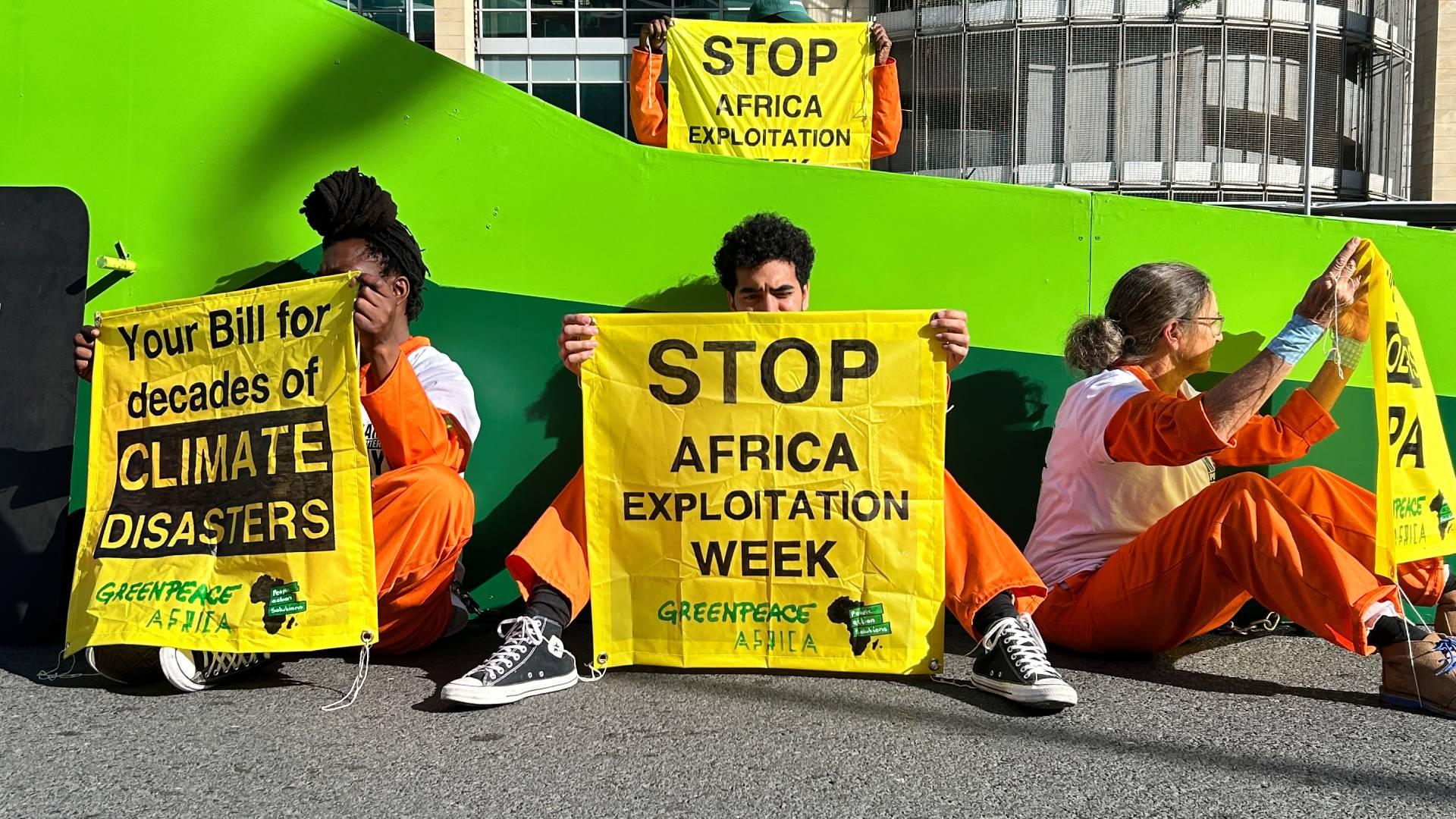
“Climate activists from Greenpeace Africa and Extinction Rebellion demonstrated outside the African Energy Week conference in Cape Town, opposing further oil and gas exploration and arguing that fossil-fuel expansion threatens the climate, vulnerable communities and Africa’s long-term development. Their protest has renewed debate about energy security, economic opportunity, environmental justice and whether new fossil-fuel projects are compatible with international climate commitments.”
Climate Activists Challenge Africa’s Oil and Gas Expansion at African Energy Week in Cape Town
A protest puts fossil-fuel development under political scrutiny
Climate activists gathered outside the African Energy Week conference in Cape Town on 13 October 2026, calling for an end to new oil and gas exploration projects across Africa. The demonstration, involving Greenpeace Africa and Extinction Rebellion, brought environmental concerns into the centre of a wider political debate about economic development, energy security, corporate responsibility and the continent’s future energy choices.
According to the Associated Press, protesters challenged the priorities of energy companies and governments that continue to promote fossil-fuel investment despite growing concerns about climate change. Demonstrators wore shirts carrying the message “Make polluters pay”, while protest leader Siya Myeza criticised the conference’s approach to African energy development. Police eventually removed protesters from the demonstration area.
The action illustrates how climate activism is increasingly challenging decisions made by governments, investors and energy companies. Rather than treating oil and gas exploration exclusively as an economic or technical question, activists are demanding that policymakers consider its environmental consequences, social costs and implications for future generations.
The protest also highlights a difficult question confronting South Africa: how can the country expand economic opportunities and strengthen its energy supply while meeting environmental responsibilities and protecting communities from climate-related harm?
Why African Energy Week became a protest target
African Energy Week brings together participants interested in energy investment, infrastructure and the development of African oil and gas resources. Supporters of fossil-fuel projects argue that investment can create employment, attract capital, generate public revenue and improve access to reliable energy.
For countries experiencing unemployment, poverty and infrastructure shortages, these arguments carry considerable political weight. Governments must demonstrate that their economic strategies can deliver tangible improvements to people’s lives, particularly in communities where opportunities remain limited.
However, environmental organisations question whether expanding fossil-fuel production offers the most sustainable route towards those objectives. They argue that investments in new oil and gas projects could prolong dependence on polluting energy sources, expose communities to environmental risks and divert financial resources from renewable alternatives.
The Cape Town demonstration therefore represented more than opposition to a single conference. It challenged the broader direction of African energy policy and the balance between immediate economic gains and long-term environmental responsibilities.
By targeting an industry gathering, activists sought to draw attention to the relationship between political decision-making and private investment. Their message was that energy development should be judged not only by the amount of money invested or the resources extracted, but also by who benefits, who bears the risks and whether the resulting economic activity supports a sustainable future.
South Africa’s energy choices and political tensions
South Africa faces competing demands when determining its energy future. Reliable and affordable electricity is essential for households, businesses, manufacturing and economic growth. At the same time, the country must address pollution, climate change and the long-term consequences of continued fossil-fuel dependence.
The government has promoted natural gas as a potential transition fuel, presenting it as one possible component of efforts to diversify energy supplies. Supporters contend that gas could complement renewable energy sources and help maintain reliable electricity during the transition.
Environmental activists challenge the assumption that additional gas infrastructure necessarily represents a practical or desirable transition. They warn that major investments can create long-lived assets and commercial incentives that encourage continued fossil-fuel use. Consequently, projects initially described as temporary solutions may complicate the expansion of cleaner alternatives.
The Associated Press report also highlighted controversy surrounding Shell’s plans to drill five deepwater wells off South Africa’s west coast. Such proposals have become part of wider disputes about exploration, environmental protection and the rights of coastal communities.
These disagreements raise questions about how government should assess energy projects. Policymakers must consider electricity demand, investment requirements, environmental impacts, consultation processes and the possibility of alternative technologies.
Activists argue that these decisions require meaningful public scrutiny rather than being determined primarily by commercial interests. Their protest places pressure on political leaders to explain how individual projects fit into national development plans and international climate commitments.
Climate change and environmental justice
A central concern expressed by protesters was that fossil-fuel expansion could worsen climate change and deepen existing inequalities. Climate-related disasters can damage homes, disrupt agriculture, threaten infrastructure and undermine livelihoods, with particularly serious consequences for people who have limited resources to recover.
In South Africa, environmental risks intersect with broader social challenges. Communities already experiencing poverty, inadequate services or insecure employment may have fewer opportunities to adapt to extreme weather and other environmental pressures.
Climate activism increasingly frames these challenges as questions of justice. The argument is that the benefits of extraction and energy production may be distributed differently from the environmental costs. Companies and investors may receive financial returns, while surrounding communities can face pollution, disruption or increased vulnerability.
Extinction Rebellion activist Judy Scott-Goldman warned about the consequences of climate change, including natural disasters and food insecurity, according to the Associated Press. Such concerns connect energy policy to everyday issues such as food prices, public health, employment and household security.
Nevertheless, environmental justice also requires attention to the workers and communities whose incomes depend on existing energy industries. A transition that eliminates employment without providing credible alternatives could deepen hardship and provoke resistance.
Consequently, a sustainable energy strategy must address both environmental protection and economic security. Activists, governments, labour organisations and businesses need to consider how communities can benefit from renewable energy investment, skills development and new employment opportunities.
The role of activism in democratic accountability
Peaceful protest is an important means through which citizens can challenge public policy and demand accountability. In this case, activists used a visible demonstration to question the priorities of influential organisations involved in African energy development.
Their approach reflects a broader strategy within civil society: bringing contested issues into public discussion, attracting media attention and encouraging policymakers to respond to concerns that might otherwise receive limited attention.
However, the effectiveness of activism depends on what follows the demonstration. Public visibility can influence debate, but meaningful progress generally requires sustained engagement, credible evidence, transparent policy proposals and opportunities for affected communities to participate.
Activists can strengthen their arguments by explaining the environmental and economic consequences of proposed projects, identifying viable alternatives and presenting clear demands to government institutions. They can also work with researchers, community organisations and professional bodies to evaluate the practical implications of different energy strategies.
Government authorities, meanwhile, have a responsibility to distinguish between legitimate dissent and unlawful conduct while respecting constitutional rights. The removal of demonstrators from the protest area illustrates the importance of examining how public-order measures are implemented during politically sensitive gatherings.
Maintaining public order should not eliminate the opportunity for peaceful criticism. Equally, effective democratic engagement requires that demonstrations remain safe and that disagreements are addressed through lawful processes.
Economic development and the renewable energy alternative
One of the central challenges raised by the protest is whether African countries can pursue economic development without expanding their dependence on fossil fuels.
Supporters of oil and gas exploration argue that Africa should be able to use its natural resources to finance development, strengthen energy security and increase industrial capacity. They also point to the continent’s continuing need for investment and improved access to modern energy services.
Environmental organisations counter that renewable energy offers opportunities to create a more sustainable economic foundation. Solar and wind power, supported by appropriate electricity networks, storage and other technologies, could contribute to diversified energy systems and reduce exposure to certain environmental risks.
However, renewable energy expansion requires planning, financing, infrastructure and technical expertise. Governments must consider grid capacity, affordability, reliability and the needs of workers currently employed in conventional energy industries.
A credible transition therefore cannot depend on slogans alone. It requires investment strategies that identify realistic projects, establish clear implementation timelines and ensure that the benefits of new industries reach communities facing economic disadvantages.
South Africa’s policy choices will influence how investors assess opportunities across the wider region. Transparent regulations, consistent planning and public participation can help establish whether energy projects contribute to development objectives without imposing unacceptable social or environmental costs.
Corporate responsibility and public participation
The demonstration also challenged energy companies to explain their responsibilities beyond financial performance. Activists argue that corporate investment decisions should account for climate impacts, environmental protection and the interests of people living near proposed developments.
Companies involved in exploration can respond by providing transparent environmental assessments, explaining potential risks and engaging communities before major decisions are finalised. Such measures cannot remove every disagreement, but they can help establish a clearer basis for public scrutiny.
Government institutions also have an important role. Regulators must assess applications according to applicable laws, enforce environmental requirements and ensure that consultation processes are meaningful. Where concerns are raised, decision-makers should provide understandable explanations of how competing interests have been considered.
Public participation becomes particularly important when projects may affect coastal environments, local livelihoods or access to natural resources. Communities need sufficient information to evaluate proposals and opportunities to raise concerns before decisions become difficult to reverse.
The political challenge is to ensure that consultation influences decisions rather than becoming a procedural exercise. When people believe their concerns are ignored, distrust can increase and disputes may become more difficult to resolve.
What the protest means for Africa’s energy future
The Cape Town demonstration reflects a wider disagreement about the direction of African development. Governments must respond to immediate needs for jobs, investment and reliable energy, while also preparing their economies for a world increasingly concerned about climate risks.
Neither economic development nor environmental protection can be treated as an isolated objective. Poorly planned energy projects may create long-term costs, while poorly managed transitions can impose serious economic hardship on workers and households.
The debate therefore requires evidence-based decisions, transparent institutions and practical alternatives. Policymakers should compare the economic benefits, environmental consequences and social implications of proposed projects instead of assuming that every investment is automatically beneficial or that every fossil-fuel project has identical consequences.
The protest does not, by itself, determine South Africa’s energy policy. Its significance lies in bringing competing priorities into public view and reminding decision-makers that energy choices have consequences extending beyond conference halls and corporate balance sheets.
Conclusion
Climate activists challenging African Energy Week have placed a fundamental political question before South Africa and the wider continent: what kind of energy development can deliver lasting prosperity without worsening environmental and social problems?
Their demonstration highlights the importance of climate accountability, community participation and transparent decision-making. It also underscores the need to recognise employment, energy access and economic growth as essential considerations when evaluating proposals for a transition away from fossil fuels.
The next steps will depend on whether governments, investors and civil society can move beyond confrontation towards credible plans, enforceable safeguards and measurable outcomes. For South Africa, the challenge is to pursue reliable energy and inclusive development while confronting climate risks honestly.
Ultimately, the protest’s lasting importance will be measured not simply by the attention it attracted, but by whether it contributes to better-informed public debate and more accountable decisions about Africa’s energy future.



