




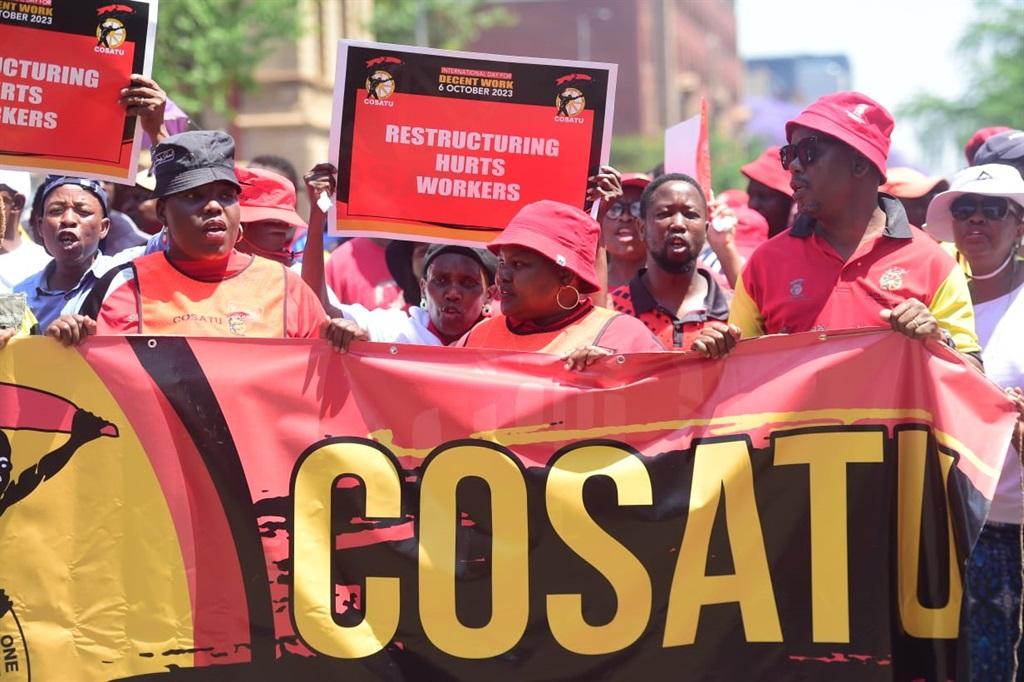
“The Congress of South African Trade Unions (COSATU) is taking its campaign for decent work to the streets across South Africa today, with nationwide marches and pickets focused on mass retrenchments, minimum-wage compliance, casualisation and the protection of workers’ rights. The mobilisation is significant politically because it places employment, economic inequality and the cost of living at the centre of public debate while South Africa approaches local government elections and organised labour confronts growing economic and internal organisational pressures.”
COSATU launches nationwide activism over jobs and workers’ rights
South Africa’s labour movement is taking its political and economic demands directly to the streets on Wednesday, 7 October, as the Congress of South African Trade Unions launches nationwide protest action to mark the International Day for Decent Work.
The demonstrations are expected to take place in major cities and towns across the country, bringing together workers and union members around a broad set of concerns, including retrenchments, non-compliance with the National Minimum Wage, casualisation, collective bargaining and inadequate social protection.
COSATU spokesperson Zanele Sabela said the federation’s action reflects growing concern about the pressure facing workers in an economy where unemployment remains exceptionally high. She said the federation would also target companies facing allegations or plans involving large-scale job losses, including Sun International and Massmart.
The protests therefore represent more than a traditional trade-union mobilisation. They are also a major form of political activism, with organised labour attempting to influence employers, government and public opinion over the direction of South Africa’s economy.
Retrenchments become a central political issue
One of the most important issues behind the demonstrations is the continuing threat of retrenchments.
COSATU says workers are confronting mass job losses at a time when unemployment is already extremely high. The federation has highlighted the contradiction between an economy struggling to create sufficient employment and companies continuing to restructure their operations and reduce staff numbers.
Among the organisations being targeted is Sun International, where COSATU says planned job reductions are a major concern. The federation is also demanding the reinstatement of Massmart workers dismissed in 2021 following a protected strike.
For organised labour, these cases demonstrate a broader problem: workers who lose employment can face years of economic insecurity, while communities dependent on those jobs can suffer reduced spending, declining household incomes and increased social pressure.
This makes employment policy a political question as much as an economic one.
A job is not only a source of income. It is connected to household stability, access to housing, education, healthcare and food. Consequently, when large numbers of workers lose their jobs, the effects can extend beyond individual companies and affect entire communities.
The fight for decent work
COSATU’s protest is also built around the concept of decent work, which goes beyond simply having employment.
The federation is challenging what it describes as increasing casualisation and non-compliance with minimum-wage requirements.
Casualisation has long been a concern for organised labour because temporary, insecure or poorly protected employment can weaken workers’ bargaining power. Workers may have employment but still lack predictable income, long-term security, benefits or meaningful opportunities for advancement.
The federation’s campaign therefore asks a fundamental question about South Africa’s economy: should economic growth be measured only through investment, production and company revenues, or should it also be judged by whether ordinary workers experience improvements in their livelihoods?
That question is especially significant in a country where unemployment, inequality and poverty remain major political concerns.
COSATU’s action has a wider political dimension
Although the immediate demands concern employment and labour rights, today’s mobilisation has a broader political significance.
COSATU is an important component of South Africa’s labour movement and has historically played a major role in national politics. Its activism has often placed pressure on government over economic policy, public services, wages and employment.
The timing of today’s protests is therefore important.
South Africa is moving toward local government elections, while voters are increasingly focused on service delivery, unemployment and the performance of political institutions. Recent reporting from Johannesburg shows that some residents are questioning whether elections can deliver meaningful improvements in their daily lives, particularly where communities continue to experience problems with electricity, jobs and basic services.
Against this backdrop, COSATU’s decision to mobilise workers gives economic grievances an organised political platform.
The demonstrations could consequently influence the broader national conversation about what political parties and governments should prioritise.
Pressure on government and business
COSATU’s demands are directed at both government and the private sector.
The federation wants employers to protect jobs and comply with labour standards, while also expecting government to create an economic environment capable of generating sustainable employment.
This places pressure on policymakers to address structural economic problems rather than relying only on short-term interventions.
The labour movement has previously warned about austerity, public-sector vacancies, budget reductions and disputes surrounding wage agreements. A recent COSATU organisational report highlighted the difficulties facing its large public-sector membership as government spending constraints affect recruitment and public services.
The federation has also argued that defending the public-sector wage bill is connected to protecting important redistributive functions of democratic South Africa.
This creates a difficult policy balance.
Government must manage public finances and debt while simultaneously responding to unemployment, shortages in critical services and pressure from workers demanding better wages and conditions.
COSATU’s protest demonstrates that this balance is becoming increasingly contested.
Workers face rising economic pressure
The activism comes at a time when households are also confronting increased living costs.
COSATU has recently criticised rising fuel prices and called for government to provide relief to consumers and businesses. The federation has argued that volatile international energy prices are placing additional pressure on South Africans already dealing with unemployment, poverty and inequality.
Higher transport and fuel costs can eventually affect the prices of food and other goods, increasing pressure on household budgets.
For workers, therefore, the definition of a decent job cannot be separated from the cost of living.
A worker may receive a wage increase, but if transport, electricity, food and other essential expenses rise faster, the practical improvement in living standards may remain limited.
This is why COSATU’s activism combines workplace issues with broader socioeconomic demands.
A test for organised labour
Today’s mobilisation also comes at an important moment for COSATU itself.
The federation has experienced internal disagreements, including disputes surrounding its national congress and leadership structures. Its congress was previously disrupted by disagreements over delegates before being scheduled to reconvene later in October.
That creates a significant test.
COSATU must demonstrate that internal political disagreements do not prevent it from addressing the problems facing workers.
The federation’s own leadership has acknowledged that unemployment, poverty, inequality, retrenchments and the cost of living remain central challenges for the working class.
Today’s nationwide action gives COSATU an opportunity to demonstrate organisational strength and reconnect its internal politics with the everyday concerns of workers.
The meaning of protest in a democracy
The protests also highlight the continuing importance of activism in South Africa’s democratic system.
Marches, pickets and strikes provide organised groups with a mechanism to place issues on the national agenda when they believe conventional political channels are not producing sufficient results.
South Africa has a long history of protest movements influencing political and social change. Modern activism takes many forms, including trade-union mobilisation, community protests, student demonstrations and civil-society campaigns.
COSATU’s action fits into that broader tradition.
At the same time, protest action creates responsibilities for organisers, authorities and participants. Demonstrations need to remain lawful and peaceful, while government and employers must take legitimate socioeconomic grievances seriously.
The effectiveness of activism ultimately depends not simply on the size of a march but on whether it produces meaningful engagement and measurable change.
What happens after the marches?
The key question now is what follows today’s demonstrations.
COSATU’s demands cover issues that cannot be resolved through a single protest. Reducing unemployment requires sustained economic growth, investment, skills development and policies that encourage job creation. Protecting workers requires effective enforcement of labour laws. Addressing casualisation requires stronger employment protections and bargaining structures.
Likewise, preventing retrenchments requires cooperation between employers, workers and government, particularly in industries undergoing restructuring.
Today’s marches can therefore be viewed as the beginning of another phase of pressure rather than the end of the campaign.
The government will face questions about how it intends to respond. Employers will also face scrutiny over their approach to restructuring and workforce reductions.
A significant day for South African political activism
COSATU’s nationwide protest action is one of the most significant activism stories in South Africa today because it combines a large-scale mobilisation with issues affecting millions of workers and households.
The federation is placing jobs, wages, workers’ rights and economic security at the heart of the national political conversation. Its campaign also comes at a time when public frustration over unemployment and basic services is influencing how South Africans view government and the approaching local political contest.
Whether today’s demonstrations lead to concrete policy changes remains to be seen. However, the mobilisation sends a clear message: organised labour believes South Africa’s economic future must be judged not only by financial indicators, but by whether ordinary people can secure stable employment, earn decent incomes and live with greater economic dignity.
For COSATU, the challenge will be turning today’s street-level activism into sustained negotiations, policy pressure and tangible improvements for workers.
For government and business, the challenge is equally clear: respond to the concerns behind the protests before economic frustration develops into even deeper political dissatisfaction.



