




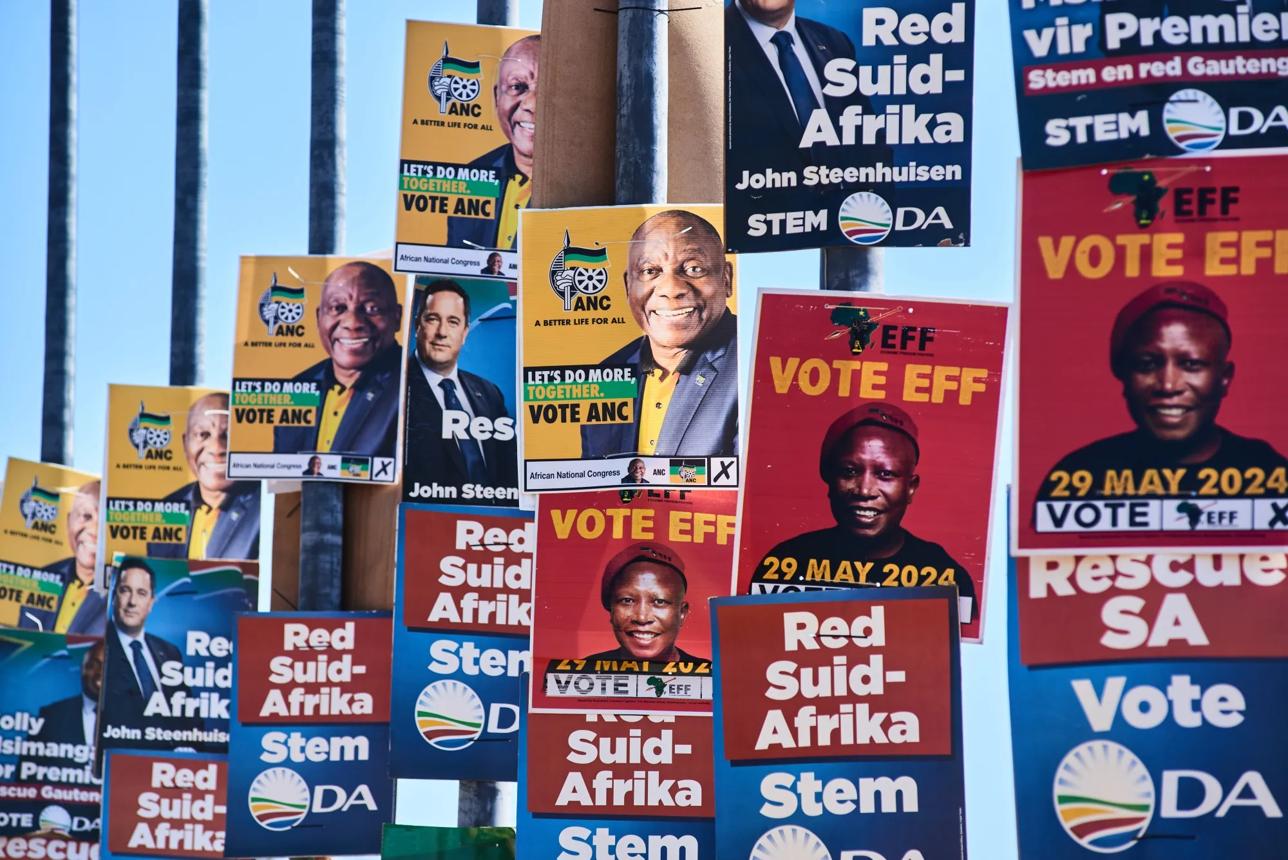
“A social-media campaign calling on South Africans not to vote for the ANC, DA or EFF is gaining attention less than a month before the 4 November 2026 local government elections, highlighting widespread frustration over service delivery and dissatisfaction with established political parties. The trend comes as polling points to a fragmented electorate, declining support for the ANC in several areas, strong competition from opposition parties and growing uncertainty about whether voters will participate at all.”
Growing frustration becomes a political message
South Africa’s political conversation has entered a critical stage as voters prepare to elect new municipal leaders on 4 November. With the campaign intensifying, political parties are attempting to persuade voters that they have the policies, leadership and organisational capacity required to improve local government.
However, a striking message circulating on social media is challenging the country’s three major political formations: the African National Congress (ANC), Democratic Alliance (DA) and Economic Freedom Fighters (EFF).
The phrase “DON’T VOTE ANC, DA & EFF” has been trending on X, formerly known as Twitter, according to The Citizen. The message is significant because it does not simply promote one alternative party. Instead, it expresses rejection of three prominent political organisations and reflects a broader question among voters: Are established political parties still capable of delivering the change South Africans want?
The debate is particularly important because local elections are often determined by practical issues that directly affect people’s daily lives. Water shortages, electricity interruptions, potholes, crime, municipal finances and unreliable services can have a much stronger influence on voters than national political rhetoric.
For many communities, therefore, the election represents an opportunity to judge political parties according to their record in government rather than simply their promises.
Service delivery is at the centre of public dissatisfaction
The Citizen reported that several municipalities are struggling with persistent service-delivery problems. These include communities experiencing prolonged water shortages, electricity problems, crime and deteriorating roads.
These problems help explain why anti-establishment messages can gain traction online.
A voter who has experienced repeated failures in basic municipal services may become less interested in traditional party loyalties. Instead, that voter may begin looking for an alternative candidate or party, or may decide not to vote altogether.
This creates two possible consequences for the November election.
The first is voter realignment, in which dissatisfied voters move from established parties to smaller or emerging political formations.
The second is political disengagement, in which citizens become so frustrated that they stay away from the ballot box.
Both possibilities could have major consequences for South Africa’s local political landscape.
Professor Andre Duvenhage, a political analyst and academic at North-West University, told The Citizen that social media is increasingly important in reaching voters during the election campaign. He also cautioned that some online campaigns may have political origins rather than being entirely spontaneous expressions of public anger.
That distinction matters because social-media popularity does not automatically translate into votes.
A slogan can trend nationally while having limited impact in individual wards. Conversely, a relatively quiet campaign can produce substantial support among voters who are not particularly active online.
Polling shows an increasingly fragmented electorate
The social-media debate is taking place against a wider backdrop of political fragmentation.
A 7 October analysis by The Common Sense compared News24/SABI polling with polling conducted by The Common Sense and the Social Research Foundation. Although the polling organisations use different methodologies, their results show broadly similar trends.
Nationally, the combined polling indicates that the ANC has been losing ground while the DA remains competitive. The Common Sense/SRF polls placed ANC support at 39% in March and 34% in July, compared with 28% and 27% respectively for the DA. The News24/SABI poll placed the ANC at 32% and the DA at 25% in its reported results.
The important point is not simply the precise percentage recorded by any individual poll. Rather, it is the broader movement of voters between parties.
The Common Sense analysis says the ANC is losing ground nationally and in several major metropolitan areas, while the DA has emerged as the largest party in Johannesburg and Tshwane and the MK Party has become particularly strong in eThekwini.
This suggests that South Africa’s electorate is not necessarily moving uniformly toward one opposition party.
Instead, voters appear to be making different choices depending on geography, political identity, local government performance and their perceptions of individual parties.
The MK Party could benefit from dissatisfaction
The Citizen’s report highlights another important dimension of public opinion: the potential beneficiary of dissatisfaction with the established parties.
Political analyst Duvenhage suggested that the MK Party could benefit if voters reject the ANC, DA and EFF. He pointed to polling showing strong support for MK despite organisational and financial difficulties within the party.
The eThekwini contest is particularly significant.
The Common Sense analysis found that polling from different organisations points toward the MK Party becoming the biggest political formation in eThekwini, although it may fall short of an outright majority.
This illustrates why public opinion ahead of local elections cannot simply be interpreted as a national popularity contest.
South Africa’s municipal system means that political outcomes will vary significantly from one municipality to another. A party may perform strongly in KwaZulu-Natal while struggling in Gauteng. Another may lead in Johannesburg but require coalition partners to govern.
Consequently, the November election could produce a complicated political map in which coalition negotiations become as important as election-night victories.
Low turnout is another warning sign
Perhaps the most serious expression of public dissatisfaction is not necessarily a vote for another party but the decision not to vote.
An analysis published by EWN on 6 October examined concerns about declining voter participation. The IEC estimates that around 40 million South Africans are eligible to vote, while just over 29 million are registered.
Dr Steven Gordon, a chief research specialist at the Human Sciences Research Council, argued that declining participation can damage democratic representation. He said dissatisfaction with politicians can produce political disengagement, particularly when citizens believe political leaders do not listen to them.
Young voters are a particular concern.
Gordon said Generation Z is among the groups least likely to register or say they intend to vote, not necessarily because young South Africans do not care about political or economic issues, but because many do not believe politicians care about them.
That finding is crucial to understanding the current public-opinion environment.
A population can be deeply interested in politics while simultaneously losing confidence in political institutions.
People may discuss unemployment, electricity, crime, housing, municipal corruption and the cost of living every day while concluding that voting will not change their circumstances.
Social media can amplify dissatisfaction
The “DON’T VOTE ANC, DA & EFF” campaign demonstrates how political communication is changing.
Traditional political campaigns generally depend on rallies, posters, television appearances, radio interviews, door-to-door canvassing and political speeches. Social media adds another powerful channel in which ordinary citizens can create political messages themselves.
The advantage for political movements is speed.
A slogan can spread across thousands of accounts within hours. However, the disadvantage is that social-media trends can create an exaggerated impression of how widely a particular political view is held.
An online campaign therefore needs to be interpreted alongside polling, turnout data, constituency-level information and actual election results.
This is especially important in South Africa, where political preferences differ considerably between provinces and municipalities.
Voters face a crowded political choice
South Africans are heading toward the local elections with more political choices than ever, but the increasing number of parties does not necessarily make the decision easier.
Instead, voters must assess whether parties can provide effective municipal government.
The central question may ultimately become less about ideology and more about performance.
Can a municipality maintain reliable water and electricity services? Can it repair roads? Can it manage its finances? Can it combat corruption? Can councillors respond to residents? Can coalition partners cooperate after the election?
These questions could determine whether established parties retain support.
The latest polling suggests that voters are increasingly willing to consider alternatives, while the social-media campaign demonstrates the depth of frustration among some citizens.
However, the election remains unpredictable.
Polls measure opinion at a particular moment. Social-media trends measure online attention. Neither can guarantee the final result.
What the November election could reveal
The 4 November local government elections could become an important test of public confidence in South Africa’s political system.
If dissatisfied voters switch parties, the country could see further fragmentation and more coalition governments.
If large numbers stay away from the polls, however, the bigger story could be declining participation and political trust.
If established parties manage to retain their support despite criticism, the current social-media backlash may prove less electorally important than it appears.
For now, the message circulating online is nevertheless significant because it captures a broader public debate: South Africans are demanding political parties that can demonstrate practical results rather than simply make promises.
The coming weeks will show whether frustration translates into votes, whether voters migrate toward alternative parties, or whether disillusionment produces abstention.
What is already clear is that public opinion has become one of the most important battlegrounds of the 2026 local government election campaign.



