




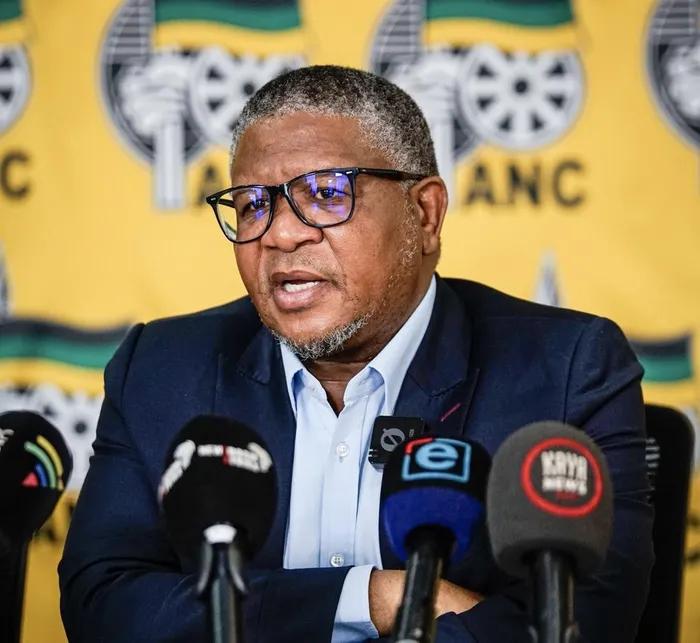
“ANC Secretary-General Fikile Mbalula is facing multiple legal battles as the African National Congress prepares for South Africa’s 4 November 2026 local government elections, creating additional organisational and political pressure on a party already confronting internal disputes and declining electoral support. Political analyst Professor Dirk Kotzé says the disputes are particularly significant because Mbalula is central to coordinating the ANC’s election campaign, while the party is simultaneously dealing with candidate-list controversies and competition from parties such as the MK Party.”
Mbalula’s legal battles expose wider ANC pressures
The African National Congress is entering the final weeks before South Africa’s local government elections under considerable political pressure, with Secretary-General Fikile Mbalula at the centre of several disputes that have moved into the courts. The latest concerns are significant not simply because they involve one of the party’s most senior officials, but because they are unfolding at a critical point in the ANC’s campaign to recover support and strengthen its position in municipalities across the country.
Mbalula is currently involved in a defamation case against ANC NEC member and former cabinet minister Nkosazana Dlamini-Zuma. The dispute follows allegations by Dlamini-Zuma concerning the use of money to influence delegates during the ANC’s internal elective processes. Mbalula has denied the allegations, and the Gauteng High Court has ordered Mbalula, Dlamini-Zuma and relevant witnesses to give evidence and face cross-examination.
The court proceedings do not constitute a finding that Mbalula committed vote-buying or any other wrongdoing. Rather, the court has determined that factual disputes surrounding the allegations should be tested through oral evidence. Mbalula has maintained that the allegations are false and has welcomed the opportunity for the evidence to be examined under oath.
The timing nevertheless creates a political problem for the ANC. Mbalula is not an ordinary party official who can easily step away from public political activity while legal matters proceed. As secretary-general, he occupies one of the most important organisational positions in the ANC and is deeply involved in the party’s preparations for the local elections. His legal disputes therefore have the potential to compete for attention with the ANC’s campaign message.
Professor Dirk Kotzé of the University of South Africa told 702 that the legal battles come at a particularly difficult time because Mbalula is central to the ANC’s election campaign. He noted that local government elections are complicated because campaigning must operate across hundreds of municipalities while simultaneously requiring coordination from the party’s national structures.
Candidate-list disputes deepen the challenge
The Mbalula-Dlamini-Zuma case is only one of the legal difficulties confronting the ANC. A separate court battle involves ANC NEC member Andile Lungisa, whose removal from the ANC’s proportional representation candidate list for Nelson Mandela Bay has become the subject of litigation.
Lungisa has challenged the decision in the Johannesburg High Court. He argues that he emerged through the party’s internal nomination process and was ranked first on the Nelson Mandela Bay list. He has alleged that Mbalula personally instructed officials to remove him, although Mbalula has rejected that claim. According to Mbalula, he did not personally order Lungisa’s removal and instead acted on an instruction from the ANC Electoral Committee.
The dispute has become sufficiently serious that ANC First Deputy Secretary-General Nomvula Mokonyane has called for political intervention. Mokonyane said the disagreement should not become something publicly portraying the ANC as being in disorder and argued that the party should consider resolving the matter outside court where possible. The Johannesburg High Court has reserved judgment in the Lungisa matter until 12 October.
For a political party preparing for an election, such disputes carry consequences beyond the individual cases. Candidate selection is closely connected to the credibility of a party’s internal processes. When candidates and senior members challenge those processes in court, opposition parties can use the disputes to question whether the ANC is sufficiently organised to manage municipalities effectively.
The broader candidate-list crisis
The Lungisa dispute is also taking place against the backdrop of a wider ANC candidate-list controversy. The party has been fighting to have candidates included in the November elections after disputes involving its submissions to the Independent Electoral Commission.
The ANC has challenged an Electoral Court decision concerning 181 candidates excluded from the elections in six municipalities. The affected areas include municipalities in the Eastern Cape, KwaZulu-Natal and the Free State. Mbalula has warned that failure in the Constitutional Court could negatively affect the ANC’s electoral performance.
The IEC, however, has argued that the ANC failed to complete the required online nomination process. According to the commission, uploading candidate information was not enough because parties were required to complete the final submission process. The ANC has argued that technical problems affected its submissions.
This dispute matters because local government elections depend heavily on party organisation. Candidate nominations, ward structures, campaign teams and municipal-level coordination must all operate effectively. Any failure in these areas can have direct electoral consequences.
SABC News has also reported internal dissatisfaction in the Eastern Cape, where ANC members raised concerns about candidate lists and the party’s failure to upload candidates because of what it described as technical glitches. The party’s National Working Committee has been assessing the situation while preparing for the election campaign.
Competition is becoming more intense
The ANC’s legal and organisational challenges are unfolding in an increasingly competitive political environment. South Africa’s political landscape has become more fragmented since the 2024 national elections, when the ANC lost its national majority and entered the Government of National Unity.
At local level, the consequences of this fragmentation could be even more pronounced. Parties such as the Democratic Alliance, Economic Freedom Fighters, MK Party, Patriotic Alliance and smaller organisations are seeking to convert dissatisfaction with established parties into electoral gains.
The MK Party is particularly important in the ANC’s calculations in KwaZulu-Natal and Gauteng. Professor Kotzé told 702 that the ANC is watching the MK Party closely in both provinces. He also argued that the ANC faces a broader problem of public trust, with voters questioning whether the party remains sufficiently focused on public service rather than internal political interests.
The Patriotic Alliance is also emerging as an increasingly disruptive force, particularly in the Western Cape. EWN reported on 7 October that the party’s support is being driven partly by its appeal to coloured and working-class communities and by its ability to mobilise voters who have historically stayed away from elections.
Meanwhile, the DA has been campaigning aggressively around service delivery and economic opportunity. During its Working for All tour in Mangaung, DA leader Geordin Hill-Lewis encountered voters demanding sustainable employment, investment and improved municipal services.
ANC faces a trust deficit
The most serious issue for the ANC may therefore not be any individual court case but the cumulative effect of internal disputes on public confidence.
Kotzé said the ANC needs to acknowledge that it has made serious mistakes and respond to voters who believe the party has moved away from its traditional focus on public service. Rebuilding trust, he suggested, will be difficult because voters will want evidence that the ANC’s new promises represent genuine organisational change rather than another election campaign message.
The ANC itself has acknowledged organisational weaknesses. Eastern Cape ANC chairperson Oscar Mabuyane recently cited organisational problems, factionalism, governance failures and declining municipal capacity as some of the factors affecting the party. He also indicated that cooperation with the South African Communist Party could become necessary after the elections if electoral results produce fragmented municipal councils.
That possibility reflects how much South African party politics has changed. The ANC can no longer automatically assume that it will govern municipalities alone. In some areas, coalition agreements or cooperation with other parties may determine who controls councils.
What the legal battles mean for the election
The immediate question is whether the legal disputes will materially damage the ANC’s campaign. Much will depend on whether the party can keep its campaign focused on local issues such as water, electricity, roads, housing, jobs, municipal finances and service delivery rather than allowing internal disputes to dominate public discussion.
Mbalula has rejected suggestions that the ANC is collapsing, particularly in the Eastern Cape. He has argued that the party remains operational, with regional structures campaigning and working on service-delivery concerns.
However, the scale and number of legal disputes make the ANC’s organisational task more difficult. Every court case requires political attention, while every candidate-list dispute can create tensions among local structures and candidates. At the same time, the party must convince voters that it has the organisational discipline necessary to manage municipalities.
The elections therefore represent more than another contest for council seats. For the ANC, they are an important test of whether the party can reverse the electoral decline that became evident in 2024.
Mbalula’s legal battles have become a symbol of that wider challenge. The cases themselves will be determined through legal processes, and allegations should not be treated as established facts. Nevertheless, their political significance cannot be ignored because they involve a senior party official at the centre of the ANC’s campaign machinery.
With voting day approaching on 4 November, the ANC will need to demonstrate unity, organisational competence and a credible commitment to service delivery. Whether it can move public attention away from internal disputes and towards its municipal programme may prove decisive.
For voters, the ultimate judgement will not come from the courts. It will come at the ballot box, where South Africans will decide whether the ANC and its candidates have earned another opportunity to govern their municipalities.



