




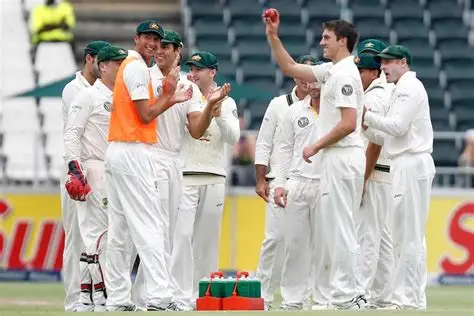
“Australia captain Pat Cummins has confirmed he will use upcoming ODIs against South Africa as preparation for October’s three-Test series, their first in the country since the 2018 ball-tampering scandal. The series is seen as crucial, with both teams currently leading the World Test Championship standings and eyeing qualification for the 2027 final.”
The Australian cricket team, fresh from a commanding victory over Bangladesh, has now shifted its attention to South Africa. The upcoming tour is not just another fixture—it represents a chance for redemption, historical significance, and a test of resilience. With the scars of the 2018 “Sandpapergate” scandal still lingering and the sting of last year’s World Test Championship final defeat at Lord’s, the October series against South Africa is shaping up to be one of the most anticipated contests in recent cricket history.
Background: From Bangladesh to South Africa
Australia’s innings-and-51-run triumph over Bangladesh in Mackay highlighted their dominance, particularly with Cummins leading from the front with a six-wicket haul. Yet, the captain wasted no time in redirecting focus to the Proteas. The Aussies will first play three ODIs in Zimbabwe, followed by three in South Africa in late September, before embarking on the Test series in Durban, Gqeberha, and Cape Town.
The Weight of History
This will be Australia’s first Test series in South Africa since the infamous ball-tampering scandal in Cape Town in 2018. That incident saw Steve Smith and David Warner banned for a year, while the team’s reputation took a severe hit. For Cummins, who was part of that squad, the return carries symbolic importance. He has openly acknowledged the “big” nature of the series, noting that revenge is on his mind after South Africa outplayed Australia in the WTC final last year.
Key Players and Selection Questions
Only six members of the current Australian squad have prior Test experience in South Africa: Cummins, Mitchell Starc, Josh Hazlewood, Nathan Lyon, Steve Smith, and Matt Renshaw. This relative inexperience could be a factor, especially given the challenging conditions across venues. Durban’s pitches differ significantly from Cape Town’s, demanding adaptability. Meanwhile, questions loom over Marnus Labuschagne’s form, with the No. 3 batsman struggling against Bangladesh and failing to score a century since 2023.
Strategic Priorities
Cummins has made it clear that the ODIs will serve as preparation for the Tests. While he may skip the Zimbabwe leg, he intends to feature in some of the South Africa ODIs to sharpen his red-ball readiness. Starc and Hazlewood are expected to follow similar paths, prioritizing Tests over limited-overs cricket. This strategy underscores Australia’s determination to reclaim dominance in the longest format.
South Africa’s Challenge
The Proteas, buoyed by their WTC triumph, will be eager to defend home turf. Led by Aiden Markram and Kagiso Rabada, South Africa has proven its ability to dismantle Australia’s batting and exploit weaknesses. Their familiarity with local conditions gives them a significant edge, and the series could well be a preview of the 2027 WTC final.
Broader Implications
Beyond cricketing rivalry, the series carries broader implications for the sport. It represents a test of Australia’s ability to move past its darkest chapter, while for South Africa, it is a chance to solidify its reputation as a powerhouse in world cricket. The outcome will influence rankings, morale, and the narrative leading into the next WTC cycle.
Conclusion
As October approaches, anticipation builds for what promises to be a gripping contest. For Cummins and his men, the series is about more than runs and wickets—it is about redemption, resilience, and rewriting history. For South Africa, it is about asserting dominance and proving that their WTC triumph was no fluke. Cricket fans worldwide will be watching closely, knowing that this clash could define the trajectory of both teams for years to come.



