




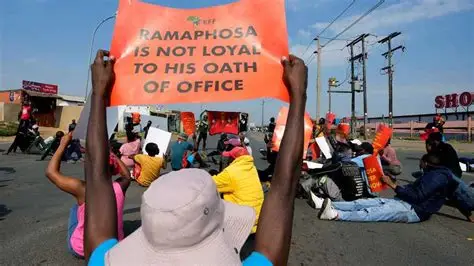
“The EFF and MK Party have launched a motion of no confidence against Speaker Thoko Didiza, accusing her of undermining Parliament’s independence during the Phala Phala impeachment inquiry. While the motion is unlikely to pass due to ANC dominance, it has ignited a wave of political activism highlighting accountability and parliamentary sovereignty.”
South Africa’s political landscape is once again dominated by activism within Parliament. On August 27, 2026, the Economic Freedom Fighters (EFF), supported by the uMkhonto weSizwe (MK) Party, tabled a motion of no confidence against National Assembly Speaker Thoko Didiza. This move, though unlikely to succeed, has become a focal point for debates about parliamentary independence, accountability, and the role of activism in governance.
Background to the Motion
The roots of this motion trace back to June 2026, when the EFF first raised concerns about Didiza’s refusal to oppose President Cyril Ramaphosa’s court interdict against the Phala Phala impeachment inquiry. Opposition parties argue that her stance undermined Parliament’s independence, prioritizing loyalty to the executive over institutional accountability. Didiza, however, defended her decision, citing legal advice and Constitutional Court precedent, claiming she saved Parliament from costly litigation.
Activism and Political Mobilization
This motion is not merely a parliamentary maneuver—it is a manifestation of political activism. The EFF and MK Party have positioned themselves as defenders of parliamentary sovereignty, framing their campaign as a grassroots struggle against executive overreach. Activists argue that Parliament must serve as a check on presidential power, and Didiza’s stance represents a dangerous precedent of subservience.
Social media has amplified this activism, with hashtags and online campaigns calling for accountability. Citizens are divided: some praise Didiza for protecting taxpayer money, while others accuse her of shielding Ramaphosa from scrutiny. This digital activism underscores how parliamentary debates increasingly spill into public discourse.
Parliamentary Dynamics
Despite the fervor, the motion is unlikely to succeed given the ANC’s numerical strength in Parliament and its coalition partners. Yet, the debate itself is significant. It exposes fractures within the Government of National Unity (GNU) arrangement, where opposition parties continue to challenge ANC dominance. The activism-driven motion forces MPs to publicly declare their stance on parliamentary independence, potentially influencing future coalition negotiations.
Broader Implications for Activism
The motion reflects a broader wave of activism in South Africa’s political environment. From Operation Ubuntu marches demanding justice and safety to parliamentary campaigns for accountability, activism is reshaping governance. Citizens are increasingly mobilizing both in the streets and within institutions, demanding transparency and accountability.
Voices from the Opposition
EFF leader Julius Malema declared that Didiza’s actions “betray the people’s trust in Parliament as an independent institution.” MK Party representatives echoed this sentiment, emphasizing that the Speaker’s role must be impartial and protective of parliamentary sovereignty. These voices highlight the intersection of activism and opposition politics, where parliamentary maneuvers are framed as part of a larger struggle for justice.
Government Response
The ANC and its allies have dismissed the motion as political theatre. They argue that Didiza acted responsibly, protecting Parliament from unnecessary legal battles. Yet, the government’s cautious stance reflects an awareness of the growing activist pressure that continues to shape public discourse.
Conclusion
While the motion of no confidence against Speaker Thoko Didiza is unlikely to succeed, its significance lies in the activism it represents. It underscores the growing role of political activism in shaping governance, forcing debates about accountability, independence, and the balance of power. Whether in Parliament or on the streets, activism continues to be a driving force in South Africa’s evolving democracy.



