




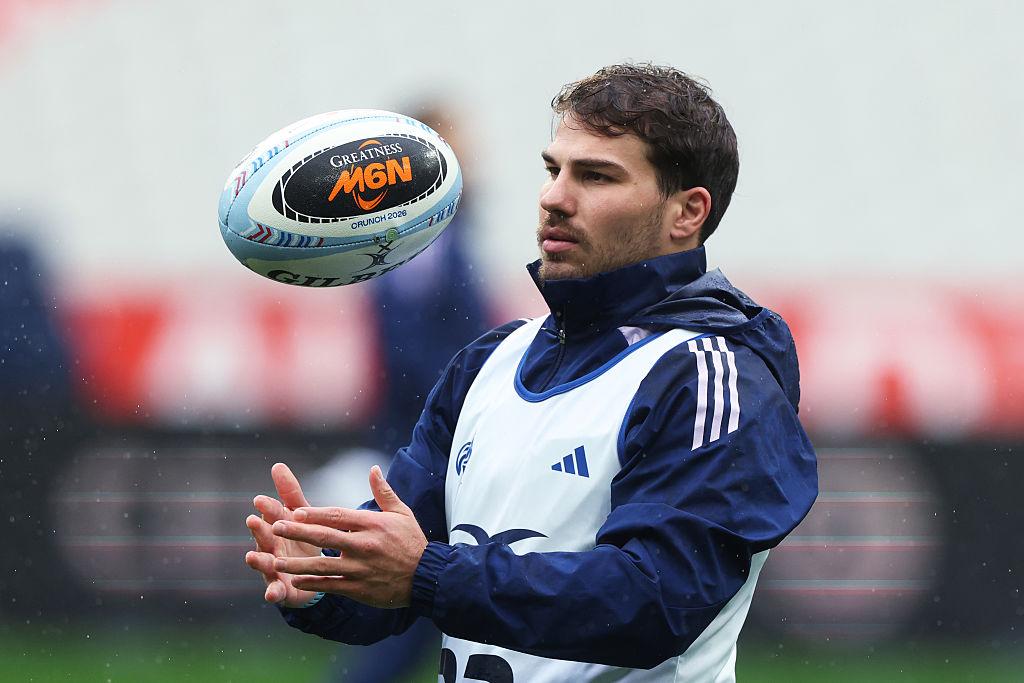
”France have strengthened and reshuffled their squad by bringing in seven players ahead of their Nations Championship meeting with South Africa, following their 54–17 victory over Fiji. The changes include the return of experienced centre Gaël Fickou and winger Teddy Thomas, while flyhalf Romain Ntamack has been ruled out after suffering a shoulder injury.”
France Reinforce Squad Ahead of Springboks Clash as Ntamack Injury Changes Nations Championship Preparations
France have made significant changes to their national rugby squad ahead of their upcoming Nations Championship encounter against South Africa, calling up seven additional players following their victory over Fiji. The announcement comes at an important moment in the international rugby calendar, with the Springboks preparing for another demanding test after their emphatic performance against Italy.
The French squad adjustment has attracted attention in South Africa because of the importance of the upcoming contest between two of international rugby’s leading teams. France’s decision to recall experienced players while addressing an injury concern involving flyhalf Romain Ntamack highlights the competitive pressure surrounding the Nations Championship.
According to Reuters, France have expanded their reshuffled squad to 42 players, with the changes following their 54–17 victory over Fiji in Lyon. The most notable development is Ntamack’s absence after he sustained a left shoulder injury during the match.
France Make Seven Changes as Preparations Intensify
France’s decision to bring seven players into their squad reflects the importance of maintaining depth during a demanding international competition.
Among the returning players is winger Teddy Thomas, who has been recalled to the national team after a five-year absence. The 33-year-old last represented France in July 2021 and has accumulated 28 international appearances.
His return gives France another experienced attacking option as the coaching staff prepares for the challenge posed by South Africa.
Centre Gaël Fickou is another significant addition. The experienced midfielder is approaching the milestone of 100 international appearances and brings valuable experience to the French backline.
Fickou’s potential involvement against the Springboks would add another dimension to France’s preparations, particularly in the areas of defensive organisation, communication and attacking distribution.
Hooker Julien Marchand has also returned after recovering from injury. His availability could strengthen France’s forward resources, especially in the set-piece areas that are likely to become important against South Africa.
The additional selections also include winger Gaël Dréan, who has returned following a lengthy absence associated with cardiac surgery earlier in the year.
Pau teammates Grégoire Arfeuil and Loïc Credoz have also received opportunities within the expanded squad.
The selections demonstrate France’s willingness to combine experienced international players with emerging talent while preparing for one of their most demanding fixtures of the competition.
Ntamack Injury Creates a Significant Selection Challenge
The most concerning development for France is the injury to Romain Ntamack.
The flyhalf sustained a left shoulder injury during the victory over Fiji and has been ruled out of the Springboks encounter. Louis Carbonel has been brought into the squad as a replacement.
Ntamack has played an important role in France’s attacking structure, particularly through his ability to combine tactical kicking, distribution and decision-making.
His absence therefore represents more than a straightforward personnel change.
A flyhalf is responsible for controlling important aspects of a team’s attacking organisation. The position requires a player capable of reading defensive formations, managing territory, making accurate tactical kicks and deciding when to accelerate attacking play.
France will consequently need to adjust their preparation to ensure that the player selected in the position can maintain the team’s tactical balance.
Carbonel’s inclusion provides an alternative option, although the French coaching staff will have to consider the different characteristics of their available playmakers.
For South Africa, the injury introduces another variable into preparations.
The Springboks will need to prepare for France’s likely tactical approach rather than relying exclusively on assumptions about the opposition’s original selection.
Springboks Arrive After Dominant Victory Over Italy
South Africa’s preparations have been strengthened by an impressive performance against Italy.
The Springboks defeated Italy 66–7 in Turin on Saturday, 7 November, maintaining their unbeaten Nations Championship campaign and collecting a substantial points contribution from their attacking performance.
South Africa scored nine tries and established a commanding 45–0 halftime advantage.
The performance demonstrated the effectiveness of the Springboks’ forward dominance, tactical kicking and finishing ability.
Malcolm Marx scored twice during the opening half, while Siya Kolisi and Damian Willemse also contributed to South Africa’s attacking effort.
Flyhalf Sacha Feinberg-Mngomezulu was another important contributor, finishing the match with 24 points through tries and successful goal-kicking.
The Springboks’ victory reinforced their position as one of the competition’s leading teams.
However, the result does not mean South Africa can approach France without further improvement.
Springbok coach Rassie Erasmus has already indicated that the team must improve despite its comprehensive victory over Italy.
The coaching staff will therefore be expected to evaluate the performance carefully, identifying areas requiring attention before the French challenge.
Why the France Match Matters for South Africa
The upcoming encounter presents South Africa with a different tactical challenge from the one experienced against Italy.
France possess considerable attacking ability, particularly through their capacity to move the ball quickly and exploit defensive weaknesses.
Their attacking structure can place considerable pressure on opponents when their forwards establish momentum and their backs receive opportunities in space.
South Africa will consequently need to maintain defensive discipline throughout the contest.
The Springboks’ physical approach has traditionally been an important component of their international success. Their forward pack can establish pressure through scrummaging, mauling, breakdown work and repeated carrying.
Nevertheless, physical dominance alone will not necessarily guarantee victory.
France’s ability to respond to pressure, maintain possession and create attacking opportunities could make the match significantly more competitive.
The Springboks will also have to manage their discipline, particularly when defending near their own try line.
Penalties can provide France with opportunities to gain territory, establish attacking platforms and place pressure on South Africa’s defensive organisation.
Forward Battle Could Determine the Outcome
One of the central areas of interest will be the contest between the two forward packs.
South Africa’s performance against Italy demonstrated the effectiveness of its driving maul and structured forward attack.
The Springboks repeatedly established opportunities through their forwards, allowing their backs to benefit from attacking platforms created close to the opposition’s defensive line.
France will need to prevent South Africa from establishing similar dominance.
Marchand’s return could prove particularly important in this context because of his experience in the French set-piece structure.
The French forwards will need to contest possession aggressively, protect their own ball and ensure that South Africa cannot repeatedly dominate the breakdown.
The scrum will also be an important area of preparation.
Both teams understand the strategic value of winning penalties and establishing territorial advantages through set-piece pressure.
Consequently, the forward battle could influence the tactical direction of the match from the opening minutes.
Experience and Depth Become Important Factors
France’s squad changes underline the importance of international depth.
The Nations Championship places significant demands on players because of the physical intensity of consecutive international fixtures.
Injuries, fatigue and tactical adjustments can require coaches to introduce players who were not initially expected to participate.
France’s recall of Thomas and Fickou demonstrates the value of experienced international players during periods of uncertainty.
Their familiarity with international rugby can help maintain communication and tactical organisation when circumstances change.
At the same time, the inclusion of younger players provides opportunities for France to assess their developing talent.
This combination of experience and emerging players could become particularly important if France encounter further injury challenges.
South Africa also faces similar considerations.
The Springboks have assembled a squad with considerable international experience, but maintaining player availability remains essential throughout the competition.
The coaching staff must balance the demands of winning immediately with the need to preserve players for subsequent fixtures.
Nations Championship Adds Greater Competitive Pressure
The Nations Championship provides an important international platform for teams from the northern and southern hemispheres.
South Africa’s performances against northern hemisphere opposition are particularly significant because they offer opportunities to measure the Springboks against different tactical approaches.
The competition also provides a meaningful environment for evaluating squad depth and consistency.
France’s preparations demonstrate how rapidly circumstances can change during an international campaign.
A team that enters a match with an established tactical plan may need to reconsider its approach following an injury or an opponent’s unexpected selection decision.
For South Africa, the challenge is to remain adaptable while maintaining the principles that have contributed to the team’s success.
The Springboks’ victory over Italy provides a positive foundation, but France represents another opportunity to demonstrate their ability to perform against elite opposition.
What South Africa Must Watch
Several tactical areas could determine the outcome of the France encounter.
First, South Africa must maintain effective defensive organisation.
France’s attacking players are capable of exploiting gaps when defensive systems become disconnected.
Second, the Springboks need to establish territorial control through accurate kicking and disciplined decision-making.
Third, the forward pack must continue producing strong performances in the scrum, lineout and driving maul.
Finally, South Africa must avoid unnecessary penalties that could allow France to establish attacking momentum.
The French coaching staff will also be evaluating similar areas, particularly how their reshuffled squad can maintain consistency following Ntamack’s injury.
Conclusion: France’s Changes Add Another Dimension to Springboks Preparations
France’s decision to recall seven players ahead of their Nations Championship encounter with South Africa has introduced another important development into the international rugby weekend.
The return of experienced players such as Teddy Thomas, Gaël Fickou and Julien Marchand strengthens France’s available resources, while Ntamack’s shoulder injury creates a significant selection challenge.
South Africa, meanwhile, enters the preparations after a commanding 66–7 victory over Italy.
The Springboks have demonstrated considerable attacking strength, but their coaching staff will continue focusing on improvements ahead of the next challenge.
Ultimately, the France encounter promises to provide a valuable examination of South Africa’s tactical discipline, forward strength and ability to adapt to changing international circumstances.
With both teams possessing considerable rugby experience and attacking potential, the match represents one of the most significant upcoming challenges in the Nations Championship.
The developments surrounding France’s squad demonstrate that preparation, depth and adaptability remain essential elements of international rugby success.
For South Africa, the priority will be to transform the confidence gained against Italy into another disciplined and effective performance against a formidable French side.



