




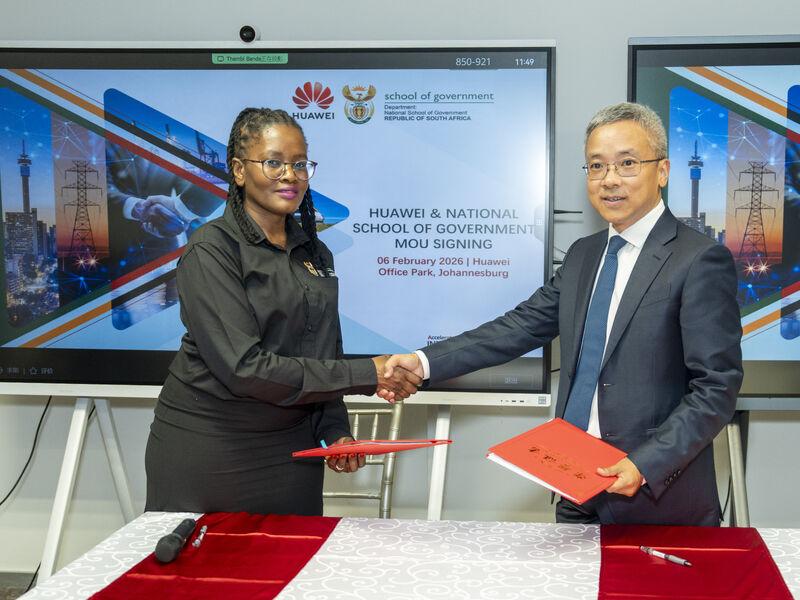
“Huawei used South Africa’s 2026 Government Technology Conference (GovTech) to outline how artificial intelligence, cloud computing, shared digital platforms and data infrastructure could support the country’s transition from connected government to digital and eventually intelligent government. The proposals include AI applications in healthcare, education and meteorology, shared government platforms, a possible national AI data centre and an “Inclusive Government AI Reference Architecture” designed around secure deployment, local skills and data sovereignty.”
South Africa’s public sector turns attention towards artificial intelligence
Artificial intelligence is increasingly moving from experimental technology into discussions about how governments deliver everyday services, and South Africa is now placing AI within a broader digital-transformation conversation.
At GovTech 2026, held in Durban from 21 to 23 September, technology providers and public-sector stakeholders examined how South Africa can develop stronger digital infrastructure while improving the way government services are delivered. Huawei used the event to present a vision in which connectivity, cloud computing, shared government platforms and artificial intelligence work to support what it describes as “intelligent government.”
The development is significant because AI adoption in government is not simply about introducing chatbots or automated software. It requires computing infrastructure, data, cybersecurity, skills, governance frameworks, and systems capable of serving citizens at scale.
Huawei’s presentation therefore focused on the infrastructure required to support AI applications, as well as practical areas in which the technology could potentially be used.
The company’s Matamela Mashau, chief technology officer for enterprise network solutions at Huawei Sub-Saharan Africa, said AI could help government automate routine tasks and support faster, data-driven decisions. Huawei also argued that the infrastructure needed to run those AI workloads is an important part of making such applications possible.
From connected government to intelligent government
GovTech has been a major platform for South Africa’s digital-government discussions for two decades. The 2026 edition marked 20 years of the event, which has followed the evolution of government technology from basic connectivity and infrastructure towards cloud computing, data, cybersecurity and shared digital services.
The South African government said ahead of the conference that this year’s theme was “Building Towards Digital Sovereignty: South Africa as Architect of its Digital Destiny for Citizens.” The government linked digital sovereignty to the development of local capabilities, secure infrastructure, trusted partnerships, innovation and greater national capacity to manage digital technologies and data.
That context is particularly relevant to artificial intelligence because modern AI systems depend heavily on data and computing resources.
Huawei’s proposal seeks to connect those elements. Rather than treating AI as a standalone software product, its presentation placed AI within a wider technology stack involving energy, chips, infrastructure, models and applications.
This approach reflects the practical requirements of deploying AI across large institutions. An AI application may be capable of analysing documents or assisting employees, for example, but it still needs secure computing infrastructure, reliable connectivity, appropriate data and people who understand how to operate and govern the system.
A shared platform for government services
One of the ideas discussed at GovTech 2026 was the development of shared government platforms.
Peng Lu, Huawei South Africa’s director of data centre solutions sales, argued that citizens should be able to access government services through a common platform from a phone or computer, regardless of whether they live in a major urban centre or a rural community.
The proposal also involves greater sharing of data between government departments.
Currently, public institutions can operate separate systems for different services and administrative functions. Shared platforms could potentially reduce duplication by allowing departments to use common infrastructure rather than independently maintaining similar systems.
Huawei said one step it would like to see before GovTech 2027 is the deployment of shared platforms on a government on-premises cloud. Such an arrangement would place greater emphasis on government-controlled infrastructure while supporting common digital services.
For AI, this type of architecture could have important implications. Artificial intelligence systems generally perform better when they can securely access relevant and properly managed information. However, government data can also be highly sensitive, making security, privacy and governance essential considerations.
AI applications across public services
Huawei highlighted several possible areas where artificial intelligence could support government operations.
In education, AI could assist with lesson planning and related administrative tasks. In meteorology, AI could contribute to weather forecasting. In healthcare, potential applications include diagnostics and drug discovery.
These examples illustrate how different government sectors may use AI for different purposes.
Education systems could potentially use AI to reduce repetitive administrative work, allowing educators to devote more time to teaching and student support. Weather-related AI systems could process large amounts of information to identify patterns and improve forecasting. Healthcare applications could assist professionals in analysing information, although systems used in medical settings require particularly careful validation and human oversight.
The broader point is that AI’s impact on government is likely to extend beyond public-facing chatbots. It can potentially be integrated into internal workflows, analytical systems and decision-support tools.
However, the existence of a potential use case does not automatically mean that an AI system should be deployed. Government institutions must consider accuracy, privacy, cybersecurity, accountability and the consequences of incorrect outputs.
A proposed national AI data centre
One of the more significant elements of Huawei’s presentation was its proposal that the company could assist the South African government in building a national AI data centre.
Mashau said such infrastructure could be designed to comply with South African law while supporting data sovereignty.
A national AI data centre would represent a substantial infrastructure proposition because advanced AI applications require significant computing capacity. Such facilities also require dependable electricity, cooling, high-speed networks, cybersecurity and appropriate governance.
The proposal consequently connects AI policy with several existing South African technology challenges.
The government has already identified secure connectivity and digital infrastructure as important foundations for digital transformation. Its GovTech 2026 statement emphasised the need for secure and protected connectivity regardless of geographical location or economic circumstances.
For AI to become widely useful, these underlying infrastructure requirements will remain important.
Data sovereignty becomes central to AI
Data sovereignty is another major issue emerging from the discussion.
Artificial intelligence systems may process large quantities of personal, institutional and operational information. When government systems are involved, questions arise about where data is stored, who can access it, which laws apply and how information is protected.
Huawei’s proposed AI architecture places on-premises computing alongside national foundation models, sector-specific applications, talent development and ecosystem partnerships.
The company presented this as an “Inclusive Government AI Reference Architecture for South Africa.”
Huawei also said its partners have launched solutions across eight industry sectors involving more than 20 common AI-agent scenarios that could be adapted for local use.
These proposals remain part of Huawei’s presentation and should therefore be distinguished from confirmed government procurement decisions or national AI infrastructure commitments.
Skills and governance remain critical
Infrastructure alone will not determine whether AI produces useful results in government.
GovTech discussions also highlighted skills development and governance. Participants considered how shared cloud services could reduce duplication while creating a secure foundation for digital services across different levels of government.
This is particularly relevant because AI systems require people who can assess outputs, manage models, protect data and determine where automated systems are appropriate.
The South African government’s own description of GovTech 2026 emphasised collaboration between government, industry, academia, entrepreneurs and other stakeholders. It also linked digital sovereignty with local skills, home-grown solutions and trusted partnerships.
Consequently, the AI conversation is broader than purchasing technology. It involves building the institutional capacity required to use that technology responsibly.
What the development means for South Africa
The GovTech discussion provides an indication of how artificial intelligence is becoming part of South Africa’s wider public-sector digital agenda.
Rather than focusing exclusively on individual AI applications, the debate is increasingly concerned with the infrastructure underneath them: cloud systems, data centres, connectivity, computing capacity, data governance and skilled personnel.
If such infrastructure is developed successfully, AI could potentially be incorporated into a range of public services. Yet the eventual impact will depend on implementation, funding, procurement, governance, cybersecurity and the quality of the data available to government systems.
It is also important to distinguish proposals made by technology companies from confirmed government policy. TechCentral identified the Huawei article as promoted content paid for by Huawei, while ITWeb likewise published the material as content issued by Huawei.
The independent context is that GovTech itself is a government-linked platform operated through the State Information Technology Agency and the Department of Communications and Digital Technologies, with digital sovereignty identified as the theme for the 2026 conference.
As South Africa enters the next phase of its digital transformation, artificial intelligence is therefore becoming part of a much larger question: how the country can build secure, inclusive and locally capable digital infrastructure while ensuring that technology improves the services citizens receive.
The discussion at GovTech 2026 does not by itself establish that South Africa has adopted a national AI data-centre programme or implemented the proposed architecture. Instead, it demonstrates the growing focus on the infrastructure and institutional foundations that would be required if AI is to become a meaningful component of public-sector service delivery.



