




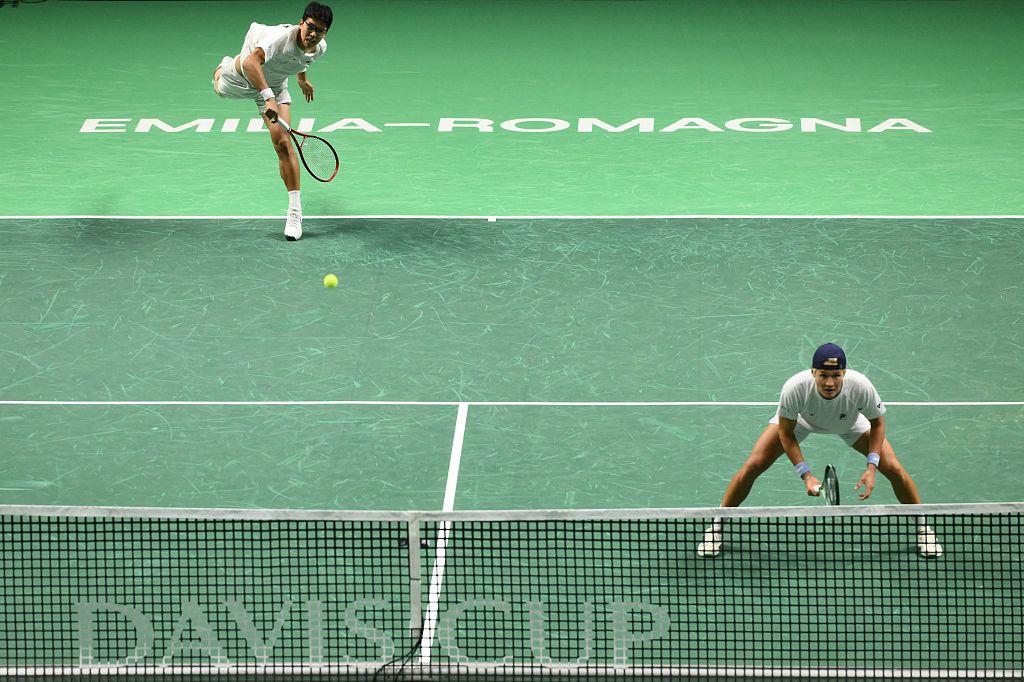
“Italy secured a place in the Davis Cup semifinals with a 2–1 victory over South Korea in Bologna, overcoming a surprise singles defeat for Flavio Cobolli before Matteo Berrettini and Andrea Vavassori won the decisive doubles rubber. The result kept Italy’s title defence alive and highlighted the competitive depth of a South Korean team making its first appearance at this stage of the competition.”
Italy survive a Davis Cup quarterfinal scare in Bologna
Italy’s pursuit of another Davis Cup title continued on Wednesday, 25 November, after the defending champions overcame South Korea 2–1 in a closely contested quarterfinal in Bologna. The hosts needed a decisive doubles victory from Matteo Berrettini and Andrea Vavassori to settle the tie after the two countries shared the opening singles matches. The result sent Italy into a semifinal against the Czech Republic and ensured that their campaign for another championship remained alive.
For South African tennis followers, the tie offered an example of the international team competition’s ability to produce unexpected results, even when one country enters with a stronger ranking and a more established record. Italy arrived as the three-time reigning champions, while South Korea were attempting to make an impression at a stage they had never previously reached. The contest ultimately reflected both the strength of the favourites and the danger of underestimating an opponent.
Italy’s victory was not straightforward. Lorenzo Musetti delivered the opening point, but Kwon Soon-woo responded with a remarkable victory over world No. 7 Flavio Cobolli. That left the doubles encounter to determine which country would advance. Berrettini and Vavassori eventually prevailed in two tiebreak sets, ending South Korea’s challenge and preserving Italy’s place in the tournament.
Musetti gives the hosts an early advantage
The opening singles rubber placed Italy in a favourable position when Musetti defeated Hong Seong-chan 6–0, 7–6 (7–5). The former world No. 5 dominated the opening set before Hong offered considerably stronger resistance in the second. Although the Korean player forced a tiebreak, Musetti held on to give the home team the first point of the tie.
The victory provided Italy with an important foundation. In a Davis Cup quarterfinal, an opening singles win can change the pressure surrounding the remaining matches. A team that establishes a 1–0 advantage has two further opportunities to secure the decisive point, while its opponent must win both remaining rubbers to advance.
Musetti’s success was therefore significant beyond the immediate scoreline. It placed South Korea in a position where a defeat in the second singles match would end their tournament. Yet the Korean team had an answer through Kwon, whose performance changed the direction of the contest.
Kwon Soon-woo delivers the upset of the tie
Kwon’s victory over Cobolli became the standout individual result of the quarterfinal. Ranked No. 139, the South Korean defeated the Italian world No. 7 by 3–6, 7–6 (7–3), 7–6 (7–5) after two hours and 50 minutes. The result levelled the tie at 1–1 and forced Italy to rely on the doubles match to progress.
Cobolli took the opening set, but Kwon refused to allow the contest to become a routine victory for the hosts. He secured the second set in a tiebreak and then maintained his composure through another closely contested tiebreak in the deciding set.
The victory carried particular significance because of the considerable difference between the players’ rankings. Cobolli was Italy’s highest-ranked player in the tie, while Kwon entered the contest outside the world’s top 100. The South Korean’s ability to overcome that gap demonstrated how national team competitions can create opportunities for players who might otherwise be considered outsiders.
The match also showed the importance of managing decisive points. A player does not need to dominate every service game to win a close contest; instead, success can depend on a handful of exchanges at critical moments. Kwon’s two tiebreak victories proved decisive, allowing South Korea to take the quarterfinal to a third rubber.
For Italy, the defeat was a reminder that their title defence would require more than the performances of their leading singles players. The absence of injured star Jannik Sinner had already placed additional importance on the available squad, and Cobolli’s loss increased the responsibility on the doubles pairing.
Doubles specialists secure the semifinal place
Berrettini and Vavassori faced Kwon and Chung Hyeon in the decisive doubles rubber. The Italians won 7–6 (7–2), 7–6 (13–11), completing a 2–1 victory for the defending champions. The second-set tiebreak was particularly demanding, with the Italian pair saving four set points before finally closing out the match.
The result underlined the importance of doubles in a competition that can be decided by a single rubber. Although singles rankings often attract the greatest attention, the Davis Cup format gives doubles specialists a potentially decisive role.
Italy’s ability to recover from difficult moments in the second tiebreak was especially important. Had South Korea converted one of their set points, the match would have continued into a deciding set, creating another opportunity for the challengers to complete an upset.
Instead, Berrettini and Vavassori held their nerve and secured the semifinal berth. Their victory ensured that Kwon’s earlier singles success would not be enough to carry South Korea into the next round.
The outcome also extended Italy’s recent dominance in the competition. According to South Korean reporting, Italy’s winning streak in the Davis Cup reached 15 matches, while South Korea’s record against Italy fell to 0–4.
South Korea’s performance offers encouragement
South Korea’s elimination should not obscure the significance of their achievement in reaching the quarterfinals. The country first competed in the Davis Cup in 1960 and had not previously reached this stage of the competition. Its appearance in Bologna represented a breakthrough for a national programme seeking to compete with established tennis powers.
The team’s route to the finals included important contributions from Kwon and Chung. Against Italy, Kwon’s singles victory provided evidence that South Korea could challenge a stronger opponent in a high-pressure environment.
There was disappointment in the final outcome, but the tie offered a valuable measure of progress. South Korea did not simply participate in the quarterfinal; they pushed the defending champions into a decisive doubles match and came within a few points of extending that contest.
The performance may also have implications for the team’s future preparation. Competitive international ties expose players to different styles, tactical demands and pressure situations. Those experiences can help coaches identify the areas in which a squad needs greater depth or consistency.
For Kwon, the victory over Cobolli was a notable individual result. It demonstrated that rankings, while useful in assessing long-term performance, do not determine the outcome of every match. The challenge for any player producing such an upset is to translate that level into sustained results across a season.
Italy prepare for the Czech Republic
Italy’s reward is a semifinal meeting with the Czech Republic, who defeated Canada 2–0 in their quarterfinal. The Italian team will therefore need to prepare for another opponent capable of winning the singles contests and placing pressure on the decisive doubles rubber.
The other side of the draw was also taking shape, with Germany scheduled to face Britain and Spain set to play Austria. Those ties would determine the remaining semifinalists.
For Italy, the immediate priority is recovery and preparation. A demanding quarterfinal can have consequences beyond the final score, especially when players are required to contest long singles matches or high-pressure doubles encounters.
The team’s depth remains an important asset. Musetti’s opening victory and the decisive contribution from Berrettini and Vavassori illustrated how different players can provide the points required to advance, even when another member of the squad loses.
The semifinal against the Czech Republic will offer Italy another opportunity to demonstrate the strength of their title defence. However, the narrow escape against South Korea suggests that the defending champions cannot afford to assume that their status alone will carry them through the remaining rounds.
Why the result matters to South African tennis audiences
Although the quarterfinal took place in Italy and did not involve South Africa, it offers useful insight into the international team tennis environment. South African players, coaches and supporters follow the Davis Cup not only for the results of leading nations but also for examples of how team depth, doubles expertise and competitive resilience can influence outcomes.
The competition provides a different challenge from the individual tour. Players must adapt to national team responsibilities, tactical decisions made by captains and the possibility that a single rubber could decide the entire tie.
South Africa’s tennis community can also take encouragement from the broader lesson of South Korea’s performance. A national programme does not need to enter every contest as the favourite to produce a meaningful result. Developing players who can compete against higher-ranked opponents, while building a dependable doubles combination, can be an important part of improving a country’s prospects in team competition.
That does not mean South Africa and South Korea are in identical competitive positions. Their player pools, competitive pathways and tournament histories differ. Nevertheless, the experience of competing against leading tennis nations illustrates the value of international exposure and the importance of preparing players for decisive moments.
The Davis Cup also serves as a reminder that national team events can create opportunities for players to attract attention beyond the individual rankings. Kwon’s performance against Cobolli is a case in point: his ability to win a difficult match became one of the most compelling stories of the quarterfinal, even though his country ultimately lost.
A victory built on depth and composure
Italy’s progress to the semifinals was ultimately secured by a combination of established quality and composure under pressure. Musetti provided the first point, Kwon levelled the contest, and Berrettini and Vavassori delivered when the tie was on the line.
The result kept Italy on course for another Davis Cup title while ending South Korea’s historic quarterfinal appearance. For the defending champions, the challenge now is to carry the momentum into the semifinal without allowing the narrow escape to undermine confidence. For South Korea, the task is to build on the experience and turn a promising international performance into further progress.
The quarterfinal will be remembered for more than Italy’s 2–1 victory. It demonstrated how quickly a team contest can change, how a lower-ranked player can disrupt expectations, and how a doubles partnership can become the difference between elimination and a place in the last four.
As the Davis Cup moves toward its decisive stages, Italy remain in contention for another title, but their experience against South Korea has provided a clear warning: the road to the championship is unlikely to be straightforward.



