




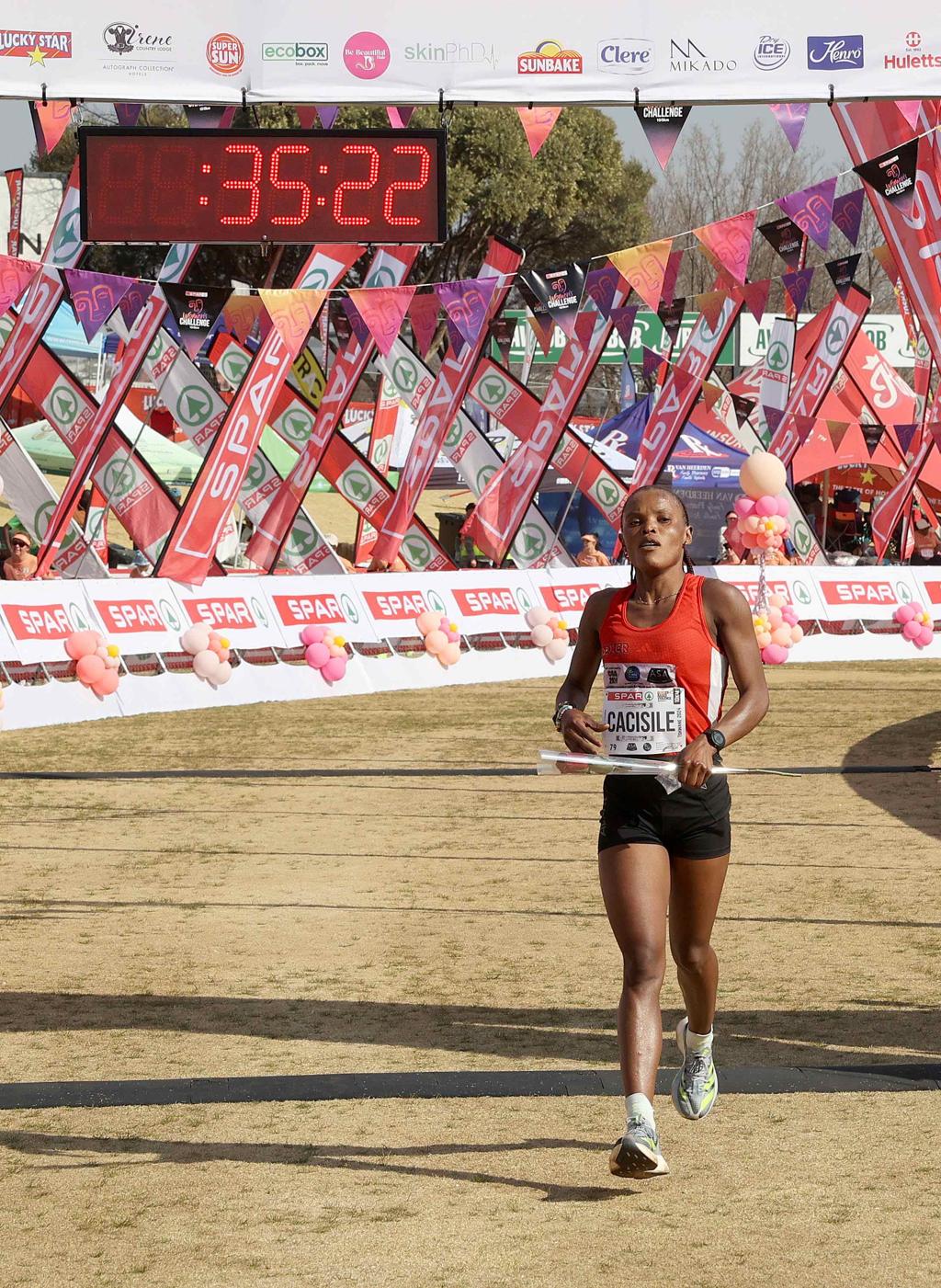
“South African veteran distance runner Janene Carey has made athletics history by completing her 113th SPAR Women’s 10km Challenge race, surpassing the previous record of 112 appearances held by former champion Sonja Laxton. The 54-year-old Boxer Running Club athlete reached the milestone in Gqeberha, where she finished third in the 50–59 age category in 41:37 and said she remains motivated to continue competing.”
South African road running produced another memorable chapter this week as veteran athlete Janene Carey reached a remarkable milestone in the SPAR Women’s 10km Challenge. The Durban-born runner completed her 113th race in the series, becoming the first woman to reach that number of appearances and moving beyond the previous record of 112 held by former champion Sonja Laxton. Carey achieved the landmark at the Gqeberha event on 26 September, where she competed in the 50–59 age category and finished third in 41:37.
The achievement is significant not simply because of the number attached to it, but because of the extraordinary period over which Carey has remained involved in competitive road running. According to SABC Sport, she first participated in the series 32 years ago, when the competition operated under a different name. Her continued participation has therefore connected several generations of South African women’s road running, from the early years of the event to the increasingly competitive modern era.
Carey’s achievement also highlights the unusual longevity required to compete consistently in athletics. Road running places considerable physical demands on athletes, and maintaining the motivation to train, travel and compete year after year requires discipline beyond simply preparing for one race. For Carey, however, the SPAR series has remained an important source of motivation.
Speaking after reaching the milestone, Carey said the competition continues to inspire her despite her age. She recalled being present at the earliest SPAR Women’s races and said there was nothing quite like the series. Her comments underline how the competition has become more than an annual race on her calendar; it has become a continuing part of her sporting life.
Her latest performance came during an important weekend for South African women’s road running. Gqeberha hosted the penultimate leg of the 2026 SPAR Grand Prix series, bringing together leading domestic athletes and international competitors. The elite women’s race was won by South African record holder Glenrose Xaba, who recorded 31:17, while training partner Karabo More finished second in 32:21 and Ethiopia’s Selam Gebre took third in 32:33. Xaba’s winning time was only five seconds outside her South African record of 31:12.
Against that backdrop, Carey’s performance represented a different but equally notable form of achievement. While the leading athletes were competing for overall Grand Prix points and elite race honours, Carey was continuing a personal journey that has stretched across more than three decades. Her third-place finish in the 50–59 category ensured that her historic appearance was also accompanied by a competitive result.
The Gqeberha race provided an opportunity to see the contrast between different generations of South African road running. Xaba is one of the country’s leading current distance runners, while younger athletes such as More and other emerging competitors are developing their own careers. Carey, meanwhile, represents the experience accumulated through decades of racing. SABC Sport noted that she has witnessed the development of a new generation of stars, including Xaba and rising runner Taylor Kavanagh.
That generational connection is particularly important in athletics because road running depends heavily on participation, development and the transfer of experience. Elite athletes attract attention through fast times and victories, but veteran competitors demonstrate that athletics can remain part of an individual’s life long after the traditional peak-performance years.
Carey’s career also demonstrates the changing structure of age-group competition. Rather than viewing advancing age as an automatic reason to stop competing, she has continued moving through different categories while maintaining a connection with the SPAR series. In her comments, she explained that each new age group can provide another goal and another reason to continue training and racing.
Her achievement comes at a time when women’s road running in South Africa continues to attract substantial participation. The SPAR Women’s Challenge combines elite competition with mass participation, creating an environment in which professional and recreational runners can take part in the same event. The official SPAR Women’s Challenge programme lists races across South Africa during 2026, including Cape Town, Durban, Tshwane, Pietermaritzburg, Gqeberha and Johannesburg.
The structure of the competition helps explain why reaching 113 appearances is so remarkable. SABC Sport notes that the Grand Prix series itself offers only five races each year. Consequently, accumulating more than 100 appearances requires extraordinary consistency over a very long period.
Carey’s record therefore goes beyond a single race result. It represents persistence, adaptation and an ability to remain engaged with competitive athletics as the sport around her changes. The runners she competes alongside today are part of a different generation from many of the athletes she faced during her early years, yet the fundamental challenge remains the same: prepare properly, reach the starting line and complete the course.
Her advice to younger athletes reflects that long-term perspective. Carey has encouraged runners to enjoy the journey, maintain a healthy lifestyle and, importantly, look after their bodies. Such guidance is particularly relevant in distance running, where managing training loads, recovery and injuries can have a major effect on an athlete’s ability to sustain a career.
The importance of recovery is especially evident in a sport where athletes may compete repeatedly throughout a season. South Africa’s leading road runners often balance domestic races with international championships and other competitions. The 2026 SPAR series itself has featured a mixture of South African and international athletes, making each event an opportunity for domestic runners to measure themselves against strong opposition.
Carey’s longevity offers another perspective on success. Athletics is frequently measured through medals, records and finishing times, but participation records can also tell important stories about the development of a sport. Her 113 appearances provide a tangible link between the history of the SPAR Women’s Challenge and its present generation.
The record also places Carey alongside the many athletes who have helped establish the SPAR series as an important fixture on the South African athletics calendar. The competition has provided opportunities for elite runners while also encouraging mass participation among women of different ages and abilities. The official event describes its programme as combining fitness, community and competition, with both 10km and 5km distances available at regional events.
For Carey, however, the story is not finished. Her comments indicate that she has no immediate intention of retiring from competitive running. Having reached 113 appearances, she can now set another personal target while continuing to compete in the age category that corresponds to her current stage of her career.
The timing of the milestone is also notable because the 2026 SPAR season is approaching its final Johannesburg event on 4 October. The official SPAR Women’s Challenge calendar lists Marks Park Sports Club as the venue for the final race, with both 10km and 5km events scheduled.
That final event will bring the 2026 series to a close, but Carey’s record will remain one of the season’s defining stories. Her achievement demonstrates that athletics success can take different forms. For elite competitors, it may be a national record or Grand Prix title. For others, it may be completing a first race, improving a personal best or simply returning to the starting line year after year.
Janene Carey’s 113th SPAR Women’s 10km Challenge race combines all of those ideas into one remarkable milestone. It is a record built not around one exceptional performance, but around decades of commitment to running.
As South African athletics continues to develop a new generation of elite performers, Carey’s story provides an enduring reminder of the value of consistency. Her journey from the early years of the SPAR series to its modern competitive era demonstrates how an athlete can remain connected to the sport through changing generations, changing age categories and changing standards.
At 54, Carey has already made history. Yet her most important message may be that the journey itself remains worth pursuing. Her 113th appearance was another finish line crossed, but it was also evidence that a long athletics career can continue to create new milestones long after an athlete’s early competitive years have passed.



