




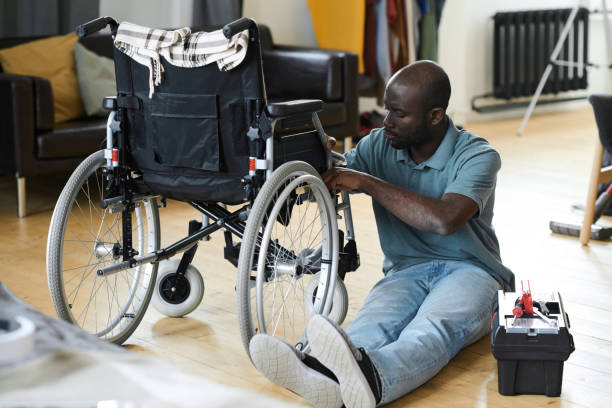
“Zacharia Mashishi’s start-up, Chief Ralekhudu Enterprises, is revolutionizing healthcare in South Africa by repairing wheelchairs and empowering people with disabilities to become entrepreneurs. His work exemplifies how social innovation can solve practical problems while strengthening communities, despite systemic barriers in funding and coordination.”
Innovation in South Africa often emerges from necessity, and nowhere is this more evident than in the healthcare sector. Millions of South Africans rely on wheelchairs and other assistive devices, yet for years there has been no accessible, large-scale system for servicing and repairing them. This gap has left countless individuals struggling with mobility, independence, and dignity. Enter Zacharia Mashishi, a township innovator whose start-up, Chief Ralekhudu Enterprises, is changing the narrative by offering repair services and training programs that empower people with disabilities to become entrepreneurs in their own communities.
Mashishi’s model is simple but powerful: repair and service wheelchairs while simultaneously building capacity among disabled individuals to run similar businesses. This dual approach not only addresses a pressing healthcare need but also creates economic opportunities in marginalized communities. It is a textbook example of social innovation—solutions that tackle systemic problems while fostering inclusion and resilience.
Yet Mashishi’s success also underscores the paradox of South Africa’s innovation ecosystem. On one hand, the country boasts world-class institutions such as the South African Medical Research Council (SAMRC), leading universities, and partnerships with international bodies like the US National Institutes of Health (NIH). These collaborations have placed South Africa on the global stage, particularly through initiatives like the Strategic Health Innovation Partnerships (SHIP). On the other hand, the ecosystem remains fragmented, under-resourced, and difficult to navigate for grassroots innovators.
Funding is a particularly thorny issue. Despite the proliferation of accelerators and platforms, access to finance remains elusive for many innovators. Research reveals stark inequities: 90% of successful SMMEs in South Africa are white-owned, highlighting systemic bias and discrimination in funding allocation. This reality means that while innovators like Mashishi break through, many equally promising ideas fail—not because they lack merit, but because they cannot overcome structural barriers.
The broader lesson here is that innovation cannot thrive in isolation. It requires coordinated support, inclusive financing, and systemic integration. Mashishi’s enterprise demonstrates the potential of community-driven solutions to address healthcare challenges, but scaling such efforts demands a more equitable ecosystem. Policymakers, funders, and institutions must recognize that innovation is not only about cutting-edge technology but also about practical, locally relevant solutions that improve lives.
Looking ahead, South Africa’s innovation landscape faces both opportunities and risks. The strengths lie in its collaborative networks and global partnerships, which provide access to expertise and resources. The risks, however, stem from persistent fragmentation and inequities that stifle grassroots innovation. If these challenges can be addressed, South Africa has the potential to become a leader in inclusive health innovation, showcasing how social entrepreneurship can transform healthcare systems in developing contexts.
Mashishi’s story is more than a tale of entrepreneurial success; it is a call to action. It demonstrates that innovation is not confined to laboratories or boardrooms—it can emerge from townships, driven by individuals determined to solve real-world problems. For South Africa, the challenge now is to ensure that such innovations are not isolated outliers but part of a broader, systemic transformation.



