




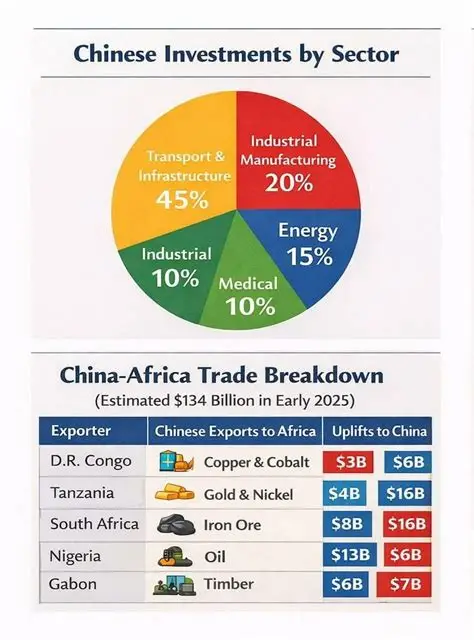
“South Africa has entered into a $122 billion energy expansion partnership with China, aimed at adding 105 GW of generation capacity and strengthening domestic supply chains. Alongside this, a R3.4 billion rail investment will modernize freight and transport networks, signaling a broader infrastructure renewal strategy.”
South Africa’s energy sector has long been plagued by instability, rolling blackouts, and insufficient generation capacity. The announcement of a $122 billion partnership with China represents one of the most ambitious energy expansion programs in the nation’s history. This initiative is designed not only to boost raw generation capacity but also to localize manufacturing of critical infrastructure components, thereby strengthening domestic supply chains and reducing reliance on imports.
Background: The Energy Crisis
For over a decade, South Africa has struggled with load shedding, a direct consequence of aging coal plants, underinvestment in renewable energy, and governance challenges at Eskom. Businesses have faced rising costs, households have endured unreliable electricity, and the broader economy has suffered from reduced productivity. The new partnership with China is seen as a strategic intervention to reverse these trends.
Details of the Partnership
- Investment Size: $122 billion
- Generation Capacity: 105 GW to be added
- Focus Areas:
- Expansion of the national power grid
- Localization of infrastructure manufacturing
- Stabilization of energy availability for businesses and communities
China’s involvement is expected to bring technical expertise, financing, and rapid deployment capacity, while South Africa will benefit from job creation and industrial growth through localized production.
Rail and Transport Investment
Complementing the energy expansion, Traxtion, a rail operator, has announced a R3.4 billion investment into South Africa’s freight and transport networks. This modernization effort will improve logistics efficiency, reduce transport costs, and support the broader energy initiative by ensuring reliable movement of materials and equipment.
Economic Implications
- Business Confidence: The program is expected to restore investor confidence by stabilizing electricity supply.
- Financial Markets: Despite municipal dysfunction, the Johannesburg Stock Exchange reported a 17% profit surge, signaling resilience in the corporate sector.
- Currency Stability: The rand has shown signs of stabilization, supported by infrastructure-driven optimism.
Social Impact
Reliable electricity will directly improve living standards, reduce costs for households, and enable municipalities to deliver better public services. The localization of manufacturing will create thousands of jobs, particularly in engineering, construction, and logistics.
Challenges Ahead
- Governance Risks: Past failures at Eskom highlight the need for strong oversight.
- Debt Concerns: Financing such a massive project raises questions about long-term debt sustainability.
- Environmental Considerations: While the expansion includes renewable energy, coal remains part of the mix, raising concerns about emissions.
Strategic Importance
This partnership positions South Africa as a regional energy hub, capable of exporting power to neighboring countries. It also strengthens ties with China, deepening geopolitical and economic relations.
Conclusion
The $122 billion Chinese energy expansion is a landmark development for South Africa, promising to transform its energy landscape, stabilize supply, and drive economic growth. Coupled with the R3.4 billion rail investment, the initiative signals a new era of infrastructure renewal. While challenges remain, the scale and ambition of this program underscore South Africa’s determination to overcome its energy crisis and secure a sustainable future.



