




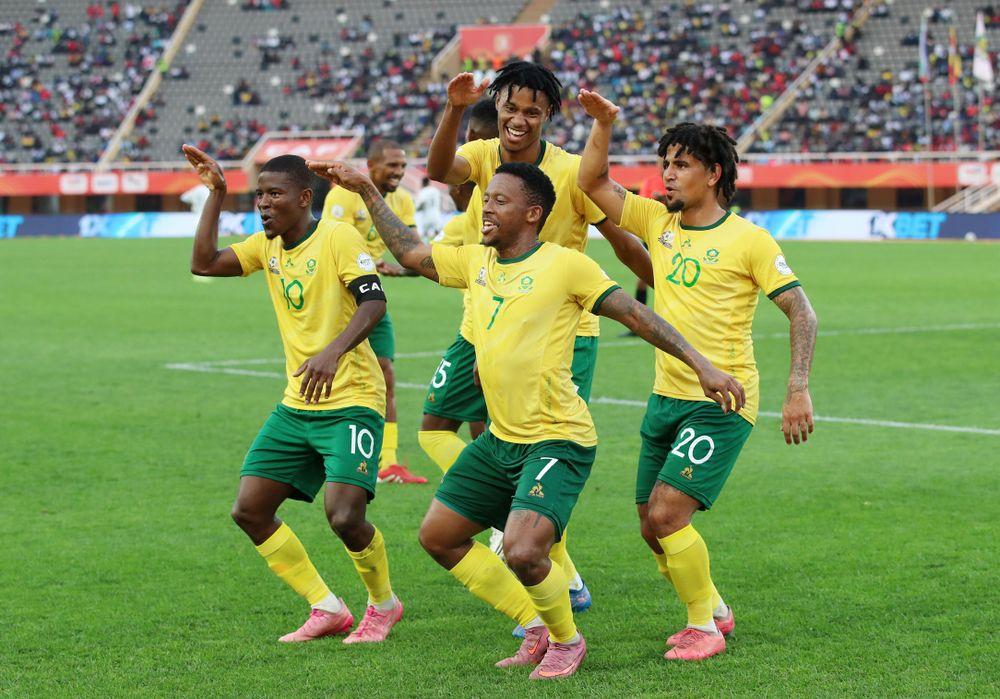
“South Africa began their 2027 Africa Cup of Nations qualifying campaign with a 2-1 victory over Guinea at Orlando Stadium in Soweto, giving returning coach Pitso Mosimane three points in his first competitive match back in charge of Bafana Bafana. Goals from defenders Ime Okon and substitute Samukele Kabini overturned Guinea’s resistance and put South Africa top of Group D after Eritrea drew 1-1 with Kenya in the other opening fixture.”
The result was important beyond the scoreline because Group D offers only one qualifying place outside the automatically qualified co-hosts, meaning South Africa cannot afford to drop many points against Guinea and Eritrea. CAF reported that Kenya, as a tournament co-host alongside Tanzania and Uganda, already has a place at the finals, leaving South Africa, Guinea and Eritrea competing for the remaining qualifying position. The stakes are now even higher.
A New Beginning Under Mosimane
The match represented the beginning of Mosimane’s latest spell as Bafana coach after South Africa’s 2026 World Cup campaign under Hugo Broos. Mosimane did not make wholesale changes to the side. Instead, he retained much of the structure and personnel that had featured during the World Cup, making three changes to the starting XI.
Olwethu Makhanya and Kamogelo Sebelebele came into the defence, while Iqraam Rayners started in attack. Ronwen Williams remained captain and goalkeeper, while Teboho Mokoena and Sphephelo Sithole formed the central midfield partnership. Relebohile Mofokeng operated behind Rayners, with Oswin Appollis and Thapelo Maseko providing width.
That selection suggested continuity was a significant part of Mosimane’s approach. The coach had limited preparation time, and the immediate objective was to collect points rather than completely rebuild the national team. The players responded with a positive opening spell, pressing Guinea high and attempting to establish control in midfield.
South Africa Start Strongly
Bafana created the early pressure and repeatedly tested the Guinea defence. Mofokeng, Maseko, Appollis and Rayners combined in the attacking third, while Mokoena and Sithole worked to prevent Guinea from settling into the match.
Guinea nevertheless showed that it could threaten on the counterattack. Ronwen Williams was called upon early to deny Aliou Balde after the attacker created space inside the South African penalty area. South Africa then missed an opportunity of their own when Mofokeng was unable to convert from close range.
The hosts eventually found the breakthrough in the 31st minute. A corner caused confusion in the Guinea defence, and Okon reacted quickly to fire the ball into the net after the initial header fell back into his path. It was Okon’s first goal for Bafana and rewarded South Africa for a sustained period of pressure.
South Africa continued to create opportunities before halftime, but the second goal did not arrive. Maseko also had an opening after a pass from midfield broke the defensive line. Guinea survived and entered the second half still within reach of an equaliser.
Guinea Fight Back
The second half changed the rhythm of the match. South Africa remained dangerous, but Guinea became more aggressive and looked for opportunities to exploit spaces behind the hosts’ defence.
The momentum shifted further when Aubrey Modiba was forced off after 55 minutes. Mosimane introduced Samukele Kabini, a Norway-based defender who had joined the squad after earning international recognition. His introduction initially appeared to be a defensive adjustment, but it eventually became one of the defining moments of the match.
Guinea equalised when a free-kick from Serhou Guirassy struck the South African defensive wall. Seydouba Cisse reacted fastest to the loose ball and fired past Williams. The goal made the final stages tense and gave Guinea renewed confidence.
For South Africa, the equaliser highlighted the danger of failing to turn sustained possession and chances into a larger advantage. Mosimane later stressed that finishing remains an area that needs improvement, warning that stronger opponents can punish missed opportunities.
Kabini Delivers the Winner
With the match level, Mosimane turned to his substitutes to change the contest. Orlando Pirates striker Yanela Mbuthuma entered the game in the 68th minute and soon made an important contribution.
In the 77th minute, Mbuthuma played Kabini into space behind the Guinea defence. Kabini, despite being a defender by position, showed composure in front of goal and placed his shot beyond goalkeeper Soumaila Sylla.
The goal restored South Africa’s lead and gave Kabini his first international goal. It also completed an unusual scoring contribution from two defenders, Okon and Kabini, in a match in which South Africa’s attacking players created much of the early pressure.
Guinea pushed for another equaliser, but Bafana held on. The final whistle confirmed a 2-1 victory and a winning start to Mosimane’s return.
What the Result Means for Group D
The opening-day result has immediate significance in the qualifying table. South Africa moved to three points, while Kenya and Eritrea took one point each from their 1-1 draw. Guinea remained without a point.
CAF’s qualification structure makes the early standings particularly relevant. Because Kenya is already qualified as a host, the remaining teams are effectively competing for one available qualifying place. South Africa’s victory over Guinea therefore represents three points gained against one of the sides most directly involved in that contest.
However, the victory does not settle the qualification race. South Africa still have to play Eritrea, Kenya and Guinea again during the campaign. The next challenge arrives quickly, with Bafana scheduled to face Eritrea in Cairo on Wednesday, September 30, at a neutral venue.
The short turnaround means recovery will be important. Mosimane will also have to assess the condition of players who carried knocks during the Guinea match, particularly Modiba, whose injury forced him out of the game.
Areas for Improvement
Despite the victory, there were clear areas South Africa will need to address. The most obvious was finishing. Bafana created chances during their strongest periods but did not build a comfortable lead, allowing Guinea to remain competitive.
Mosimane himself identified the issue after the match, saying South Africa need to score more of the chances they create. His concern is especially relevant in away matches and against stronger opposition, where opportunities may be less frequent.
Defensive concentration will also require attention. Guinea’s equaliser came from a set-piece situation after the initial free-kick was blocked. South Africa recovered quickly enough to score again, but similar lapses could prove costly later in the qualifying campaign.
At the same time, the match offered encouraging signs. South Africa showed resilience after conceding, and the impact of substitutes was significant. Mbuthuma provided the assist for the winner, while Kabini transformed an enforced defensive change into a match-winning contribution.
The Road Ahead
The victory gives Mosimane an ideal competitive starting point in terms of points, but the qualification campaign is only beginning. The next fixture against Eritrea will test South Africa’s ability to recover quickly and carry momentum into an away match.
Eritrea’s 1-1 draw with Kenya means they also collected a point from their opening game. South Africa therefore have an opportunity to strengthen their position by winning again, although the neutral venue removes some of the conventional home-and-away dynamics.
For Bafana supporters, the most significant development is that the new era has begun with a victory. The performance was not perfect, but South Africa demonstrated enough attacking pressure, defensive resilience and late-game composure to take all three points.
The 2-1 win over Guinea has therefore established a foundation rather than a conclusion. South Africa now lead Group D, while Mosimane has secured the result required from his first competitive match. The next test against Eritrea will reveal whether Bafana can turn that promising opening into sustained qualification momentum.



