




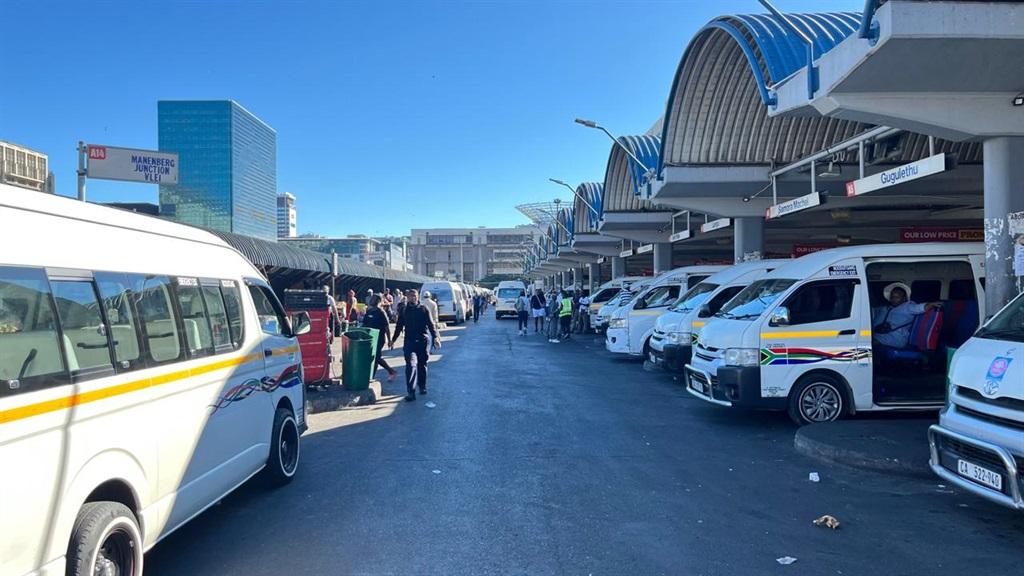
New research into South Africa’s minibus-taxi industry argues that policymakers should look beyond the sector’s informal status and recognize the practical knowledge, organization and social systems developed by drivers, operators, marshals, commuters and communities. The research raises broader policy questions about formalization, regulation, labour conditions, governance and how government can incorporate local knowledge when designing reforms for complex informal economic systems.”
New research into South Africa’s minibus-taxi industry argues that policymakers should look beyond the sector’s informal status and recognize the practical knowledge, organization and social systems developed by drivers, operators, marshals, commuters and communities. The research raises broader policy questions about formalization, regulation, labour conditions, governance and how government can incorporate local knowledge when designing reforms for complex informal economic systems.
South Africa’s minibus-taxi industry is providing policymakers with a different way of thinking about informal economic systems, according to research published in a new analysis highlighted by Moneyweb on 27 September 2026. The discussion focuses on how government approaches informal industries and argues that policymakers can gain important insights by recognizing the knowledge and organizational systems that already exist within those sectors.
The issue is particularly significant in South Africa because minibus taxis form an important part of the country’s public transport system. Millions of commuters depend on them to travel between homes, workplaces, schools, commercial centres and other essential destinations. This makes the industry not only a transport issue but also a question of economic participation, employment, urban development and public policy.
The research behind the article draws on more than a decade of work and two books examining the South African minibus-taxi sector. These works consider formalization, labour precarity, regulation, governance, violence, mobility and social justice. They also question whether describing an industry as “informal” adequately captures the systems through which it operates.
Rethinking the Meaning of Informal
One of the central policy questions is what it actually means for an industry to be informal.
Minibus taxis are frequently described as informal, unregulated or difficult to govern. Such descriptions can identify genuine problems, including poor working conditions, exploitation, violence and conflicts within the sector. However, researchers argue that these descriptions can also overlook the knowledge and organizational structures that have developed over decades.
Taxi drivers, for example, possess detailed knowledge of routes, passenger demand and the economic realities of operating vehicles. Taxi operators understand the costs and pressures involved in running businesses. Marshals manage queues, coordinate vehicles and organise passenger movements at taxi ranks. Commuters also possess knowledge about which routes work, where transport is inadequate and how the system affects their daily lives.
This means that an industry can be informal without necessarily being disorganised.
For policymakers, that distinction has practical implications. If government approaches an informal institution as though it has no existing organisational structure, policy interventions may focus primarily on imposing new systems rather than understanding the systems already in place.
The research therefore raises a broader question: whose knowledge should count when governments design policies affecting informal sectors?
Formalization Is More Complicated Than Regulation
Formalization is often presented as a straightforward policy objective. Bringing informal businesses and workers into formal regulatory structures can improve accountability, safety, taxation, employment standards and access to services.
However, the research argues that formalization should not automatically be regarded as a simple technical process.
South Africa’s experience with the minibus-taxi industry illustrates why. Government has introduced various interventions intended to improve the sector, including programmes designed to replace older vehicles with safer models. The Taxi Recapitalisation Programme, introduced in 2006, provided financial assistance to qualifying taxi owners who scrapped older vehicles and used the allowance towards purchasing newer vehicles. Earlier research from the University of Cape Town noted that tens of thousands of minibuses had been scrapped under the programme by 2017.
Such interventions demonstrate how public policy can change the physical characteristics of an industry. Newer vehicles can provide improvements such as better seating, seat belts, emergency exits and braking systems.
Yet replacing vehicles does not necessarily transform working relationships, labour conditions or the wider governance structure of the industry.
That distinction is central to the current policy debate.
A government can change infrastructure while leaving the underlying social and economic relationships largely unchanged. Consequently, researchers argue that formalisation should consider how workers and businesses actually experience the industry rather than focusing only on regulatory compliance or physical assets.
The Importance of Local Knowledge
The research also challenges the assumption that valuable policy knowledge must come from government departments, universities or professional consultants.
A taxi driver with decades of experience may not have formal qualifications in economics, transport planning or sociology, but that does not mean the driver lacks relevant knowledge.
Such a driver may understand passenger behaviour, route economics, operational challenges and regulatory consequences based on years of direct experience.
The same applies to taxi marshals, operators and commuters.
This does not mean that policymakers should automatically accept every claim made by industry participants. Experience can be incomplete, contradictory or influenced by individual interests. Instead, the argument is that lived experience should be included as one source of evidence alongside statistics, academic research, government information and professional expertise.
This approach could make policy development more responsive to actual conditions.
For example, transport planners may design a system that appears efficient on paper but fails to account for how commuters actually travel. A road or transport facility may technically exist but remain difficult to access for people living in surrounding communities. Likewise, a regulatory requirement may appear reasonable from an administrative perspective but create unintended costs for small operators.
Understanding these realities requires policymakers to engage directly with the people affected by the policies.
Why the Taxi Industry Matters to Economic Policy
The significance of the debate extends beyond transport.
South Africa’s informal economy supports livelihoods for large numbers of people, making the relationship between government and informal economic activity an important policy issue.
The minibus-taxi sector demonstrates how informal institutions can develop their own rules, networks and systems of coordination. At the same time, it shows the difficulties governments face when attempting to regulate sectors that have evolved outside conventional formal structures.
The sector also illustrates the connection between transport and economic opportunity.
People need affordable and accessible transport to reach employment, education, healthcare and markets. Consequently, weaknesses in public transport can have wider economic consequences.
For businesses, unreliable transport can affect employees’ ability to reach workplaces. For households, transport costs can influence disposable income. For communities located far from economic centres, the availability of transport can affect access to employment and services.
Transport policy is therefore closely linked to broader questions of economic development and inequality.
Learning Rather Than Simply Replacing
The research does not suggest that existing problems within the minibus-taxi industry should be ignored.
The sector has experienced serious challenges, including violence, exploitation, labour insecurity and conflicts. These problems require effective regulation and enforcement.
Instead, the research questions whether simply replacing informal structures with formal ones is enough.
The policy challenge may be to identify which existing practices work, which create harm and which can be incorporated into improved systems.
This could lead to a more collaborative approach in which government, operators, workers, commuters and communities contribute to the development of reforms.
South Africa has previously attempted different forms of collaboration with the taxi industry, including vehicle-recapitalisation initiatives and efforts to integrate taxi operators into broader public transport systems. The experience demonstrates both the possibilities and difficulties of changing a sector that has developed over many decades.
A Broader Lesson for South African Policymakers
The minibus-taxi debate ultimately raises a wider question about how South Africa governs informal institutions.
The research suggests that policymakers should not view informal systems simply as incomplete versions of formal institutions. Instead, they can be studied as institutions with their own histories, relationships, incentives, knowledge and organisational structures.
This does not mean that informal systems should be exempt from regulation.
Rather, effective regulation may require a deeper understanding of why these systems operate as they do.
For South Africa, that could influence future approaches to transport, informal businesses, employment, urban development and economic inclusion.
The lesson is also relevant beyond the taxi sector. Informal traders, small businesses, community organisations and other economic networks often develop practical systems to deal with gaps in formal infrastructure or government services.
Policy that ignores these systems may struggle to achieve its intended results.
Conversely, policy that understands how these systems operate can potentially identify opportunities for cooperation while still addressing safety, accountability and legal requirements.
The latest discussion therefore places the minibus-taxi industry within a much broader policy conversation. It is not simply a question of how government should regulate taxis. It is a question of how policymakers can understand complex economic institutions before attempting to transform them.
For South Africa, where formal and informal economic activity frequently overlap, that distinction could be important for future policy design.
The research ultimately argues for greater recognition of African experiences and locally produced knowledge in policymaking. The minibus-taxi industry, despite its challenges, demonstrates that informal institutions can contain substantial organisational knowledge.
For policymakers, the implication is that successful reform may depend not only on creating new rules, but also on understanding the systems, people and relationships that already exist.



