




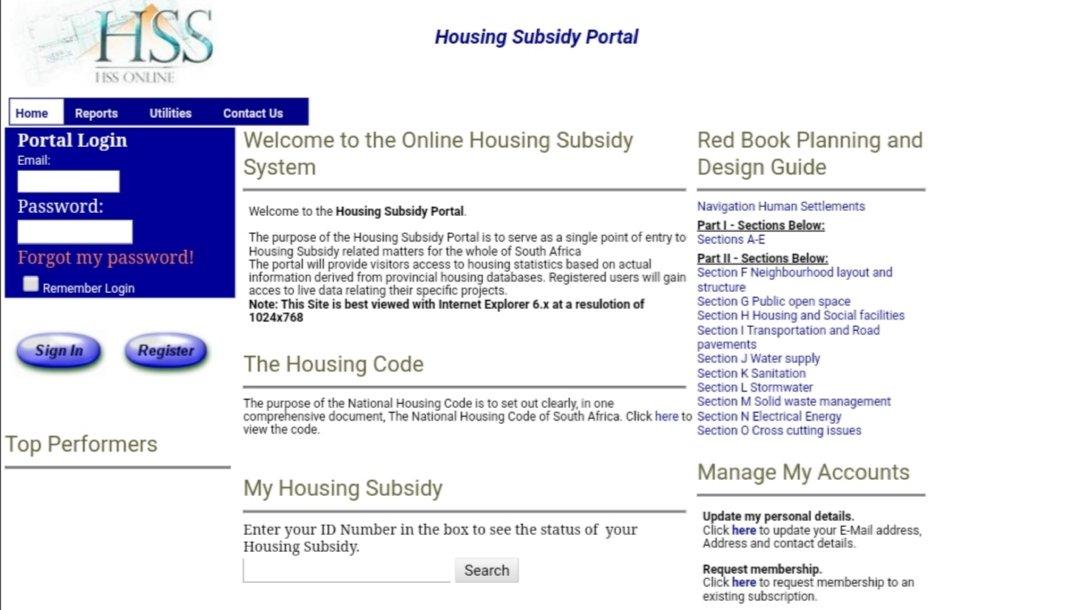
“South Africa’s State Information Technology Agency (SITA), acting for the Department of Human Settlements, has advertised a 36-month project to design and develop a National Digital Human Settlements Management System (NDHSMS) to replace the existing Housing Subsidy System. The proposed platform is intended to improve beneficiary administration, integrate government databases, use artificial intelligence to help identify potential fraud, incorporate satellite imagery for project verification and strengthen transparency in housing delivery.”
South Africa moves to modernise housing administration through a new digital platform
Introduction
South Africa is taking another step towards modernising public administration through a proposed national computing platform designed to improve the management of housing subsidies, beneficiary information and government housing projects. The project, announced through a tender published by the State Information Technology Agency (SITA) on behalf of the Department of Human Settlements, aims to replace the existing Housing Subsidy System with a more comprehensive digital environment.
The planned National Digital Human Settlements Management System represents an important development in government computing because it combines software engineering, database integration, artificial intelligence, geographical information systems and data analytics in a single public-sector programme.
According to ITWeb’s report published on 26 October 2026, the project is expected to run for 36 months. The tender documentation identifies weaknesses in the existing system, including reliability concerns, difficulties tracking beneficiary queues and insufficient transparency in housing allocation and project monitoring.
The proposed replacement therefore has implications beyond information technology. If successfully designed and implemented, it could influence how housing applications are processed, how projects are monitored and how officials account for the allocation of public resources.
An outdated system creates pressure for change
Digital systems are central to the administration of large government programmes. Housing departments must manage applications, verify eligibility, maintain beneficiary records, coordinate development projects and track the delivery of homes across different provinces and municipalities.
When these responsibilities depend on fragmented databases, manual processes or unreliable software, officials can struggle to obtain an accurate picture of programme performance.
The existing Housing Subsidy System supports housing subsidies, beneficiary allocation and project tracking. However, the tender documentation reportedly describes the platform as increasingly inadequate for the department’s needs and vulnerable to manipulation of beneficiary lists.
The lack of centralised information also creates difficulties when monitoring queues, assessing project progress and measuring the impact of human settlements grants.
These problems demonstrate why public-sector computing projects require more than replacing old software with a new interface. A successful platform must improve the reliability of information, establish consistent procedures and make important records accessible to authorised users across different administrative levels.
The new NDHSMS is intended to address these challenges by bringing major housing administration functions together in one integrated environment.
Nevertheless, issuing a tender is only the beginning of the process. The final results will depend on the quality of the selected solution, the implementation team’s capabilities and the department’s ability to manage organisational change.
A unified platform for housing administration
The proposed system is intended to cover several connected areas of human settlements management.
These include housing subsidy applications, beneficiary administration, land management, infrastructure planning, project delivery, financial management, community development and stakeholder engagement.
Integrating these functions could reduce the need for officials to repeatedly transfer information between separate applications. It could also give decision-makers a more complete view of housing programmes, from initial applications through project construction and final allocation.
For example, an integrated platform could help officials connect information about a registered beneficiary with an approved housing project, its location, construction progress and eventual handover.
This would make it easier to identify incomplete records, follow up on outstanding administrative requirements and determine where delays are occurring.
However, integration must be carefully designed. Government departments often operate systems developed at different times, using different data formats, access controls and technical standards. Connecting them requires clear rules about which records are authoritative, how information is updated and how inconsistencies are resolved.
The NDHSMS tender identifies integration with multiple government databases as a core requirement. Its effectiveness will therefore depend on reliable interfaces, well-defined data standards and cooperation between the institutions responsible for the connected systems.
Linking records across government databases
One of the project’s most important technical components is the proposed verification of eligibility using information from several public-sector databases.
The tender identifies sources including the Department of Home Affairs, the Deeds Office, PERSAL, the Unemployment Insurance Fund, the Government Employees Pension Fund and the National Housing Subsidy Database.
Access to relevant records could help officials verify information more consistently and reduce reliance on manual checks.
For example, appropriately authorised checks against property records could help identify cases requiring further examination when assessing eligibility for a housing benefit. Employment or pension-related records could also support specified verification procedures where legally permitted.
These examples illustrate potential uses of integrated computing; they do not mean that every record will automatically disqualify an applicant or that all databases contain identical information.
The system must account for incomplete records, outdated information, spelling differences and other data-quality problems. A mismatch should trigger appropriate investigation rather than automatically being treated as evidence of wrongdoing.
The project will also need strict access controls. Information held by public institutions can be highly sensitive, particularly when it relates to identity, employment, finances and housing circumstances.
A modern platform should therefore record who accesses information, limit permissions to legitimate duties and protect information during transmission and storage.
The practical objective is to improve verification while preserving the security, accuracy and lawful use of personal data.
Artificial intelligence enters public housing administration
Artificial intelligence is another major feature of the proposed platform.
According to the tender report, the system is expected to incorporate AI capabilities for document analysis, anomaly detection, fraud identification, automated claims verification, contractor risk profiling and identifying title deed backlogs.
These applications could help officials analyse large volumes of information more efficiently than conventional manual processes alone.
Document-analysis tools, for instance, could extract relevant information from submitted records and flag missing documentation. Anomaly-detection systems could identify unusual patterns in applications, payments or project reporting that deserve closer examination.
Similarly, analytics could help officials identify contractors or projects requiring additional verification because of irregular reporting patterns.
However, AI does not automatically establish whether fraud has occurred. An unusual transaction or inconsistent record may result from an administrative mistake, a delayed database update or an unusual but legitimate circumstance.
Consequently, AI-generated alerts should support qualified human investigators rather than replace evidence-based decisions.
The department will need documented procedures for reviewing flagged cases, correcting inaccurate records and allowing affected individuals to challenge decisions where appropriate.
The quality of the underlying data will also be crucial. If the system learns from incomplete or historically inconsistent records, it could reproduce existing errors or unfairly flag certain applicants.
Responsible implementation will require testing, regular monitoring and clear accountability for decisions made with AI assistance.
Satellite imagery and digital project monitoring
The proposed platform will also use near-real-time satellite imagery, with imagery updates specified at two-week intervals, to help validate project claims and delivery information.
This requirement introduces an additional computing capability into the monitoring of housing and infrastructure development.
Satellite imagery and geographical information systems can help officials compare reported construction activity with visible changes at project sites. When combined with location data and project schedules, imagery may help identify developments that need closer inspection.
For example, if a project report indicates substantial construction progress but imagery shows little visible change, officials could investigate the discrepancy.
Nevertheless, satellite imagery has limitations. Weather, cloud cover, image resolution, construction conditions and the timing of image capture can affect what is visible. Images may not reveal the internal condition of a building or establish whether a completed structure meets every required standard.
The technology should therefore complement site inspections, contractor documentation and other verification methods.
Combining geospatial data with project-management software could nevertheless improve oversight by making it easier to connect financial claims, physical progress and recorded milestones.
A modern software architecture
The tender allows for a microservices, service-oriented or event-driven architecture. These are different approaches to structuring complex software systems.
Microservices divide a platform into smaller services responsible for specific functions. A service-oriented architecture organises reusable services that communicate through defined interfaces. Event-driven architecture enables components to respond to events, such as an application being submitted or a project milestone being recorded.
Each approach can support integration, but each also introduces design and operational challenges.
A modular architecture could make it easier to update individual functions without rebuilding the entire platform. It could also help technical teams separate beneficiary management from reporting, land administration or project tracking.
However, distributed systems require careful monitoring, secure interfaces, dependable data synchronisation and clear arrangements for managing failures.
The tender also calls for dashboards, predictive analytics, geographical information system integration, multilingual support, mobile accessibility and future offline capabilities.
These requirements indicate that the proposed solution is intended to serve users with different responsibilities and levels of connectivity.
Offline functionality could be particularly useful for authorised personnel working in areas with unreliable internet access, although the final design must ensure that locally stored information is protected and synchronised accurately.
Historical data migration presents a major challenge
Replacing an established government system is rarely straightforward because valuable records may have accumulated over decades.
The NDHSMS project requires a phased migration of historical information dating back to 1996. The identified sources include provincial housing subsidy systems, HSS Online, the National Housing Needs Register and the National Housing Subsidy Database.
The tender rejects a simple, one-time migration approach in favour of phased data migration.
This is an important distinction. Historical information may contain duplicate entries, inconsistent formats, missing fields or records that were created under different administrative rules.
Moving these records into a new platform without validation could transfer old errors into the replacement system.
A careful migration programme should therefore catalogue source systems, map data fields, identify duplicates, test transformations and reconcile records before and after transfer.
The department will also need to preserve appropriate audit trails so that officials can understand how historical records were transferred or corrected.
Testing should cover both technical accuracy and practical usability. Staff need to be able to find relevant historical records and understand how those records relate to current applications and projects.
Transparency, privacy and public accountability
The intended improvements in housing administration could be meaningful, but technology alone cannot guarantee fair outcomes.
A reliable digital platform can strengthen oversight by producing consistent records, tracking changes and helping officials identify irregularities. It can also make it easier for managers to examine project delays and compare performance across regions.
At the same time, centralising sensitive information creates responsibilities for cybersecurity, privacy protection and responsible access.
The department and its technology partners will need to establish appropriate authentication, role-based permissions, secure data handling, backup arrangements and incident-response procedures.
There should also be clear procedures for correcting inaccurate beneficiary information. Applicants should not be left unable to resolve a problem because information from one connected database conflicts with information held elsewhere.
Transparency must be balanced with privacy: making administration more accountable does not mean publishing individuals’ sensitive personal records.
The most valuable outcome would be a system that enables authorised oversight, supports explainable decisions and provides reliable information without exposing beneficiaries to unnecessary risks.
What the project means for South Africa’s computing sector
The tender creates an opportunity for qualified software developers, systems integrators, data specialists and technology service providers.
A project of this complexity requires expertise in application development, cybersecurity, database engineering, geospatial information systems, analytics, infrastructure management and technical support.
It also demonstrates the growing role of computing in public administration. Government technology projects increasingly involve connected systems rather than isolated websites or standalone databases.
For suppliers, the challenge will be to deliver a maintainable system that satisfies the department’s requirements while remaining secure and usable over its expected operational life.
The project may also highlight the importance of skills transfer. Public institutions need staff who can operate the platform, interpret its reports, manage access and oversee vendors after implementation.
Procurement and delivery milestones will therefore be important indicators of progress, but they should not be confused with proof that the system has already been built or is operational.
Project timeline and next steps
ITWeb reports that the tender specifies a compulsory briefing session on 28 October 2026 through Microsoft Teams, with submissions due by 11:00 on 12 November 2026. The proposed development period is 36 months.
The next stage is for interested suppliers to examine the official tender documents, understand the technical requirements and submit bids in accordance with the prescribed process.
Following procurement, the selected provider and department will need to agree on detailed designs, integration requirements, migration plans, testing arrangements and deployment milestones.
The eventual implementation should be evaluated against measurable outcomes, including system availability, data accuracy, processing times, security performance and the ability to track housing projects reliably.
The tender announcement does not establish the final contract award, the total project cost or the date on which the replacement platform will become operational. Those details should be confirmed through subsequent official announcements.
Conclusion
South Africa’s planned National Digital Human Settlements Management System is an important computing initiative because it aims to combine software modernisation, data integration, AI-assisted analysis and geospatial monitoring in one public-sector platform.
Its success will depend on more than the sophistication of its technology. Accurate historical data, secure information sharing, transparent procedures, capable staff and accountable decision-making will all be essential.
If implemented effectively, the system could help the Department of Human Settlements improve administrative consistency, monitor housing projects more closely and identify cases that require further investigation.
For South Africa’s computing industry, the project also illustrates the growing importance of building secure, integrated and maintainable digital infrastructure for essential public services.
Ultimately, the measure of success will not be the number of features the platform contains, but whether it delivers more reliable administration, better oversight and fairer, more accountable housing processes.



