




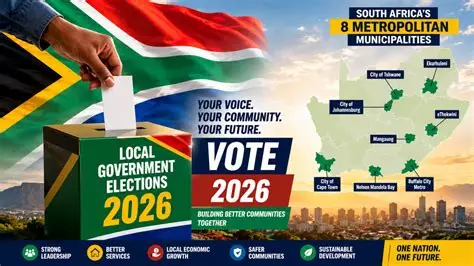
“South Africa’s Cooperative Governance Minister Velenkosini Hlabisa has formally proclaimed Wednesday, 4 November 2026 as the date for municipal elections, closing the voters’ roll and triggering the official election timetable. The Electoral Commission has outlined deadlines for voter roll certification, candidate nominations, objections, special votes, and final results, setting the stage for one of the most contested polls in recent history.”
South Africa has entered a decisive phase in its democratic journey with the formal proclamation of 4 November 2026 as the date for local government elections. This announcement, published in the Government Gazette by Cooperative Governance and Traditional Affairs Minister Velenkosini Hlabisa, transforms earlier presidential statements into binding law. The proclamation not only closes the voters’ roll but also activates the Electoral Commission’s 89‑day timetable, which governs every aspect of the electoral process—from candidate nominations to the declaration of results.
Electoral Timetable and Key Deadlines
The proclamation sets in motion a series of deadlines critical to ensuring a transparent and orderly election:
- Provisional voters’ roll inspection: Opens 11 August 2026.
- Objections to the roll: Must be lodged by 18 August 2026.
- Certification of final roll: Scheduled for 26 August 2026.
- Publication of voting stations: Including mobile stations, due 14 August 2026.
- Candidate nominations: Open immediately, closing 28 August 2026 at 5 p.m.
- Special vote applications: Begin 21 September 2026.
These milestones are designed to guarantee fairness, accessibility, and accountability. The Electoral Commission emphasized that all deadlines expire at 5 p.m. on their respective dates, underscoring the importance of punctual compliance.
Voter Registration Snapshot
Commission chair Mosotho Moepya revealed that approximately two million registration transactions were recorded during the second registration weekend, supplemented by an additional 210,000 transactions. While this figure does not represent two million new voters, it highlights the scale of engagement and the effectiveness of digital platforms such as the commission’s data-free online portal and WhatsApp channel. These innovations have expanded access, particularly for younger and rural voters, reinforcing inclusivity in the democratic process.
Candidate Nominations and Political Stakes
Candidate nominations, now officially open, are expected to intensify political competition. Registered parties and independent candidates may submit documents manually or via the Online Candidate Nomination System. This flexibility is intended to streamline participation and reduce administrative bottlenecks.
The stakes are particularly high for the African National Congress (ANC), which has conceded that it faces its “most difficult elections ever.” Secretary-General Fikile Mbalula acknowledged declining support, noting that the party is “shedding votes” and must work harder to convince citizens. The ANC’s campaign will be led by President Cyril Ramaphosa, with the party banking on national leadership to offset local dissatisfaction.
Security Concerns and Political Violence
The proclamation comes amid heightened concerns over political violence. The National Joint Operational and Intelligence Structure (NatJoints) recently sounded alarms about a surge in political killings, with at least six individuals from major parties—including the ANC, EFF, and DA—assassinated since January. Law enforcement has responded with over 400 arrests, including 180 alleged hitmen, through the Political Killings Task Team. Authorities have vowed to ensure that the elections proceed without disruption, warning perpetrators of “lengthy prison sentences.”
Immigration Raids and Electoral Climate
Parallel to election security, the government has intensified immigration raids and border sweeps. While officials argue these measures enhance national security, critics warn they risk inflaming xenophobic sentiment ahead of the polls. The timing of these operations has sparked debate, with some analysts suggesting they may serve as political theater rather than genuine enforcement.
Broader Political Context
The 2026 local elections are widely regarded as a litmus test for South Africa’s political future. With coalition politics increasingly shaping municipal governance, the outcomes will influence service delivery, economic development, and community stability. The ANC’s struggle to maintain dominance, coupled with rising support for opposition parties, suggests that many councils could face hung outcomes, requiring complex coalition negotiations.
Conclusion
The formal proclamation of 4 November 2026 as election day marks a turning point in South Africa’s democratic calendar. With the voters’ roll closed, candidate nominations underway, and security forces mobilized, the nation is bracing for one of its most contested and consequential local elections. The coming weeks will test the resilience of institutions, the credibility of political parties, and the commitment of citizens to shaping their communities through the ballot box.



