




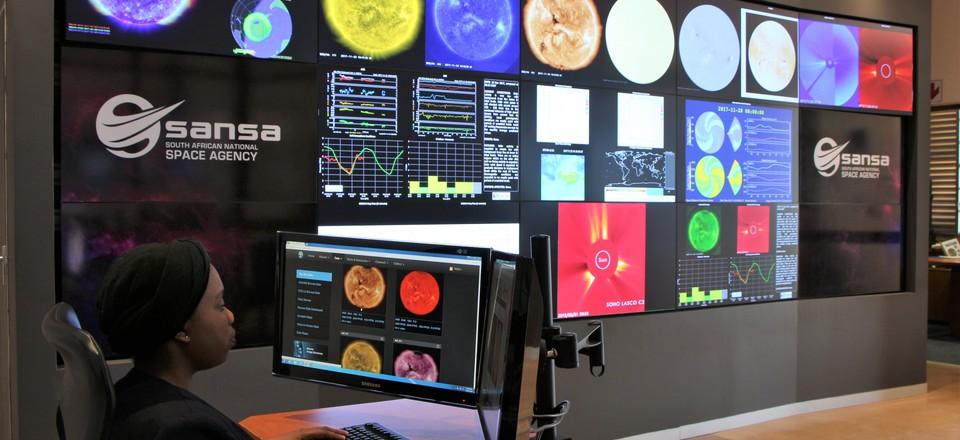
“South Africa’s National Space Agency reported on 28 October that solar activity remained low, with no significant solar flares and no confirmed Earth-directed coronal mass ejections identified in the available imagery over the previous 24 hours. The update highlights the importance of continuous space-weather monitoring for satellite operations, radio communications, navigation, aviation and other technologies that can be affected by disturbances originating from the Sun.”
South Africa’s latest space-weather assessment
South Africa’s national space-weather monitoring programme has reported relatively calm conditions in the space environment, providing an important update for organisations that depend on reliable satellite services, radio communications and navigation systems.
The South African National Space Agency, commonly known as SANSA, published its daily space-weather bulletin on Wednesday, 28 October 2026. The report described low solar activity, with X-ray emissions remaining at background B-class levels and no significant solar flaring observed during the preceding 24 hours. It also reported that no confirmed Earth-directed coronal mass ejections had been identified in the available coronagraph imagery during that period.
Although these conditions do not indicate a major solar disturbance, the bulletin illustrates why monitoring the Sun remains an important part of South Africa’s scientific and technological infrastructure. Space weather can change, and a quiet period does not eliminate the possibility of future solar events.
SANSA’s monitoring activities help scientists and operational users understand conditions between the Sun and Earth, assess potential risks and prepare for events that could affect technological systems.
The latest assessment is therefore best understood as a routine operational update with practical significance, rather than an announcement of a new satellite mission or a major astronomical discovery.
What the bulletin says about the Sun
The bulletin’s principal finding is that solar activity remained low during the observation period.
The Sun continuously releases energy and streams of charged particles into space. Its surface and atmosphere can also produce flares and large eruptions of solar material. When these phenomena interact with Earth’s magnetic environment, they can sometimes cause disturbances known collectively as space weather.
SANSA reported background X-ray flux at B-class levels. Solar flares are classified according to the strength of their X-ray emissions, with A, B, C, M and X representing progressively stronger classes. B-class activity is relatively weak, although the classification alone does not describe every possible space-weather effect.
The agency also reported that only one sunspot region with a simple magnetic configuration was visible on the solar disk at the time of the bulletin. Sunspots are regions associated with concentrated magnetic fields. Some develop complicated magnetic structures capable of producing powerful flares, while others remain comparatively uncomplicated.
However, the number of visible sunspot regions is not, by itself, a complete measure of the Sun’s activity. Solar eruptions depend on magnetic conditions, and scientists use multiple observations to assess whether a developing region could produce significant events.
For South Africa, the value of the daily report lies in its combination of observations and operational interpretation. Instead of relying on a single image of the Sun, space-weather specialists examine several indicators to determine whether conditions could affect Earth.
Why coronal mass ejections matter
Another important finding was the absence of confirmed Earth-directed coronal mass ejections in the available imagery during the previous 24 hours.
A coronal mass ejection, or CME, is a large release of magnetised plasma from the Sun’s outer atmosphere. Some eruptions travel away from the Sun without approaching Earth. Others move in Earth’s direction and may interact with the planet’s magnetosphere.
The consequences depend on factors including the eruption’s speed, magnetic orientation and the conditions encountered during its journey through space. A sufficiently strong interaction can trigger a geomagnetic storm.
Geomagnetic storms may affect satellite operations, radio communications, navigation accuracy and certain electricity infrastructure. They can also create conditions that make auroras visible at latitudes where they are not normally observed.
The absence of a confirmed Earth-directed CME in the latest bulletin is therefore a reassuring observation. Nevertheless, it should not be interpreted as a guarantee that all space-weather risks have disappeared. Solar activity continues, and forecasts must be updated as new observations become available.
The bulletin’s finding applies to the period examined by SANSA, not to every possible event that could develop later.
Geomagnetic conditions remain relatively quiet
SANSA also reported that global geomagnetic conditions were at quiet to unsettled levels, with the planetary Kp index ranging from 1 to 3 over the preceding 24 hours.
The Kp index is a measure of disturbances in Earth’s magnetic field. It ranges from 0 to 9, with higher values generally indicating stronger geomagnetic disturbance. Values between 1 and 3 are low compared with the levels associated with significant geomagnetic storms.
The index provides scientists and operational organisations with a useful way to describe the broad state of Earth’s magnetic environment. It is not, however, a direct measure of every possible effect on every satellite, radio link or navigation system.
Individual systems respond differently to environmental conditions. The frequency of a radio transmission, the altitude and design of a spacecraft, its position relative to Earth and the nature of a particular disturbance can all influence the consequences.
This is why space-weather services combine broad indicators with specialised observations and forecasts.
The latest Kp readings suggest that the period covered by the bulletin did not experience a major geomagnetic storm. They do not remove the need for monitoring, especially for organisations whose operations depend on uninterrupted communication and accurate positioning.
Why space weather matters to everyday technology
Space weather can sound remote from daily life, but its effects may extend to services used by households, businesses, transport operators and government institutions.
Satellites support telecommunications, television distribution, Earth observation, navigation, weather forecasting and emergency response. Some of these services depend on radio signals travelling through Earth’s upper atmosphere, a region that can change in response to solar activity.
The ionosphere contains electrically charged particles that influence the propagation of radio waves. During certain solar events, changes in ionospheric conditions can affect high-frequency radio communications and the accuracy of satellite-based positioning.
These effects are particularly relevant to aviation, maritime operations, remote communications and activities carried out in areas where alternative communication networks are limited.
Space weather can also increase radiation exposure for spacecraft and affect satellite electronics. During stronger geomagnetic disturbances, electrical currents induced in long conductors can pose additional challenges for certain power systems and pipelines.
Not every solar event causes measurable disruption, and the impact varies significantly according to its strength and the systems involved. The purpose of forecasting is to identify potentially hazardous conditions early enough for operators to assess their exposure and take appropriate precautions.
SANSA’s latest bulletin provides an example of this preventive approach: monitoring current conditions, recording what has been observed and communicating the results to users who need reliable information about the space environment.
SANSA’s role in protecting space-dependent services
SANSA operates a space-weather warning centre in Hermanus in the Western Cape. The agency monitors solar activity and the near-Earth space environment, providing forecasts, warnings, alerts and environmental information for technological and operational users.
The centre forms part of the International Space Environment Service, an international network that coordinates space-weather information and forecasting. SANSA has also been designated by the International Civil Aviation Organization to provide space-weather information to the global aviation sector.
This work is significant because space weather crosses national boundaries. A solar eruption does not respect political borders, and the resulting disturbances may affect systems operating across several countries.
International observations and information-sharing therefore complement national monitoring. They help scientists compare measurements, improve forecasts and communicate risks to operators whose infrastructure extends across regions.
For South Africa, maintaining local expertise is especially valuable. The country can contribute observations and scientific knowledge while providing services to domestic institutions and users elsewhere in Africa.
The latest bulletin demonstrates the practical role of that capability. A daily assessment may not attract the attention generated by a rocket launch or a distant-galaxy discovery, but reliable monitoring is essential for understanding whether conditions are changing and whether warnings may be required.
The importance of forecasting rather than reacting
A central challenge in space-weather science is that the Sun is dynamic. Conditions can evolve as magnetic structures change, active regions develop and streams of charged particles travel through space.
Scientists cannot infer every future event from a single day’s measurements. Instead, they combine observations from ground-based instruments, spacecraft and other monitoring systems to build a more complete picture.
Coronagraph imagery is particularly useful for examining material moving away from the Sun. Magnetometers, solar imaging instruments and measurements of the solar wind provide additional information about the environment and the disturbances that may eventually reach Earth.
The value of this information depends not only on scientific accuracy but also on how effectively it reaches the organisations that need it.
A satellite operator may use a forecast to assess spacecraft exposure or review operational procedures. Aviation stakeholders may require information about radiation and communications conditions. Radio users may consult predictions to understand how the ionosphere could affect signal propagation.
Different users have different needs, so space-weather services must communicate both the overall situation and the limitations of available forecasts.
The latest SANSA bulletin provides an example of this process by describing the current solar activity, the absence of confirmed Earth-directed CMEs and the state of geomagnetic conditions.
South Africa’s wider space-science ambitions
Space-weather monitoring forms one part of South Africa’s broader scientific activity in space and astronomy.
The country’s institutions also conduct research into distant galaxies, cosmic hydrogen, radio astronomy and other phenomena. The South African Radio Astronomy Observatory manages major radio-astronomy facilities, including the MeerKAT telescope in the Northern Cape, and leads South Africa’s involvement in the Square Kilometre Array programme.
On 27 October 2026, SARAO highlighted new research from the MeerKLASS collaboration measuring the large-scale clustering of cosmic hydrogen. The work advances methods that could help researchers study the distribution of matter across the Universe. This is a separate development from SANSA’s daily space-weather bulletin, but both illustrate the range of scientific work being carried out in South Africa.
The distinction is important. Space weather concerns the Sun and its effects on Earth’s space environment, while radio astronomy investigates radio signals from celestial objects and structures. Both depend on specialised instruments, skilled researchers, advanced data analysis and international cooperation.
Investment in these fields can contribute to scientific education, engineering expertise, data-processing capabilities and the development of a skilled workforce. It also gives South African researchers opportunities to participate in international scientific projects.
What the latest update means for the public
For the general public, the immediate message is that SANSA’s latest assessment did not report major solar flaring or a confirmed Earth-directed CME during the period examined. The reported geomagnetic conditions were also relatively quiet to unsettled rather than storm-level.
There is no basis in this bulletin alone to suggest that a significant disruption to South African communications, electricity supplies or satellite services is imminent.
At the same time, the report should not be treated as a long-term guarantee. Space weather can change, and the conditions described in one daily bulletin may not reflect the situation several days later.
People who work in aviation, telecommunications, satellite operations, navigation or other space-dependent sectors should continue to consult official forecasts and any relevant operational guidance. For most members of the public, the bulletin is primarily a scientific update rather than a reason to change normal activities.
The public can follow future updates through SANSA’s official space-weather website, where the agency publishes current conditions and daily assessments.
Outlook: continued monitoring remains essential
South Africa’s 28 October space-weather bulletin is a reminder that responsible space operations depend on continuous observation, even when conditions appear calm.
Low solar activity, the absence of significant flares and the lack of confirmed Earth-directed CMEs are encouraging findings for the period assessed. They indicate that the latest observations did not identify the types of major solar disturbances that can produce severe space-weather effects.
Nevertheless, scientists must continue monitoring the Sun, solar wind and Earth’s magnetic environment because the situation can evolve. Accurate measurements and timely communication help operators distinguish routine conditions from events that warrant additional attention.
For SANSA, this work supports a wider national and regional role in space science. By providing space-weather information and maintaining forecasting capabilities, the agency helps South Africa participate in international monitoring efforts while supporting sectors that depend on space-based technologies.
The key development on 28 October is therefore not a dramatic solar event, but the publication of a current assessment indicating relatively calm conditions. Its importance lies in the continuing scientific work that makes such assessments possible—and in the readiness required to identify and communicate a changing space environment.



