




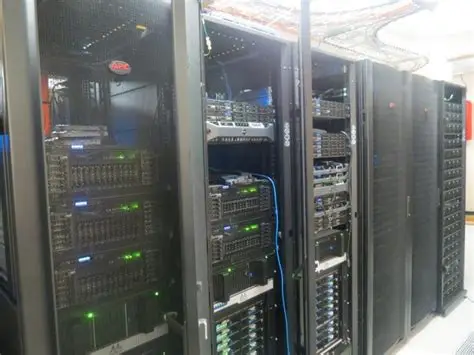
“South Africa has announced a landmark investment in computing infrastructure: a R292 million supercomputer project that will replace the country’s current flagship system, Lengau, at the Centre for High Performance Computing (CHPC). The new system will deliver 4 petaflops of performance, tripling national computing capacity and positioning South Africa as a continental leader in high-performance computing.”
South Africa is making a bold leap forward in computing power with the announcement of a R292 million investment in a new supercomputer scheduled for deployment in 2026/27. This initiative, spearheaded by the Department of Science and Innovation (DSI) and the Council for Scientific and Industrial Research (CSIR), will replace the country’s current flagship system, Lengau, which has served as Africa’s most powerful supercomputer since 2016.
Legacy of Lengau
- Launched in 2016, Lengau (Setswana for “cheetah”) delivered 1.3 petaflops of performance.
- Supported diverse applications:
- Weather and seismic modeling
- Drug discovery and genomics
- Fluid dynamics and computational chemistry
- Astronomy projects like the Square Kilometre Array (SKA) and MeerKAT telescope
- During the COVID-19 pandemic, Lengau played a vital role in genomic sequencing of SARS-CoV-2, helping scientists track variants.
The New Supercomputer
- Performance: 4 petaflops, tripling national computing capacity.
- Cost: R292 million.
- Location: Centre for High Performance Computing (CHPC) in Cape Town.
- Applications:
- Genomics research for precision medicine.
- Climate modeling to predict and mitigate environmental risks.
- Artificial intelligence (AI) for advanced machine learning applications.
- Astronomy, supporting projects like SKA, one of the world’s largest radio telescope arrays.
Strategic Importance
- Positions South Africa as a continental leader in HPC.
- Enhances competitiveness in global research and innovation.
- Supports academic institutions, startups, and industries reliant on computational power.
- Strengthens South Africa’s role in international collaborations in science and technology.
Challenges and Opportunities
- Energy demands: Ensuring sustainable power supply amid South Africa’s history of load-shedding.
- Skills development: Training local scientists and engineers to maximize the system’s potential.
- Global partnerships: Leveraging collaborations with universities and research centers worldwide.
- Economic impact: Potential to attract investment in biotech, AI, and climate-tech industries.
Conclusion
The deployment of this new supercomputer marks a transformative milestone in South Africa’s computing journey. By tripling national capacity, the country is not only investing in technology but also in the future of science, innovation, and sustainable development.



