




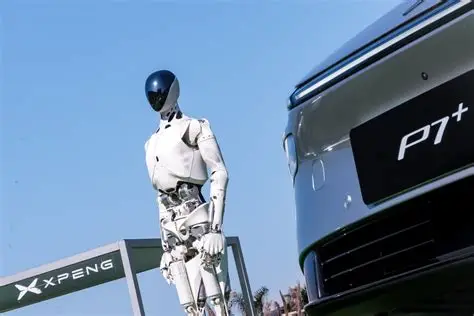
“Xpeng has officially launched its first production-model humanoid robot, Iron, which autonomously walked off the assembly line in Guangzhou, China. Equipped with advanced AI chipsets and 76 degrees of freedom, Iron represents a leap toward mass production of humanoid robots, with global rollout expected in 2027.”
On September 9, 2026, Chinese automaker and tech innovator Xpeng stunned the robotics world by announcing that its humanoid robot, Iron, had literally walked off the production line. While robotics demonstrations are not new, this event marks a symbolic and practical milestone: the transition from prototype to production-ready humanoid robots. For South Africa, where robotics adoption is accelerating in manufacturing and education, this development signals both opportunities and challenges in the global robotics race.
The Breakthrough Moment
Xpeng’s announcement was carefully staged. The robot, named Iron, emerged from the Guangzhou-based facility, greeted by CEO He Xiaopeng. Unlike staged demonstrations, this was presented as a genuine production milestone: the first humanoid robot manufactured at scale, capable of autonomous locomotion right off the line.
The robot is powered by three Turing AI chipsets, delivering 2,250 TOPS (trillion operations per second). With 76 degrees of freedom across its body and 21 degrees in each hand, Iron can mimic human motion with remarkable fidelity.
Technical Specifications
- AI Power: 2,250 TOPS processing capacity
- Mobility: 76 degrees of freedom, enabling fluid walking and gestures
- Dexterity: 21 degrees of freedom per hand, allowing fine manipulation
- Factory Automation: Production lines are 80% automated, showcasing robotics manufacturing efficiency
These specifications place Iron among the most advanced humanoid robots currently in development, rivaling projects from Boston Dynamics and Tesla’s Optimus.
Strategic Vision
CEO He Xiaopeng emphasized that this milestone is “a small step” toward a new product category. The company plans mass production by the end of 2026 and an international launch in 2027. Initially, Iron will serve within Xpeng’s own factories and retail stores, performing tasks such as customer assistance and logistics support.
Global Implications
The launch of Iron has implications far beyond China. Humanoid robots are poised to transform industries ranging from manufacturing and healthcare to retail and education. For South Africa, which is actively investing in robotics through initiatives like the CSIR’s automation showcase and Roboticon 2026, Xpeng’s achievement underscores the urgency of scaling local innovation.



