




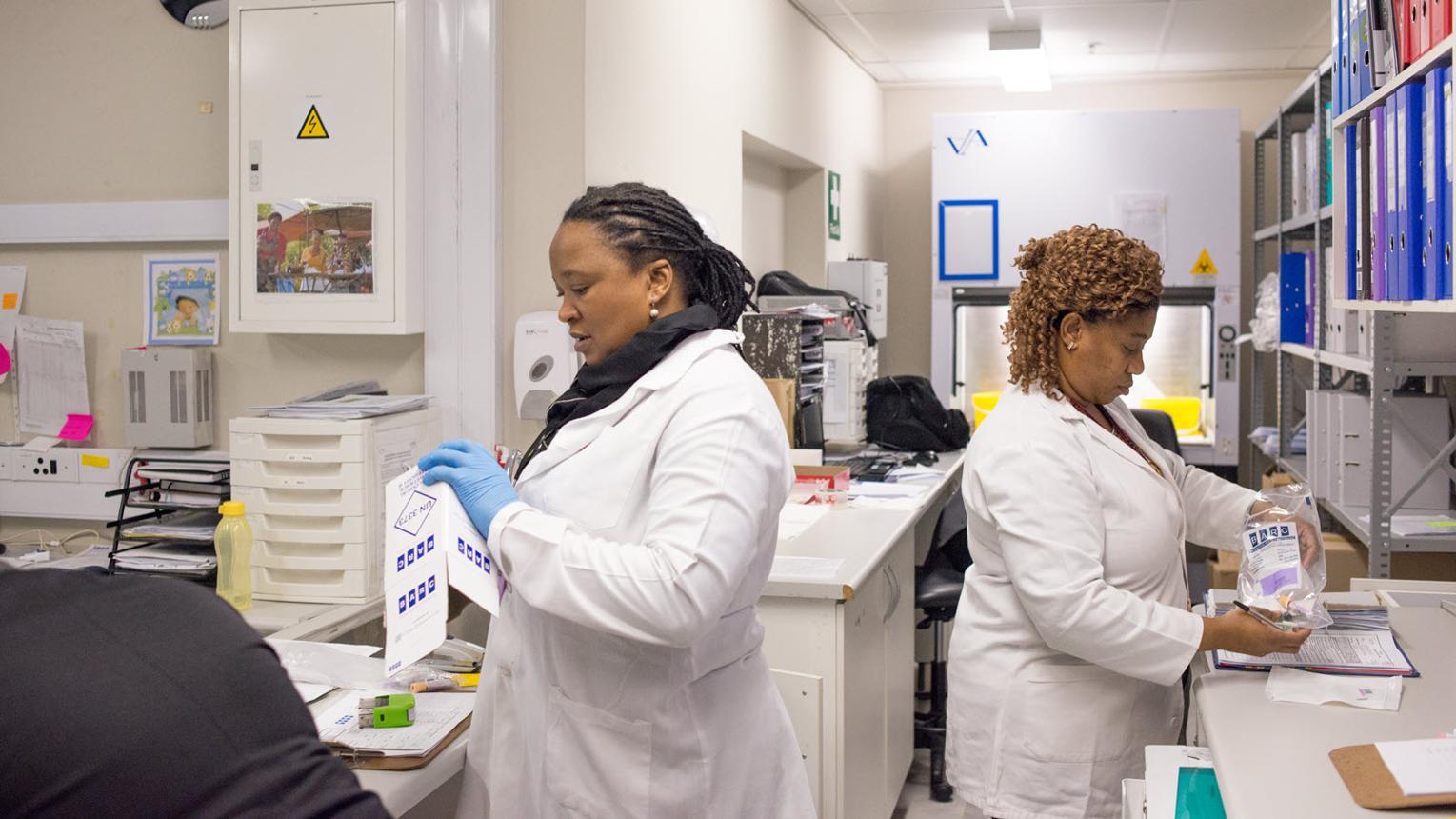
“Researchers from the University of the Witwatersrand, South Africa’s National Health Laboratory Service, and University Medical Center Utrecht have developed a targeted testing strategy that can help identify people with HIV who are most likely to have developed resistance to dolutegravir, an important antiretroviral medicine. The ITREMA-2 approach uses measurement of dolutegravir in a patient’s blood alongside viral-load information to distinguish possible treatment non-adherence from drug resistance, and an adapted version has been incorporated into South Africa’s national HIV treatment guidelines.”
South African biotechnology and medical research have taken another step toward more targeted HIV treatment management, following research showing how drug-level testing can help determine which patients experiencing viral rebound are most likely to require HIV drug-resistance testing.
The research, conducted by scientists from the University of the Witwatersrand (Wits), the South African National Health Laboratory Service (NHLS) and University Medical Center Utrecht in the Netherlands, focuses on patients receiving dolutegravir-based antiretroviral therapy. The findings form part of the Intensified Treatment Evaluation and Monitoring Approach, known as ITREMA-2, an implementation study conducted in Johannesburg.
The development is significant because dolutegravir is widely used in HIV treatment, while resistance testing remains an important but resource-intensive component of managing patients whose HIV viral load rises during treatment. The researchers investigated whether measuring the amount of dolutegravir in a patient’s blood could help clinicians decide who should undergo more specialized resistance testing.
The study involved 288 people living with HIV receiving care at Hillbrow Community Health Centre and Helen Joseph Hospital in Johannesburg. The research examined patients who experienced an increase in HIV viral load while taking dolutegravir-based treatment.
Why Drug Resistance Testing Matters
Antiretroviral therapy has transformed HIV from a disease that once frequently resulted in severe illness and death into a condition that can generally be managed through sustained treatment. However, successful treatment depends on maintaining viral suppression.
When an HIV viral load rises in someone receiving antiretroviral therapy, there can be several explanations. One possibility is that the virus has developed resistance to one or more medicines. Another possibility is that the patient has not been able to take the medication consistently.
These possibilities require different responses.
If drug resistance is suspected, resistance testing can help determine whether the virus contains mutations associated with reduced susceptibility to particular medicines. If the problem is primarily related to missed doses or interruptions in treatment, adherence support may instead be appropriate.
The difficulty is that viral rebound alone does not necessarily tell clinicians which of these situations is occurring.
The ITREMA-2 strategy attempts to address this problem by adding another piece of information: whether dolutegravir can be detected in the patient’s blood.
How the ITREMA-2 Approach Works
The underlying principle is relatively straightforward.
When a patient has a rising viral load, clinicians can measure the amount of dolutegravir present in the person’s blood.
If little or no drug is detected, this may indicate that the medicine has not recently been taken or that there has been another problem affecting drug exposure. In such circumstances, resistance may be less likely than treatment non-adherence.
On the other hand, if dolutegravir is present in the blood but HIV continues to replicate, clinicians have a stronger reason to investigate whether the virus has developed resistance to the medicine.
The approach therefore helps separate two different clinical questions.
The first is whether the patient is receiving sufficient exposure to the medication. The second is whether the virus may be able to replicate despite exposure to the medicine.
Professor Annemarie Wensing, a lead researcher from Wits Ezintsha and University Medical Center Utrecht, explained that an increased viral load does not automatically establish that drug resistance is responsible. Measuring dolutegravir exposure alongside viral-load results can help identify people who need resistance testing while also providing objective information that can support treatment-adherence interventions.
Research Conducted in Johannesburg
The South African implementation study was conducted at two major public healthcare facilities in Johannesburg: Hillbrow Community Health Centre and Helen Joseph Hospital.
The study is particularly relevant to South Africa because the country has one of the world’s largest HIV treatment programmes. Consequently, approaches that can make laboratory testing more targeted could have implications for the way limited healthcare resources are allocated.
The researchers were not simply investigating the technology in a laboratory setting. Instead, ITREMA-2 examined how the approach could be integrated into routine clinical care.
This implementation component is important because biotechnology innovations do not necessarily improve healthcare simply because a laboratory test works. For a technology to have practical value, healthcare systems need to be able to incorporate it into existing diagnostic pathways, laboratory networks and treatment guidelines.
The research team worked with the South African Department of Health during the development and implementation process. According to Wits, an adapted version of the reflex testing strategy has subsequently been incorporated into national HIV treatment guidelines.
Potential Cost Implications
Another important finding concerns healthcare costs.
According to the Wits report, incorporating the testing strategy into the care pathway following confirmed virological failure was associated with estimated laboratory monitoring costs that were 23% lower than under the previous approach. The reduction was attributed to avoiding unnecessary resistance tests by first identifying patients who were more likely to benefit from such testing.
This does not mean that resistance testing becomes unnecessary. Instead, the approach is intended to make the use of resistance testing more targeted.
For health systems operating under resource constraints, this distinction can be important. Advanced molecular tests can require specialised laboratories, trained personnel, equipment and reagents. Directing these resources toward patients with a higher probability of resistance could potentially improve the efficiency of laboratory services.
The economic finding is therefore one of the practical aspects of the study rather than simply a laboratory research result.
Biotechnology Behind the Strategy
The work demonstrates how modern biotechnology increasingly operates at the intersection of molecular biology, laboratory medicine and public healthcare.
HIV drug-resistance testing involves analysing the virus at the genetic level to identify mutations that can affect susceptibility to antiretroviral medicines. Drug-level testing, meanwhile, provides information about whether a particular medicine is present in the patient’s bloodstream.
Combining these forms of information creates a more detailed picture of what may be happening during treatment.
The ITREMA-2 research therefore represents more than a single diagnostic test. It is an example of how laboratory technologies can be incorporated into decision-making pathways.
The study was published in The Lancet HIV on 2 September 2026 under the title “Plasma dolutegravir exposure testing to identify people with HIV at highest risk for dolutegravir resistance (ITREMA-2): a two-centre, prospective implementation study in South Africa.”
Implications for Patients
From a patient perspective, the strategy is designed to help clinicians respond more precisely when HIV treatment appears to be failing.
For a person whose viral load has increased because of difficulty taking medication consistently, the appropriate response may involve identifying and addressing barriers to adherence rather than immediately changing the treatment regimen.
For another patient whose virus is replicating despite measurable exposure to dolutegravir, resistance testing may be more important.
This distinction can potentially reduce unnecessary treatment changes while helping clinicians identify patients who need a different therapeutic strategy.
Wits says the approach could also support more patient-centred care by reducing the likelihood that people experiencing treatment difficulties are automatically treated as though drug resistance has already been established. Instead, laboratory information can provide additional evidence about what may be occurring.
A South African Contribution to Global HIV Research
The research also highlights South Africa’s role in developing healthcare approaches suited to resource-limited settings.
Drug resistance is a global challenge, particularly as people remain on antiretroviral therapy for many years. The research published by the study team notes that dolutegravir resistance is increasingly being reported among treatment-experienced people with HIV in low- and middle-income countries, while resistance-testing resources are limited.
A strategy that can help determine who is most likely to benefit from resistance testing could therefore have relevance beyond South Africa.
However, the South African implementation experience remains especially important because the research was conducted within the country’s public healthcare environment and has been connected to national treatment guidance.
From Research to Routine Healthcare
One of the most notable aspects of the announcement is the movement from scientific research toward routine clinical implementation.
Medical biotechnology often progresses through several stages: laboratory development, clinical research, evaluation in real-world settings, regulatory or policy consideration and eventual implementation.
ITREMA-2 illustrates this process.
The study was conducted at public clinics, examined an operational testing pathway and assessed its potential cost implications. The research team also engaged with the Department of Health during the project, helping translate the findings into an adapted approach for routine public-sector care.
Dr Kim Steegen of the NHLS and Wits University, a co-principal investigator, was involved in supporting the translation of the research into South African public healthcare.
The resulting approach illustrates how biotechnology can have its greatest impact when scientific innovation is connected to healthcare infrastructure and policy.
What Comes Next
The continuing challenge will be ensuring that the testing approach can be implemented consistently across healthcare settings and that patients who require further resistance testing can access it promptly.
South Africa’s HIV programme operates across facilities with different levels of laboratory and clinical capacity. Consequently, successful implementation involves more than establishing the scientific validity of a test.
Training, laboratory logistics, sample transportation, turnaround times and integration with existing HIV monitoring systems can all affect how effectively such an approach operates in practice.
The research nevertheless provides evidence supporting a more targeted pathway for managing viral rebound among people receiving dolutegravir-based therapy.
As biotechnology becomes increasingly integrated into healthcare, the South African experience demonstrates how molecular measurements can be combined with conventional clinical information to support more targeted decisions.
The ITREMA-2 study therefore represents a significant development in the country’s HIV research landscape, particularly because its findings have moved beyond academic publication toward incorporation into routine public healthcare. The research also demonstrates the importance of collaboration between universities, national laboratory services, international research institutions and government health programmes in translating biotechnology discoveries into practical healthcare applications.



