




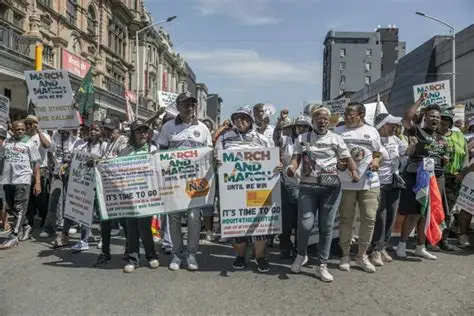
“A protest against undocumented migrants in Durban descended into violence, injuring several Congolese nationals, including children. The incident highlights growing tensions around migration, xenophobia, and activism in South Africa’s political landscape.”
Durban, South Africa, became the epicenter of violent clashes between anti-migrant activists and foreign nationals. What began as a demonstration organized by the March and March Movement quickly spiraled into chaos, underscoring the fragile balance between activism, politics, and human rights in the country.
Background: Rising Anti-Migrant Sentiment
South Africa has long grappled with migration issues, particularly from neighboring countries such as Zimbabwe, Mozambique, and the Democratic Republic of Congo (DRC). Economic hardship, unemployment, and strained public services have fueled resentment among some South Africans, who accuse migrants of “taking jobs” and “burdening the system.” Activist groups like the March and March Movement have capitalized on these sentiments, organizing “clean-up campaigns” targeting migrant encampments.
The Protest in Durban
The September 3 protest drew around 100 marchers who confronted hundreds of foreign nationals encamped outside a government office. These migrants, many from the DRC, had been living at the site for 13 weeks, seeking protection from xenophobic mobs. Witnesses reported that stones were thrown, police deployed stun grenades, and at least five Congolese nationals—including two children—were injured. One foreign national was arrested after allegedly striking a police officer with a stone.
Activism and Political Dimensions
This protest was not an isolated incident but part of a broader wave of activism against irregular migration. Activist groups argue they are defending South African sovereignty and protecting local communities. However, human rights organizations condemn these actions as xenophobic and violent, warning that they undermine South Africa’s constitutional commitment to equality and dignity.
Political leaders are divided: some local officials tacitly support the activists, while national authorities emphasize the need for law and order. The clashes in Durban highlight how activism can blur the line between legitimate political expression and dangerous populism.
Humanitarian Concerns
The violence has sparked outrage among humanitarian groups. Bishop Raphael, a Congolese community leader, condemned the attacks, stating: “We are not committing any crime by being here. We are simply seeking safety.”
International observers warn that South Africa risks repeating cycles of xenophobic violence seen in 2008 and 2015, when dozens of migrants were killed. The United Nations has urged South Africa to strengthen protections for vulnerable communities and address the root causes of hostility.
Police Response
The South African Police Service (SAPS) attempted to disperse the crowd with stun grenades but faced criticism for failing to prevent injuries. Activists accuse police of siding with migrants, while migrants accuse police of excessive force. This tension reflects the broader challenge of policing activism in a polarized society.
Broader Implications for Activism in Politics
The Durban protest illustrates how activism in South Africa is increasingly intertwined with politics. Anti-migrant activism is shaping public discourse, influencing policy debates, and testing the resilience of democratic institutions.
- For activists, the protest was a demonstration of grassroots power.
- For migrants, it was a reminder of vulnerability and exclusion.
- For politicians, it was a test of leadership in balancing national interests with human rights.
Conclusion
The violence in Durban is more than a local incident—it is a reflection of South Africa’s ongoing struggle with migration, activism, and political identity. As the country prepares for future elections, the role of activism in shaping political narratives will remain central. The challenge lies in ensuring that activism strengthens democracy rather than undermines it through division and violence.



